PUBLISHER: Global Market Insights Inc. | PRODUCT CODE: 2019148

PUBLISHER: Global Market Insights Inc. | PRODUCT CODE: 2019148
Utility Terrain Vehicle (UTV) Market Opportunity, Growth Drivers, Industry Trend Analysis, and Forecast 2026 - 2035
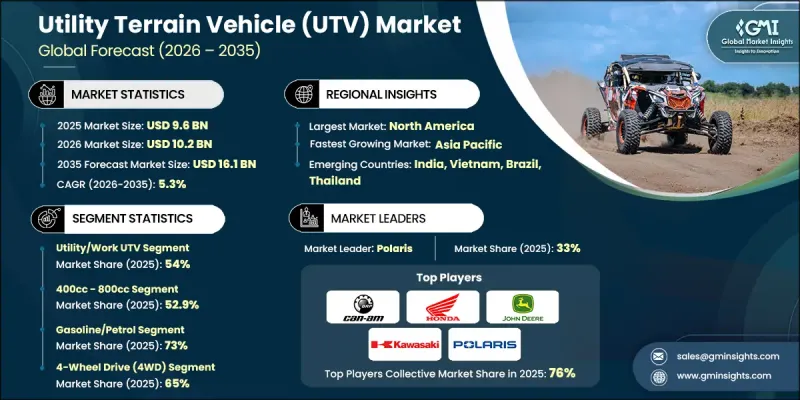
The Global Utility Terrain Vehicle Market was valued at USD 9.6 billion in 2025 and is estimated to grow at a CAGR of 5.3% to reach USD 16.1 billion by 2035.
Market expansion is driven by continuous advancements in vehicle technology that improve operational efficiency while supporting sustainability goals. Modern UTVs are being equipped with enhanced engine performance, electric powertrains, and upgraded suspension systems to meet evolving industrial and commercial requirements. The growing introduction of electric UTVs is addressing stricter emission regulations while lowering operating and maintenance costs, increasing their adoption across multiple end-use sectors. In addition, integration of advanced features such as electronic power steering, GPS-enabled navigation, and smart connectivity is transforming UTVs into more efficient and safer machines. Fleet management capabilities supported by connected systems are expected to become standard, enabling real-time tracking, performance monitoring, and improved utilization. These advancements, combined with rising demand for versatile off-road vehicles, continue to support steady market growth.
| Market Scope | |
|---|---|
| Start Year | 2025 |
| Forecast Year | 2026-2035 |
| Start Value | $9.6 Billion |
| Forecast Value | $16.1 Billion |
| CAGR | 5.3% |
The utility or work UTV segment held a 54% share in 2025 and is projected to grow at a CAGR of 3.8% through 2035. These vehicles are widely utilized across multiple industries due to their ability to transport materials, equipment, and personnel efficiently across challenging terrains. Their robust construction allows them to handle heavy loads and towing requirements while maintaining durability in demanding environments. Work-focused UTVs are designed for reliability and productivity, offering superior maneuverability in off-road conditions and confined operational spaces. Their versatility enables users to perform a wide range of tasks with minimal downtime, making them a preferred choice for commercial and industrial applications where efficiency and durability are essential.
The 400cc to 800cc engine capacity segment accounted for 52.9% share in 2025 and is anticipated to grow at a CAGR of 5.4% from 2026 to 2035. Vehicles in this category deliver a balanced combination of power, fuel efficiency, and towing capability, making them suitable for both utility-driven and recreational usage. This engine range supports consistent performance while maintaining cost efficiency, which appeals to a broad customer base. Their adaptability across varied applications contributes to strong demand, as they offer sufficient power for operational tasks without significantly increasing fuel consumption or maintenance requirements.
United States Utility Terrain Vehicle Market accounted for 85% share, generating USD 7.1 billion in 2025. Demand in the country is supported by strong usage across recreational, agricultural, and property management activities. UTVs are widely utilized in environments that require reliable mobility over uneven and remote terrain, enabling users to carry out daily operations efficiently. Their ability to navigate difficult landscapes while transporting equipment and materials enhances productivity and operational flexibility. The increasing reliance on off-road vehicles for routine activities continues to strengthen market demand, supported by ongoing technological improvements and expanding use cases across various sectors.
Key players operating in the Global Utility Terrain Vehicle Market include Polaris, Yamaha, Kawasaki, Honda, John Deere, Kubota, BRP/Can-Am, CFMOTO, Club Car, and EZGO/Cushman. Companies in the Utility Terrain Vehicle Market are strengthening their market position by investing in advanced product development, including electric powertrains and smart connectivity features. Manufacturers are focusing on improving vehicle performance, durability, and efficiency to meet evolving customer requirements. Strategic partnerships with distributors and dealers help expand geographic reach and improve product availability. Firms enhance after-sales services and maintenance support to build long-term customer relationships. Competitive pricing strategies and product differentiation through technology integration further strengthen brand positioning. Additionally, companies are expanding into emerging markets and increasing production capabilities to meet rising demand, ensuring sustained growth and a stronger foothold in the global utility terrain vehicle industry.
Table of Contents
Chapter 1 Methodology
- 1.1 Research approach
- 1.2 Quality Commitments
- 1.2.1 GMI AI policy & data integrity commitment
- 1.2.1.1 Source consistency protocol
- 1.2.1 GMI AI policy & data integrity commitment
- 1.3 Research Trail & Confidence Scoring
- 1.3.1 Research Trail Components
- 1.3.2 Scoring Components
- 1.4 Data Collection
- 1.4.1 Partial list of primary sources
- 1.5 Data mining sources
- 1.5.1 Paid sources
- 1.5.1.1 Sources, by region
- 1.5.1 Paid sources
- 1.6 Base estimates and calculations
- 1.6.1 Base year calculation for any one approach
- 1.7 Forecast model
- 1.7.1 Quantified market impact analysis
- 1.7.1.1 Mathematical impact of growth parameters on forecast
- 1.7.1 Quantified market impact analysis
- 1.8 Research transparency addendum
- 1.8.1 Source attribution framework
- 1.8.2 Quality assurance metrics
- 1.8.3 Our commitment to trust
Chapter 2 Executive Summary
- 2.1 Industry 360° synopsis, 2022 - 2035
- 2.2 Key market trends
- 2.2.1 Regional
- 2.2.2 Vehicle
- 2.2.3 Displacement
- 2.2.4 Fuel
- 2.2.5 Drive
- 2.2.6 End Use
- 2.3 TAM Analysis, 2026-2035
- 2.4 CXO perspectives: Strategic imperatives
Chapter 3 Industry Insights
- 3.1 Industry ecosystem analysis
- 3.1.1 Supplier landscape
- 3.1.2 Profit margin analysis
- 3.1.3 Cost structure
- 3.1.4 Value addition at each stage
- 3.1.5 Factor affecting the value chain
- 3.1.6 Disruptions
- 3.2 Industry impact forces
- 3.2.1 Growth drivers
- 3.2.1.1 Rising demand for off-road recreational activities
- 3.2.1.2 Growing adoption in agriculture and farming operations
- 3.2.1.3 Expansion of construction and infrastructure projects
- 3.2.1.4 Technological improvements in vehicle performance
- 3.2.2 Industry pitfalls and challenges
- 3.2.2.1 High vehicle purchase and maintenance costs
- 3.2.2.2 Safety concerns and accident risks
- 3.2.3 Market opportunities
- 3.2.3.1 Expansion of electric and hybrid utility terrain vehicles
- 3.2.3.2 Growing demand from tourism and recreational parks
- 3.2.3.3 Increasing adoption in defense and public safety operations
- 3.2.1 Growth drivers
- 3.3 Growth potential analysis
- 3.4 Regulatory landscape
- 3.4.1 North America
- 3.4.1.1 United States recreational off highway vehicle safety regulations and CPSC guidelines
- 3.4.1.2 Federal land access and off highway vehicle management policies
- 3.4.1.3 Emission standards for off road engines and utility vehicles
- 3.4.1.4 Canada off road vehicle safety standards and provincial registration requirements
- 3.4.2 Europe
- 3.4.2.1 European Union type approval framework for light utility vehicles and quadricycles
- 3.4.2.2 ECE vehicle safety and braking system regulations
- 3.4.2.3 Country level homologation and off highway vehicle usage restrictions
- 3.4.2.4 Environmental and noise emission compliance standards
- 3.4.3 Asia Pacific
- 3.4.3.1 China off highway vehicle manufacturing and emission regulations
- 3.4.3.2 India quadricycle and off highway vehicle homologation standards
- 3.4.3.3 Japan vehicle safety and small mobility vehicle guidelines
- 3.4.3.4 Australia off road vehicle design and safety requirements
- 3.4.3.5 ASEAN regional vehicle certification and compliance frameworks
- 3.4.4 Latin America
- 3.4.4.1 Brazil off road vehicle safety and environmental compliance regulations
- 3.4.4.2 Argentina off highway vehicle registration and operational rules
- 3.4.4.3 Mexico vehicle manufacturing standards and safety compliance requirements
- 3.4.4.4 Regional off highway vehicle regulatory frameworks
- 3.4.5 Middle East & Africa
- 3.4.5.1 UAE off road vehicle licensing and desert operation regulations
- 3.4.5.2 Saudi Arabia vehicle safety and inspection requirements
- 3.4.5.3 South Africa off road vehicle registration and safety standards
- 3.4.1 North America
- 3.5 Porter's analysis
- 3.6 PESTEL analysis
- 3.7 Technology and innovation landscape
- 3.7.1 Current technological trends
- 3.7.2 Emerging technologies
- 3.8 Pricing Analysis (Driven by Primary Research)
- 3.8.1 Historical Price Trend Analysis
- 3.8.2 Pricing Strategy by Player Type
- 3.9 Trade Data Analysis (Driven by Paid Database)
- 3.9.1 Import/export volume & value trends
- 3.9.2 Key trade corridors & tariff impact
- 3.10 Capacity & Production Landscape (Driven by Primary Research)
- 3.10.1 Installed Capacity by Region & Key Producer
- 3.10.2 Capacity Utilization Rates & Expansion Pipelines
- 3.11 Cost breakdown analysis
- 3.12 Patent analysis (Driven by Primary Research)
- 3.13 Sustainability and environmental aspects
- 3.13.1 Sustainable practices
- 3.13.2 Waste reduction strategies
- 3.13.3 Energy efficiency in production
- 3.13.4 Eco-friendly Initiatives
- 3.13.5 Carbon footprint considerations
- 3.14 Impact of AI and Generative AI on the Market
- 3.14.1 AI Driven Disruption of Existing Business Models
- 3.14.2 GenAI Use Cases and Adoption Roadmap by Segment
- 3.14.3 Risks Limitations and Regulatory Considerations
- 3.15 Forecast assumptions & scenario analysis (Driven by Primary Research)
- 3.15.1 Base Case- Key Macro & Industry Variables Driving CAGR
- 3.15.2 Optimistic Scenarios- Favorable macro and industry tailwinds
- 3.15.3 Pessimistic Scenario - Macroeconomic slowdown or industry headwinds
Chapter 4 Competitive Landscape, 2025
- 4.1 Introduction
- 4.2 Company market share analysis
- 4.2.1 North America
- 4.2.2 Europe
- 4.2.3 Asia Pacific
- 4.2.4 LATAM
- 4.2.5 MEA
- 4.3 Competitive analysis of major market players
- 4.4 Competitive positioning matrix
- 4.5 Key developments
- 4.5.1 Mergers & acquisitions
- 4.5.2 Partnerships & collaborations
- 4.5.3 New Product Launches
- 4.5.4 Expansion Plans and funding
Chapter 5 Market Estimates & Forecast, By Vehicle, 2022 - 2035 (USD Mn, Units)
- 5.1 Key trends
- 5.2 Sport UTV
- 5.3 Utility/Work UTV
- 5.4 Hybrid/Rec-Utility UTV
Chapter 6 Market Estimates & Forecast, By Displacement, 2022 - 2035 (USD Mn, Units)
- 6.1 Key trends
- 6.2 Below 400cc
- 6.3 400cc - 800cc
- 6.4 Above 800cc
Chapter 7 Market Estimates & Forecast, By Fuel, 2022 - 2035 (USD Mn, Units)
- 7.1 Key trends
- 7.2 Gasoline/Petrol
- 7.3 Diesel
- 7.4 Electric
Chapter 8 Market Estimates & Forecast, By Drive, 2022 - 2035 (USD Mn, Units)
- 8.1 Key trends
- 8.2 2-Wheel Drive (2WD)
- 8.3 4-Wheel Drive (4WD)
- 8.4 All-Wheel Drive (AWD)
Chapter 9 Market Estimates & Forecast, By End Use, 2022 - 2035 (USD Mn, Units)
- 9.1 Key trends
- 9.2 Agriculture & Farming
- 9.3 Construction & Mining
- 9.4 Forestry
- 9.5 Military & Defense
- 9.6 Sports & Racing
- 9.7 Recreation & Tourism
- 9.8 Industrial & Utility Services
- 9.9 Others
Chapter 10 Market Estimates & Forecast, By Region, 2022 - 2035 (USD Mn, Units)
- 10.1 Key trends
- 10.2 North America
- 10.2.1 US
- 10.2.2 Canada
- 10.3 Europe
- 10.3.1 Germany
- 10.3.2 UK
- 10.3.3 France
- 10.3.4 Italy
- 10.3.5 Spain
- 10.3.6 Russia
- 10.3.7 Norway
- 10.3.8 Netherlands
- 10.3.9 Sweden
- 10.4 Asia Pacific
- 10.4.1 China
- 10.4.2 India
- 10.4.3 Japan
- 10.4.4 Australia
- 10.4.5 South Korea
- 10.4.6 Singapore
- 10.4.7 Thailand
- 10.4.8 Indonesia
- 10.4.9 Vietnam
- 10.5 Latin America
- 10.5.1 Brazil
- 10.5.2 Mexico
- 10.5.3 Argentina
- 10.6 MEA
- 10.6.1 South Africa
- 10.6.2 Saudi Arabia
- 10.6.3 UAE
- 10.6.4 Turkey
Chapter 11 Company Profiles
- 11.1 Global Players
- 11.1.1 BRP
- 11.1.2 CFMOTO
- 11.1.3 Honda Motor
- 11.1.4 John Deere
- 11.1.5 Kawasaki
- 11.1.6 Kubota
- 11.1.7 Polaris
- 11.1.8 Yamaha Motor
- 11.2 Regional Players
- 11.2.1 KYMCO
- 11.2.2 Hisun Motors
- 11.2.3 Linhai
- 11.2.4 Massimo Motor
- 11.2.5 TGB (Taiwan Golden Bee)
- 11.2.6 Tracker Off Road
- 11.3 Emerging Players / Disruptors
- 11.3.1 DRR USA
- 11.3.2 Nikola Powersports
- 11.3.3 ODES Industries
- 11.3.4 Segway Powersports
- 11.3.5 Volcon
- 11.3.6 Taotao

