
PUBLISHER: Global Market Insights Inc. | PRODUCT CODE: 2038349

PUBLISHER: Global Market Insights Inc. | PRODUCT CODE: 2038349
Lithium-Ion Battery Dispersant Market Opportunity, Growth Drivers, Industry Trend Analysis, and Forecast 2026 - 2035
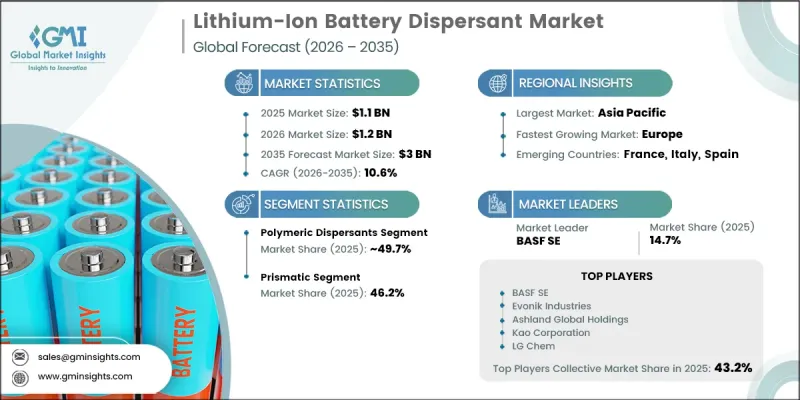
The Global Lithium-Ion Battery Dispersant Market was valued at USD 1.1 billion in 2025 and is estimated to grow at a CAGR of 10.6% to reach USD 3 billion by 2035.
The industry is gaining notable traction as dispersants play a critical role in ensuring the uniform distribution of active materials within battery electrodes, ultimately enhancing performance, efficiency, and lifecycle. Growing demand for lithium-ion batteries across multiple end-use industries is significantly strengthening market expansion. Increasing emphasis on energy efficiency and sustainability, combined with continuous advancements in battery technologies, is further accelerating the demand for high-quality dispersant solutions. The shift toward cleaner energy systems and electrification trends continues to support long-term demand. Rising adoption of battery-powered technologies, coupled with expanding energy storage infrastructure, is contributing to consistent market growth. In addition, ongoing research efforts aimed at improving battery output and reducing production costs are creating opportunities for advanced dispersant formulations. The overall market outlook remains positive as industries increasingly prioritize performance optimization, cost efficiency, and environmentally aligned solutions in battery manufacturing processes.
| Market Scope | |
|---|---|
| Start Year | 2025 |
| Forecast Year | 2026-2035 |
| Start Value | $1.1 Billion |
| Forecast Value | $3 Billion |
| CAGR | 10.6% |
Polymeric dispersants accounted for 49.7% share in 2025 and is expected to grow at a CAGR of 12% through 2035. This segment maintains a leading position due to its ability to enhance dispersion quality, improve electrode stability, and deliver consistent performance across battery systems. These materials offer strong compatibility with electrode compositions and provide effective binding characteristics, making them highly suitable for advanced battery applications. Continuous innovation efforts are focused on developing formulations that align with evolving environmental standards while maintaining high efficiency.
The prismatic cell formats segment held a share of 46.2% in 2025, supported by their structural advantages, including efficient space utilization, lightweight configuration, and improved energy density. These features make them highly suitable for compact and high-performance battery systems. Increasing adoption of lithium-ion batteries across various applications is reinforcing the demand for dispersants used in prismatic cell production. The segment is expected to maintain its dominance due to its adaptability and growing preference in modern battery design.
North America Lithium-Ion Battery Dispersant Market reached USD 354.9 million in 2025, driven by increasing demand for advanced battery technologies across the region. Continued technological progress and a strong focus on sustainable energy solutions are contributing to the rising consumption of dispersants. The region is witnessing steady growth supported by innovation in battery manufacturing and increasing deployment of energy storage systems.
Key companies operating in the Global Lithium-Ion Battery Dispersant Market include BASF SE, Evonik Industries, LG Chem, Nouryon, Ashland Global Holdings, BYK (Altana AG), Kao Corporation, Lubrizol Corporation, Synthomer, Trinseo, Zeon Corporation, Shandong Gelon Lib Co., Ltd, and Toyo Ink (Artience Group). Companies in the lithium-ion battery dispersant market are focusing on innovation, strategic collaborations, and production expansion to strengthen their market position. Many manufacturers are investing in research and development to create advanced formulations that improve dispersion efficiency and battery performance while meeting sustainability standards. Partnerships with battery producers and technology firms are helping companies expand their customer base and enhance product integration. Firms are also optimizing manufacturing processes to reduce costs and improve scalability. Geographic expansion into high-growth regions and strengthening distribution networks are further supporting market penetration.
Table of Contents
Chapter 1 Methodology & Scope
- 1.1 Market scope and definition
- 1.2 Research design
- 1.2.1 Research approach
- 1.2.2 Data collection methods
- 1.3 Data mining sources
- 1.3.1 Global
- 1.3.2 Regional/Country
- 1.4 Base estimates and calculations
- 1.4.1 Base year calculation
- 1.4.2 Key trends for market estimation
- 1.5 Primary research and validation
- 1.5.1 Primary sources
- 1.6 Forecast model
- 1.7 Research assumptions and limitations
Chapter 2 Executive Summary
- 2.1 Industry 360° synopsis
- 2.2 Key market trends
- 2.2.1 Regional
- 2.2.2 Dispersant type
- 2.2.3 Cell format
- 2.2.4 Application
- 2.2.5 Distribution channel
- 2.3 TAM Analysis, 2026-2035
- 2.4 CXO perspectives: Strategic imperatives
Chapter 3 Industry Insights
- 3.1 Industry ecosystem analysis
- 3.1.1 Supplier landscape
- 3.1.2 Profit margin
- 3.1.3 Value addition at each stage
- 3.1.4 Factor affecting the value chain
- 3.1.5 Disruptions
- 3.2 Industry impact forces
- 3.2.1 Growth drivers
- 3.2.1.1 Increasing demand for electric vehicles globally
- 3.2.1.2 Surging adoption of portable electronic devices
- 3.2.1.3 Ongoing research for enhancing battery performance
- 3.2.2 Industry pitfalls and challenges
- 3.2.2.1 Material compatibility with diverse battery chemistries is complex
- 3.2.2.2 Supply chain disruptions impact production and distribution
- 3.2.3 Market opportunities
- 3.2.3.1 Development of bio-based & sustainable dispersants
- 3.2.3.2 Growing adoption of water-based electrode processing
- 3.2.1 Growth drivers
- 3.3 Growth potential analysis
- 3.4 Regulatory landscape
- 3.4.1 North America
- 3.4.2 Europe
- 3.4.3 Asia Pacific
- 3.4.4 Latin America
- 3.4.5 Middle East & Africa
- 3.5 Porter's analysis
- 3.6 PESTEL analysis
- 3.7 Price trends
- 3.7.1 By region
- 3.7.2 By dispersant type
- 3.8 Future market trends
- 3.9 Technology and innovation landscape
- 3.9.1 Current technological trends
- 3.9.2 Emerging technologies
- 3.10 Patent Landscape
- 3.11 Trade statistics (HS code)
- 3.11.1 Major importing countries
- 3.11.2 Major exporting countries
- 3.12 Sustainability and environmental aspects
- 3.12.1 Sustainable practices
- 3.12.2 Waste reduction strategies
- 3.12.3 Energy efficiency in production
- 3.12.4 Eco-friendly initiatives
- 3.13 Carbon footprint consideration
Chapter 4 Competitive Landscape, 2025
- 4.1 Introduction
- 4.2 Company market share analysis
- 4.2.1 By region
- 4.2.1.1 North America
- 4.2.1.2 Europe
- 4.2.1.3 Asia Pacific
- 4.2.1.4 LATAM
- 4.2.1.5 MEA
- 4.2.1 By region
- 4.3 Competitive analysis of major market players
- 4.4 Competitive positioning matrix
- 4.5 Key developments
- 4.5.1 Mergers & acquisitions
- 4.5.2 Partnerships & collaborations
- 4.5.3 New Product Launches
- 4.5.4 Expansion Plans
Chapter 5 Market Estimates and Forecast, By Dispersant Type, 2022-2035 (USD Billion) (Kilo Tons)
- 5.1 Key trends
- 5.2 Polymeric dispersants
- 5.2.1 Block copolymers
- 5.2.2 Polyacrylic acid (PAA)
- 5.2.3 Polyethylene glycol (PEG)
- 5.2.4 PVDF-based systems
- 5.2.5 Styrene-butadiene rubber (SBR) emulsions
- 5.3 Surfactant-based dispersants
- 5.3.1 Anionic (naphthalene sulfonates)
- 5.3.2 Nonionic
- 5.3.3 Cationic
- 5.3.4 Amphoteric
- 5.4 Lignosulfonates
- 5.5 Others
Chapter 6 Market Estimates and Forecast, By Cell Format, 2022-2035 (USD Billion) (Kilo Tons)
- 6.1 Key trends
- 6.2 Cylindrical
- 6.3 Prismatic
- 6.4 Pouch
Chapter 7 Market Estimates and Forecast, By Application, 2022-2035 (USD Billion) (Kilo Tons)
- 7.1 Key trends
- 7.2 Consumer electronics
- 7.2.1 Smartphones
- 7.2.2 Laptops
- 7.2.3 Wearables
- 7.2.4 Others
- 7.3 Automotive
- 7.3.1 Passenger electric vehicles
- 7.3.2 Commercial electric vehicles
- 7.4 Energy storage systems
- 7.4.1 Grid storage
- 7.4.2 Commercial energy systems
- 7.4.3 Home energy systems
- 7.5 Industrial
- 7.5.1 Robotics
- 7.5.2 Machinery
- 7.5.3 Others
- 7.6 Military & defense
Chapter 8 Market Estimates and Forecast, By Distribution Channel, 2022-2035 (USD Billion) (Kilo Tons)
- 8.1 Key trends
- 8.2 Direct sales
- 8.3 Distributors
- 8.4 Online retail
Chapter 9 Market Estimates and Forecast, By Region, 2022-2035 (USD Billion) (Kilo Tons)
- 9.1 Key trends
- 9.2 North America
- 9.2.1 U.S.
- 9.2.2 Canada
- 9.3 Europe
- 9.3.1 Germany
- 9.3.2 UK
- 9.3.3 France
- 9.3.4 Spain
- 9.3.5 Italy
- 9.3.6 Rest of Europe
- 9.4 Asia Pacific
- 9.4.1 China
- 9.4.2 India
- 9.4.3 Japan
- 9.4.4 Australia
- 9.4.5 South Korea
- 9.4.6 Rest of Asia Pacific
- 9.5 Latin America
- 9.5.1 Brazil
- 9.5.2 Mexico
- 9.5.3 Argentina
- 9.5.4 Rest of Latin America
- 9.6 Middle East and Africa
- 9.6.1 Saudi Arabia
- 9.6.2 South Africa
- 9.6.3 UAE
- 9.6.4 Rest of Middle East and Africa
Chapter 10 Company Profiles
- 10.1 BASF SE
- 10.2 Ashland Global Holdings
- 10.3 BYK (Altana AG)
- 10.4 Evonik Industries
- 10.5 Kao Corporation
- 10.6 LG Chem
- 10.7 Lubrizol Corporation
- 10.8 Nouryon
- 10.9 Shandong Gelon Lib Co., Ltd
- 10.10 Synthomer
- 10.11 Toyo Ink (Artience Group)
- 10.12 Trinseo
- 10.13 Zeon Corporation

