PUBLISHER: Global Market Insights Inc. | PRODUCT CODE: 2045860

PUBLISHER: Global Market Insights Inc. | PRODUCT CODE: 2045860
Adaptogenic Beverages Market Opportunity, Growth Drivers, Industry Trend Analysis, and Forecast 2026 - 2035
The Global Adaptogenic Beverages Market was valued at USD 1.4 billion in 2025 and is estimated to grow at a CAGR of 7% to reach USD 2.7 billion by 2035.
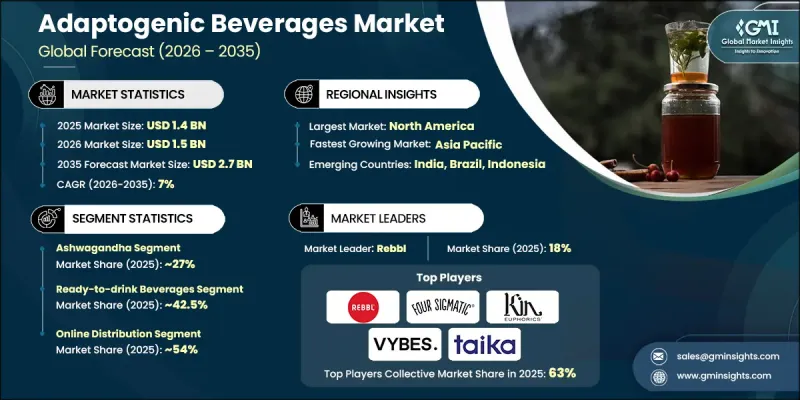
Growth across the adaptogenic beverages industry is fueled by increasing consumer preference for functional wellness drinks that support focus, relaxation, and emotional balance. Consumers are actively shifting toward beverage alternatives designed to deliver energy and stress management benefits without relying on traditional caffeinated or alcoholic products. Expanding shelf presence across supermarkets, specialty retail stores, and e-commerce platforms is further strengthening market penetration worldwide. Beverage manufacturers are enhancing formulations through scientifically supported botanical ingredients and plant-based functional compounds that combine wellness benefits with appealing taste profiles. The growing influence of social media and digital wellness trends is significantly increasing consumer awareness, particularly among younger demographics seeking healthier lifestyle choices. Product diversification across cold brews, powdered beverage mixes, wellness tonics, and functional drink formats is also broadening consumption occasions beyond conventional settings. In addition, rising consumer demand for low-sugar, sustainably sourced, and clean-label beverages is encouraging innovation throughout the market. The adaptogenic beverages sector continues to evolve from a niche wellness category into a mainstream functional beverage segment integrated into everyday health and lifestyle routines.
| Market Scope | |
|---|---|
| Start Year | 2025 |
| Forecast Year | 2026-2035 |
| Start Value | $1.4 Billion |
| Forecast Value | $2.7 Billion |
| CAGR | 7% |
Manufacturers operating in the adaptogenic beverages market are increasingly focusing on innovative ingredient combinations and multifunctional formulations to improve product differentiation and consumer engagement. Blended botanical beverages featuring plant-based functional ingredients are gaining popularity as consumers seek products that combine wellness support with enjoyable sensory experiences. The market is also witnessing strong expansion in functional beverage formats, including ready-to-drink products, tea-based beverages, coffee-inspired wellness drinks, smoothies, and superfood juices. Consumers are increasingly drawn toward beverages that deliver convenience, balanced functionality, and appealing flavor profiles in a single product. Growing interest in holistic wellness and stress management solutions continues to support demand for adaptogenic beverage products across multiple retail channels.
Ready-to-drink beverages segment accounted for 42.5% share in 2025 and is expected to grow at a CAGR of 14.8% through 2035. Strong demand for convenient and portable wellness drinks is driving growth within this segment, as consumers increasingly prefer functional beverages that fit into busy daily routines. The ready-to-drink category remains highly popular for on-the-go consumption, while tea-based blends and coffee-inspired wellness beverages continue gaining traction due to their combination of familiar consumption habits and added functional benefits. Growing preference for beverages that support energy, relaxation, and overall wellness is expected to sustain long-term growth across the ready-to-drink segment.
The online distribution segment held a 54% share in 2025 and is projected to grow at a CAGR of 13.9% through 2035. Growth within online retail channels is being driven by increasing consumer preference for digital shopping convenience and direct-to-consumer purchasing models. E-commerce platforms allow brands to strengthen customer engagement through personalized recommendations, subscription-based services, educational content, and targeted digital marketing strategies. Online channels also support stronger brand storytelling and transparency, helping companies build consumer trust and establish long-term relationships focused on wellness, stress management, and healthy lifestyle adoption.
North America Adaptogenic Beverages Market is expected to grow from USD 498 million in 2025 to USD 965.8 million by 2035. Strong regional growth is being supported by rising consumer demand for plant-based wellness beverages and continued innovation across retail and online distribution platforms. Adaptogenic drinks have become increasingly integrated into mainstream health and wellness routines throughout the region, supported by growing consumer awareness regarding functional nutrition and clean-label ingredients. Expanding availability across supermarkets, cafes, specialty wellness stores, and e-commerce platforms is also contributing to market expansion. In addition, collaborations with fitness professionals, wellness advocates, and lifestyle-focused digital campaigns are helping brands strengthen visibility and improve consumer confidence in functional beverage products.
Major companies operating in the Global Adaptogenic Beverages Market include Rebbl, Four Sigmatic, Kin Euphorics, SOM Sleep, Vybes, Taika, Hiyo, Moment, Mayawell, Clevr Blends, Odyssey Elixir, Kuli Kuli, and Sunwink. Companies active in the adaptogenic beverages industry are implementing multiple strategies to strengthen their market position and expand consumer reach. Leading brands are investing heavily in product innovation by developing multifunctional beverages that combine botanical ingredients, wellness support, and appealing flavor profiles. Many companies are also focusing on clean-label formulations, low-sugar products, and sustainably sourced ingredients to align with evolving consumer preferences. Strategic partnerships with retailers, wellness influencers, and digital marketing platforms are helping brands improve visibility and strengthen customer engagement. In addition, businesses are expanding online distribution capabilities through subscription services and direct-to-consumer sales models to enhance brand loyalty and recurring purchases.
Table of Contents
Chapter 1 Methodology & Scope
- 1.1 Market scope and definition
- 1.2 Research design
- 1.2.1 Research approach
- 1.2.2 Data collection methods
- 1.3 Data mining sources
- 1.3.1 Global
- 1.3.2 Regional/Country
- 1.4 Base estimates and calculations
- 1.4.1 Base year calculation
- 1.4.2 Key trends for market estimation
- 1.5 Primary research and validation
- 1.5.1 Primary sources
- 1.6 Forecast model
- 1.7 Research assumptions and limitations
Chapter 2 Executive Summary
- 2.1 Industry 360° synopsis
- 2.2 Key market trends
- 2.2.1 Regional
- 2.2.2 Product Type
- 2.2.3 Beverages Type
- 2.2.4 Distribution Channel
- 2.3 TAM Analysis, 2026-2035
- 2.4 CXO perspectives: Strategic imperatives
- 2.4.1 Executive decision points
- 2.4.2 Critical success factors
- 2.5 Future Outlook and Strategic Recommendations
Chapter 3 Industry Insights
- 3.1 Industry ecosystem analysis
- 3.1.1 Supplier landscape
- 3.1.2 Profit margin
- 3.1.3 Value addition at each stage
- 3.1.4 Factor affecting the value chain
- 3.1.5 Disruptions
- 3.2 Industry impact forces
- 3.2.1 Growth drivers
- 3.2.1.1 Rising demand for stress-relief functional drinks
- 3.2.1.2 Shift toward mental wellness and holistic health
- 3.2.1.3 Growth of plant-based and clean-label beverages
- 3.2.2 Industry pitfalls and challenges
- 3.2.2.1 Limited awareness in developing regions
- 3.2.2.2 Supply chain volatility for organic adaptogens
- 3.2.3 Market opportunities
- 3.2.3.1 Expansion into no-alcohol social beverage space
- 3.2.3.2 Technological advances in adaptogenic extraction
- 3.2.1 Growth drivers
- 3.3 Growth potential analysis
- 3.4 Regulatory landscape
- 3.4.1 North America
- 3.4.2 Europe
- 3.4.3 Asia Pacific
- 3.4.4 Latin America
- 3.4.5 Middle East & Africa
- 3.5 Porter's analysis
- 3.6 PESTEL analysis
- 3.7 Price trends
- 3.7.1 By region
- 3.7.2 By Product type
- 3.8 Future market trends
- 3.9 Technology and Innovation landscape
- 3.9.1 Current technological trends
- 3.9.2 Emerging technologies
- 3.10 Patent Landscape
- 3.11 Trade statistics (HS code)
- 3.11.1 Major importing countries
- 3.11.2 Major exporting countries
- 3.12 Sustainability and environmental aspects
- 3.12.1 Sustainable practices
- 3.12.2 Waste reduction strategies
- 3.12.3 Energy efficiency in production
- 3.12.4 Eco-friendly initiatives
- 3.13 Carbon footprint consideration
Chapter 4 Competitive Landscape, 2025
- 4.1 Introduction
- 4.2 Company market share analysis
- 4.2.1 By region
- 4.2.1.1 North America
- 4.2.1.2 Europe
- 4.2.1.3 Asia Pacific
- 4.2.1.4 LATAM
- 4.2.1.5 MEA
- 4.2.1 By region
- 4.3 Company matrix analysis
- 4.4 Competitive analysis of major market players
- 4.5 Competitive positioning matrix
- 4.6 Key developments
- 4.6.1 Mergers & acquisitions
- 4.6.2 Partnerships & collaborations
- 4.6.3 New Product Launches
- 4.6.4 Expansion Plans
Chapter 5 Market Estimates and Forecast, By Product Type, 2022-2035 (USD Billion) (Kilo Tons)
- 5.1 Key trends
- 5.2 Ashwagandha
- 5.3 Mushrooms
- 5.4 Holy basil
- 5.5 Maca
- 5.6 Lavender
- 5.7 Others
Chapter 6 Market Estimates and Forecast, By Beverages Type, 2022-2035 (USD Billion) (Kilo Tons)
- 6.1 Key trends
- 6.2 Ready-to-drink
- 6.3 Tea-based
- 6.4 Smoothies & juices
- 6.5 Coffee-based
- 6.6 Others
Chapter 7 Market Estimates and Forecast, By Distribution Channel, 2022-2035 (USD Billion) (Kilo Tons)
- 7.1 Key trends
- 7.2 Online
- 7.3 Offline
Chapter 8 Market Estimates and Forecast, By Region, 2022-2035 (USD Billion) (Kilo Tons)
- 8.1 Key trends
- 8.2 North America
- 8.2.1 U.S.
- 8.2.2 Canada
- 8.3 Europe
- 8.3.1 Germany
- 8.3.2 UK
- 8.3.3 France
- 8.3.4 Spain
- 8.3.5 Italy
- 8.3.6 Rest of Europe
- 8.4 Asia Pacific
- 8.4.1 China
- 8.4.2 India
- 8.4.3 Japan
- 8.4.4 Australia
- 8.4.5 South Korea
- 8.4.6 Rest of Asia Pacific
- 8.5 Latin America
- 8.5.1 Brazil
- 8.5.2 Mexico
- 8.5.3 Argentina
- 8.5.4 Rest of Latin America
- 8.6 Middle East and Africa
- 8.6.1 Saudi Arabia
- 8.6.2 South Africa
- 8.6.3 UAE
- 8.6.4 Rest of Middle East and Africa
Chapter 9 Company Profiles
- 9.1 Rebbl
- 9.2 Four Sigmatic
- 9.3 Kin Euphorics
- 9.4 SOM Sleep
- 9.5 Vybes
- 9.6 Taika
- 9.7 Hiyo
- 9.8 Moment
- 9.9 Mayawell
- 9.10 Clevr Blends
- 9.11 Odyssey Elixir
- 9.12 Kuli Kuli
- 9.13 Sunwink

