
PUBLISHER: Global Market Insights Inc. | PRODUCT CODE: 2045868

PUBLISHER: Global Market Insights Inc. | PRODUCT CODE: 2045868
Europe E-Gasoline Market Opportunity, Growth Drivers, Industry Trend Analysis, and Forecast 2026 - 2035
Europe E-Gasoline Market was valued at USD 1 billion in 2025 and is estimated to grow at a CAGR of 27.5% to reach USD 12.3 billion by 2035.
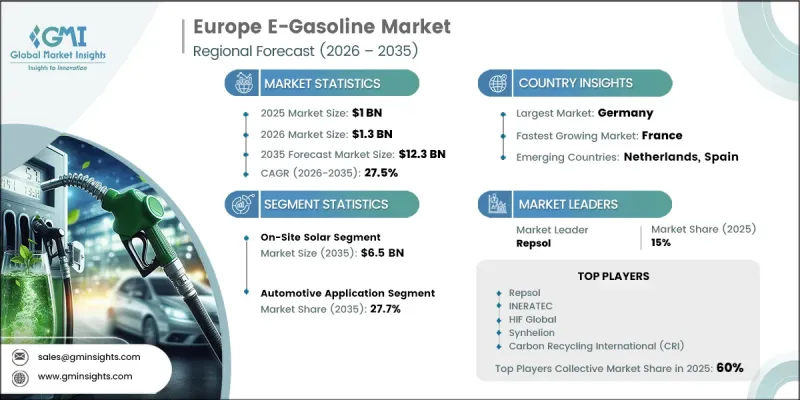
The market is gaining strong momentum due to rapid advancements in renewable fuel technologies, increasing investments in sustainable energy systems, and supportive regulatory frameworks aimed at reducing transportation-related emissions. E-gasoline is emerging as a promising alternative fuel solution because it can significantly reduce carbon intensity while remaining compatible with existing fuel infrastructure and internal combustion engine technologies. Production of e-gasoline is highly dependent on renewable energy availability, particularly green hydrogen generated through renewable-powered electrolysis processes. The integration of renewable energy into fuel production is strengthening the environmental sustainability of the overall fuel lifecycle. Growing government initiatives focused on reducing dependence on conventional fossil fuels and accelerating decarbonization strategies are further contributing to market expansion across Europe. Increasing pressure on the transportation sector to lower greenhouse gas emissions is also supporting the adoption of synthetic fuel technologies. In addition, rising investments in sustainable fuel infrastructure and expanding collaboration between energy providers and industrial stakeholders are creating favorable conditions for long-term market development throughout the region.
| Market Scope | |
|---|---|
| Start Year | 2025 |
| Forecast Year | 2026-2035 |
| Start Value | $1 Billion |
| Forecast Value | $12.3 Billion |
| CAGR | 27.5% |
The Europe e-gasoline industry is shaped by continuous technological advancements in renewable energy integration, hydrogen production, and carbon capture systems. Market participants are increasingly focusing on improving fuel synthesis efficiency and reducing production costs to support commercial scalability. Favorable policy support, emissions reduction targets, and clean energy transition programs across European countries are further strengthening industry growth. The market is also benefiting from rising interest in low-carbon fuel alternatives capable of supporting sectors where direct electrification remains challenging. Expanding research activities related to synthetic fuel production and sustainable transportation technologies are encouraging greater industry participation and investment. Furthermore, increasing awareness regarding climate change mitigation and energy transition strategies is accelerating the shift toward renewable fuel adoption across the region.
The on-site solar segment is projected to reach USD 6.5 billion by 2035, driven by rapid advancements in solar energy utilization and renewable fuel production technologies. Improvements in photovoltaic efficiency, hydrogen generation processes, and carbon capture systems are enhancing the commercial viability of solar-powered e-gasoline production. Increasing deployment of renewable energy infrastructure is also supporting the integration of clean electricity into synthetic fuel manufacturing operations. As production technologies continue to advance, manufacturers are focusing on improving operational efficiency while lowering overall energy costs associated with e-gasoline generation. The growing emphasis on sustainable fuel ecosystems and decentralized renewable energy production is further strengthening the outlook for the on-site solar segment across Europe.
The automotive application segment is anticipated to grow at a CAGR of 27.7% through 2035. Growth within the segment is being driven by the automotive industry's ongoing transition toward low-emission mobility solutions and increasing integration of alternative fuel-compatible vehicle technologies. Automakers are increasingly exploring sustainable fuel options that can support existing combustion engine platforms while contributing to carbon reduction goals. E-gasoline is gaining attention as a practical solution for supporting cleaner mobility without requiring extensive modifications to current fueling infrastructure. Rising investments in advanced fuel technologies, combined with the growing focus on reducing transportation emissions, are expected to strengthen demand for e-gasoline across automotive applications over the coming years.
Germany E-Gasoline Market is forecast to reach USD 2.6 billion by 2035. The country continues to play a significant role in regional market development due to strong regulatory support, increasing environmental awareness, and rising investments in decarbonization initiatives. Public and private sector organizations across Germany are actively supporting sustainable fuel innovation through funding programs, industrial partnerships, and renewable energy expansion projects. The country's advanced industrial infrastructure and strong focus on clean mobility technologies are also creating favorable conditions for synthetic fuel adoption. In addition, growing emphasis on reducing transport-related emissions and strengthening energy transition strategies is expected to further accelerate market growth throughout Germany.
Major companies operating in the Europe E-Gasoline Market include CAC Synfuel, Carbon Recycling International, German eFuel One, HIF Global, INERATEC, ORLEN HyFly, Porsche, Repsol, Synhelion, and Zero Petroleum. Companies operating in the Europe e-gasoline market are implementing several strategic initiatives to strengthen their market presence and enhance long-term competitiveness. Industry participants are investing heavily in renewable fuel research, advanced hydrogen production technologies, and carbon capture integration to improve fuel efficiency and production scalability. Strategic collaborations with renewable energy providers, automotive manufacturers, and industrial technology firms are becoming increasingly important for accelerating commercial deployment and infrastructure development. Many companies are also focusing on expanding production capacities and securing renewable energy supply agreements to support future demand growth. In addition, businesses are prioritizing innovation in synthetic fuel processing technologies to reduce operational costs and improve environmental performance.
Table of Contents
Chapter 1 Methodology & Scope
- 1.1 Research approach
- 1.2 Quality commitment
- 1.2.1 GMI AI policy & data integrity commitment
- 1.2.1.1 Source consistency protocol
- 1.2.1 GMI AI policy & data integrity commitment
- 1.3 Research Trail & Confidence Scoring
- 1.3.1 Research Trail Components
- 1.3.2 Scoring Components
- 1.4 Data Collection
- 1.4.1 Partial list of primary sources
- 1.5 Data mining sources
- 1.5.1 Paid sources
- 1.5.1.1 Sources, by country
- 1.5.1 Paid sources
- 1.6 Base estimates and calculations
- 1.6.1 Base year calculation for any one approach
- 1.7 Forecast model
- 1.8 Research transparency addendum
- 1.8.1 Source attribution framework
- 1.8.2 Quality assurance metrics
- 1.8.3 Our commitment to trust
- 1.9 Market definitions
Chapter 2 Executive Summary
- 2.1 Industry synopsis, 2022 - 2035
- 2.1.1 Business trends
- 2.1.2 Renewable source trends
- 2.1.3 Technology trends
- 2.1.4 Application trends
- 2.1.5 Country trends
Chapter 3 Industry Insights
- 3.1 Industry ecosystem analysis
- 3.1.1 Fuel capture & synthesis analysis
- 3.1.2 Supply chain & distribution network analysis
- 3.1.3 Disruptions
- 3.2 Regulatory landscape
- 3.3 Industry impact forces
- 3.3.1 Growth drivers
- 3.3.1.1 Increasing integration with renewable energy
- 3.3.1.2 Favorable government policies & incentives
- 3.3.2 Industry pitfalls & challenges
- 3.3.2.1 Consumer awareness & price constraints
- 3.3.1 Growth drivers
- 3.4 Growth potential analysis
- 3.5 Porter's analysis
- 3.5.1 Bargaining power of suppliers
- 3.5.2 Bargaining power of buyers
- 3.5.3 Threat of new entrants
- 3.5.4 Threat of substitutes
- 3.6 PESTEL analysis
- 3.6.1 Political factors
- 3.6.2 Economic factors
- 3.6.3 Social factors
- 3.6.4 Technology factors
- 3.6.5 Environmental factors
- 3.6.6 Legal factors
- 3.7 Production method and technology analysis
- 3.8 Emerging opportunities & trends
- 3.9 Digitalization & IoT integration
- 3.10 Investment analysis & future prospects
- 3.11 Impact of AI & Generative AI on the market (Solution Core)
- 3.11.1 AI-driven production optimization
- 3.11.2 Predictive volume analysis
- 3.11.3 Production & consumption trend analysis
- 3.12 Capacity & production landscape (Driven by Primary Research)
Chapter 4 Competitive landscape, 2026
- 4.1 Introduction
- 4.2 Company market share analysis, 2025
- 4.2.1 By country
- 4.2.1.1 Germany
- 4.2.1.2 Netherlands
- 4.2.1.3 France
- 4.2.1.4 Spain
- 4.2.1.5 Italy
- 4.2.2 Market concentration analysis
- 4.2.1 By country
- 4.3 Competitive analysis of major market players
- 4.4 Competitive positioning matrix
- 4.4.1 Key developments
- 4.4.2 Merger & acquisition
- 4.4.3 Partnership & collaboration
- 4.4.4 New product launched
- 4.5 Expansion plans & funding
- 4.6 Company tier benchmarking
- 4.6.1 Tier classification criteria & qualifying thresholds
- 4.6.2 Tier positioning matrix by revenue, geography & innovation
Chapter 5 Market Size and Forecast, By Renewable Source, 2022 - 2035 (USD Million)
- 5.1 Key trends
- 5.2 On-Site Solar
- 5.3 Wind
Chapter 6 Market Size and Forecast, By Technology, 2022 - 2035 (USD Million)
- 6.1 Key trends
- 6.2 Fischer-Tropsch
- 6.3 eRWGS
- 6.4 Others
Chapter 7 Market Size and Forecast, By Application, 2022 - 2035 (USD Million)
- 7.1 Key trends
- 7.2 Automotive
- 7.3 Marine
- 7.4 Aviation
- 7.5 Industrial
- 7.6 Others
Chapter 8 Market Size and Forecast, By Country, 2022 - 2035 (USD Million)
- 8.1 Key trends
- 8.2 Germany
- 8.3 Netherlands
- 8.4 France
- 8.5 Spain
- 8.6 Italy
Chapter 9 Company Profiles
- 9.1 CAC Synfuel
- 9.2 Carbon Recycling International
- 9.3 German eFuel One
- 9.4 HIF Global
- 9.5 INERATEC
- 9.6 ORLEN HyFly
- 9.7 Porsche
- 9.8 Repsol
- 9.9 Synhelion
- 9.10 Zero Petroleum

