PUBLISHER: Global Market Insights Inc. | PRODUCT CODE: 2083062

PUBLISHER: Global Market Insights Inc. | PRODUCT CODE: 2083062
Crop Protection from Insect Symbionts Market Opportunity, Growth Drivers, Industry Trend Analysis, and Forecast 2026 - 2035
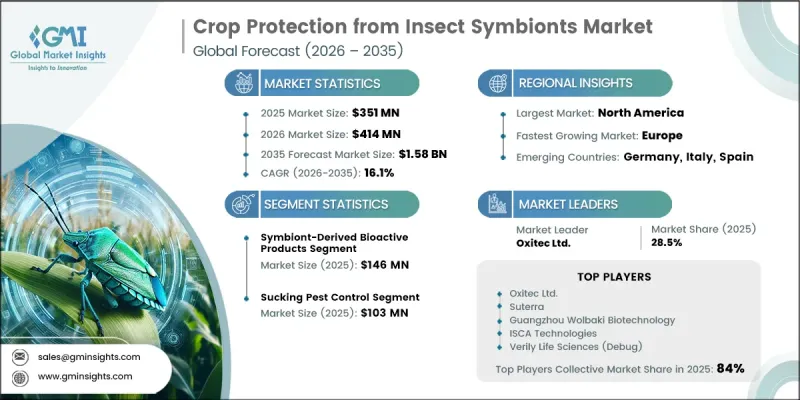
The Global Crop Protection from Insect Symbionts Market was valued at USD 351 million in 2025 and is estimated to grow at a CAGR of 16.1% to reach USD 1.58 billion by 2035.
The crop protection from insect symbionts market is witnessing rapid expansion as agricultural producers increasingly adopt biological pest management technologies to improve crop productivity while reducing dependence on conventional chemical insecticides. Growing regulatory restrictions on synthetic crop protection products, combined with rising demand for sustainable farming practices, continue to create favorable conditions for biologically derived pest control solutions. Advances in microbial research, genetic engineering, and biotechnology are accelerating the development and commercialization of innovative symbiont-based platforms, enabling companies to introduce more targeted and environmentally responsible crop protection products. Expanding field validation, increasing grower confidence, and wider commercial deployment are further supporting market growth across major agricultural regions. Symbiont-based technologies also offer significant advantages by helping producers meet increasingly stringent residue standards while supporting integrated pest management programs and sustainable agricultural practices. As regulatory frameworks continue to evolve and demand for residue-free crop protection solutions increases, manufacturers are strengthening investments in research, product development, and commercialization activities to expand the adoption of insect symbiont-based technologies throughout the global agricultural sector.
| Market Scope | |
|---|---|
| Start Year | 2025 |
| Forecast Year | 2026-2035 |
| Start Value | $351 Million |
| Forecast Value | $1.58 Billion |
| CAGR | 16.1% |
In 2025, the symbiont-derived bioactive products segment accounted for USD 146 million, representing 41.6% share. The segment maintains its leadership due to the increasing commercial availability of biologically derived crop protection products, established distribution networks, and expanding regulatory acceptance across key agricultural markets. Continuous product innovation and growing demand for environmentally responsible pest management solutions continue to reinforce the segment's strong market position.
The sucking pest control segment generated USD 103 million, accounting for 29.3% share in 2025. Strong adoption of biological pest management solutions targeting crop-damaging insects continues to support segment growth across fruit, vegetable, and cereal production. Increasing focus on minimizing crop losses, maintaining product quality, and complying with strict residue requirements in domestic and international agricultural markets further strengthens demand for biologically based sucking pest control solutions.
North America Crop Protection from Insect Symbionts Market generated USD 111 million in 2025. The United States continues to account for the largest share of regional demand, while Canada is experiencing steady growth supported by increasing adoption of sustainable crop protection technologies across high-value agricultural production systems.
Major companies operating in the global crop protection from insect symbionts market include Guangzhou Wolbaki Biotechnology Co., Ltd., Oxitec Ltd., Verily Life Sciences LLC, ISCA Technologies, Inc., Suterra LLC, MosquitoMate, Inc., icipe, Koppert Biological Systems, Andermatt Biocontrol AG, Biobest Group NV, AgBiome, Inc., Marrone Bio Innovations (Bioceres Crop Solutions), Indigo Agriculture, and Vestaron Corporation. Companies operating in the global crop protection from insect symbionts market are strengthening their competitive position through continuous investment in biotechnology research, product innovation, and commercialization of biologically based crop protection solutions. Industry participants are expanding research partnerships, increasing field validation programs, and accelerating regulatory approvals to broaden product availability across key agricultural markets. Businesses are also focusing on improving product performance, scalability, and manufacturing capabilities to support growing global demand. Strategic collaborations with agricultural distributors, research organizations, and farming communities help companies expand market reach while increasing customer awareness and adoption.
Table of Contents
Chapter 1 Methodology & Scope
- 1.1 Research approach
- 1.2 Quality Commitments
- 1.2.1 GMI AI policy & data integrity commitment
- 1.2.1.1 Source consistency protocol
- 1.2.1 GMI AI policy & data integrity commitment
- 1.3 Research Trail & Confidence Scoring
- 1.3.1 Research Trail Components
- 1.3.2 Scoring Components
- 1.4 Data Collection
- 1.4.1 Partial list of primary sources
- 1.5 Data mining sources
- 1.5.1 Paid sources
- 1.5.1.1 Sources, by region
- 1.5.1 Paid sources
- 1.6 Base estimates and calculations
- 1.6.1 Base year calculation for any one approach
- 1.7 Forecast model
- 1.7.1 Quantified market impact analysis
- 1.7.1.1 Mathematical impact of growth parameters on forecast
- 1.7.1 Quantified market impact analysis
- 1.8 Research transparency addendum
- 1.8.1 Source attribution framework
- 1.8.2 Quality assurance metrics
- 1.8.3 Our commitment to trust
Chapter 2 Executive Summary
- 2.1 Industry 360° synopsis
- 2.2 Key market trends
- 2.2.1 Regional
- 2.2.2 Product Type
- 2.2.3 Crop Type
- 2.2.4 Application
- 2.3 TAM Analysis, 2026-2035
- 2.4 CXO perspectives: Strategic imperatives
Chapter 3 Industry Insights
- 3.1 Industry ecosystem analysis
- 3.1.1 Supplier landscape
- 3.1.2 Profit margin
- 3.1.3 Value addition at each stage
- 3.1.4 Factor affecting the value chain
- 3.1.5 Disruptions
- 3.2 Industry impact forces
- 3.2.1 Growth drivers
- 3.2.2 Industry pitfalls and challenges
- 3.2.3 Market opportunities
- 3.3 Growth potential analysis
- 3.4 Regulatory landscape
- 3.4.1 North America
- 3.4.2 Europe
- 3.4.3 Asia Pacific
- 3.4.4 Latin America
- 3.4.5 Middle East & Africa
- 3.5 Porter's analysis
- 3.6 PESTEL analysis
- 3.7 Price trends
- 3.7.1 By region
- 3.7.2 By product type
- 3.8 Future market trends
- 3.9 Technology and Innovation landscape
- 3.9.1 Current technological trends
- 3.9.2 Emerging technologies
- 3.10 Patent Landscape
- 3.11 Trade statistics (HS code)
- 3.11.1 Major importing countries
- 3.11.2 Major exporting countries
- 3.12 Sustainability and environmental aspects
- 3.12.1 Sustainable practices
- 3.12.2 Waste reduction strategies
- 3.12.3 Energy efficiency in production
- 3.12.4 Eco-friendly initiatives
- 3.13 Carbon footprint consideration
Chapter 4 Competitive Landscape, 2025
- 4.1 Introduction
- 4.2 Company market share analysis
- 4.2.1 By region
- 4.2.1.1 North America
- 4.2.1.2 Europe
- 4.2.1.3 Asia Pacific
- 4.2.1.4 LATAM
- 4.2.1.5 MEA
- 4.2.1 By region
- 4.3 Company matrix analysis
- 4.4 Competitive analysis of major market players
- 4.5 Competitive positioning matrix
- 4.6 Key developments
- 4.6.1 Mergers & acquisitions
- 4.6.2 Partnerships & collaborations
- 4.6.3 New Product Launches
- 4.6.4 Expansion Plans
Chapter 5 Market Estimates and Forecast, By Product Type, 2022-2035 (USD Million)
- 5.1 Key trends
- 5.2 Live Symbiont Products
- 5.2.1 Wolbachia-Infected Insect Releases
- 5.2.2 Direct Symbiont Biocontrol Formulations
- 5.2.3 Gut Probiotic Formulations
- 5.3 Engineered Symbiont Products
- 5.3.1 CRISPR/Cas9-Modified Symbiont Products
- 5.3.2 Symbiont-Mediated RNAi (SMR) Delivery Systems
- 5.3.3 Paratransgenesis-Based Anti-Pest Effector Products
- 5.4 Symbiont-Derived Bioactive Products
- 5.4.1 Pheromone & Aggregation Semiochemical Formulations
- 5.4.2 Symbiont-Derived Toxin & Antimicrobial Compounds
- 5.4.3 Volatile Attractant & Lure Formulations
- 5.5 Symbiont-Disruption Agents
- 5.5.1 Antibiotic-Based Symbiont Disruptors
- 5.5.2 Antifungal Agents Targeting Yeast-Like Symbionts (YLS)
- 5.5.3 dsRNA-Based Symbiont-Host Interaction Disruptors
Chapter 6 Market Estimates and Forecast, By Crop Type, 2022-2035 (USD Million)
- 6.1 Key trends
- 6.2 Cereals & Grains
- 6.2.1 Rice
- 6.2.2 Maize
- 6.2.3 Wheat & Other Cereals
- 6.3 Fruits & Vegetables
- 6.3.1 Fruits
- 6.3.2 Vegetables
- 6.4 Oilseeds & Pulses
- 6.4.1 Soybean & Bean
- 6.4.2 Other Oilseeds & Pulses
- 6.5 Specialty & Industrial Crops
- 6.5.1 Cotton
- 6.5.2 Sugarcane
- 6.5.3 Potato
- 6.6 Others
Chapter 7 Market Estimates and Forecast, By Application, 2022-2035 (USD Million)
- 7.1 Key trends
- 7.2 Sucking Pest Control
- 7.2.1 Aphid Management
- 7.2.2 Whitefly Management
- 7.2.3 Planthopper & Leafhopper Management
- 7.2.4 Mealybug & Psyllid Management
- 7.3 Chewing Pest Control
- 7.3.1 Caterpillar & Lepidopteran Pest Management
- 7.3.2 Coleopteran & Weevil Management
- 7.3.3 Locust & Orthopteran Management
- 7.4 Dipteran & Tephritid Pest Control
- 7.4.1 Oriental & Mediterranean Fruit Fly Management
- 7.4.2 Spotted Wing Drosophila Management
- 7.4.3 Other Dipteran Crop Pest Management
- 7.5 Vector-Borne Plant Disease Management
- 7.5.1 Rice Virus Disease Management
- 7.5.2 Cassava & Tropical Crop Virus Management
- 7.5.3 Begomovirus & Other Geminivirid Disease Management
- 7.6 Stored Product Pest Control
- 7.6.1 Grain Weevil & Bruchid Beetle Management
- 7.6.2 Cigarette Beetle & Stored Tobacco Pest Management
Chapter 8 Market Estimates and Forecast, By Region, 2022-2035 (USD Million)
- 8.1 Key trends
- 8.2 North America
- 8.2.1 U.S.
- 8.2.2 Canada
- 8.3 Europe
- 8.3.1 Germany
- 8.3.2 UK
- 8.3.3 France
- 8.3.4 Spain
- 8.3.5 Italy
- 8.3.6 Rest of Europe
- 8.4 Asia Pacific
- 8.4.1 China
- 8.4.2 India
- 8.4.3 Japan
- 8.4.4 Australia
- 8.4.5 South Korea
- 8.4.6 Rest of Asia Pacific
- 8.5 Latin America
- 8.5.1 Brazil
- 8.5.2 Mexico
- 8.5.3 Argentina
- 8.5.4 Rest of Latin America
- 8.6 Middle East and Africa
- 8.6.1 Saudi Arabia
- 8.6.2 South Africa
- 8.6.3 UAE
- 8.6.4 Rest of Middle East and Africa
Chapter 9 Company Profiles
- 9.1 Guangzhou Wolbaki Biotechnology Co., Ltd.
- 9.2 Oxitec Ltd.
- 9.3 Verily Life Sciences LLC (Debug Program)
- 9.4 ISCA Technologies, Inc.
- 9.5 Suterra LLC
- 9.6 MosquitoMate, Inc.
- 9.7 icipe
- 9.8 Koppert Biological Systems
- 9.9 Andermatt Biocontrol AG
- 9.10 Biobest Group NV
- 9.11 AgBiome, Inc.
- 9.12 Marrone Bio Innovations (Bioceres Crop Solutions)
- 9.13 Indigo Agriculture
- 9.14 Vestaron Corporation

