PUBLISHER: Global Market Insights Inc. | PRODUCT CODE: 2101873

PUBLISHER: Global Market Insights Inc. | PRODUCT CODE: 2101873
Printing Plates Market Opportunity, Growth Drivers, Industry Trend Analysis, and Forecast 2026 - 2035
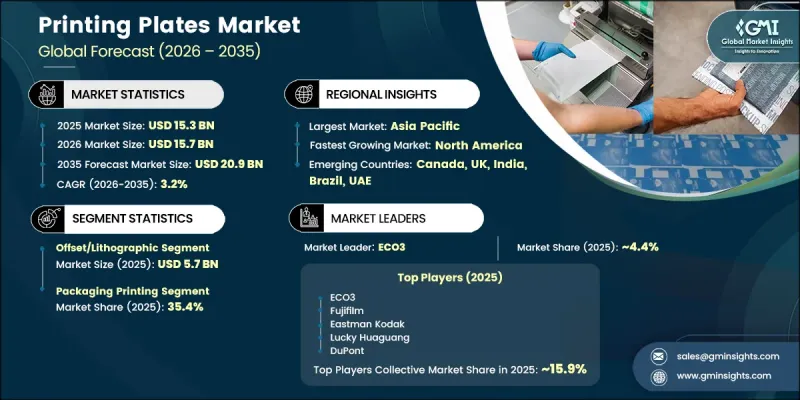
The Global Printing Plates Market was valued at USD 15.3 billion in 2025 and is estimated to grow at a CAGR of 3.2% to reach USD 20.9 billion by 2035.
The printing plates market is advancing steadily due to the widespread shift toward computer-to-plate technologies, rising consumption of flexographic plates in sustainable packaging applications, and continuous expansion of pharmaceutical packaging production in emerging economies. Growing adoption of flexible packaging formats is significantly boosting demand for flexographic printing plates as brand owners increasingly transition away from rigid packaging structures. The rise of e-commerce is further amplifying demand for labels and corrugated packaging, leading to higher print volumes and shorter production cycles across the value chain. At the same time, SKU proliferation in consumer goods is driving demand for shorter print runs and faster turnaround times, reinforcing the importance of digital prepress workflows. Computer-to-plate systems have transformed the printing industry by eliminating traditional film-based processes and significantly reducing production cycle times, improving efficiency and consistency across commercial printing operations. Overall, the industry continues to evolve toward more efficient, sustainable, and high-precision printing technologies that support diverse end-use applications.
| Market Scope | |
|---|---|
| Start Year | 2025 |
| Forecast Year | 2026-2035 |
| Start Value | $15.3 Billion |
| Forecast Value | $20.9 Billion |
| CAGR | 3.2% |
The offset and lithographic printing plates segment generated USD 5.7 billion in 2025 and is projected to grow at a CAGR of 2.6% through 2035. This segment remains the leading technology category due to its extensive use in commercial printing, packaging production, and publishing applications. Offset lithographic plates continue to be widely deployed across large-scale printing operations supported by a substantial installed base of printing presses globally. Although demand remains stable in packaging applications, gradual decline in traditional print media usage is moderating overall growth in this segment, resulting in a more steady expansion trajectory over the forecast period.
The packaging printing application segment accounted for 35.4% share in 2025 and is expected to grow at a CAGR of 3.7% through 2035, exceeding the overall market growth rate. This segment includes flexible packaging, corrugated packaging, folding cartons, labels, and pharmaceutical packaging, each requiring specialized plate performance in terms of durability, precision, and ink compatibility. Rising demand for branded packaging and regulatory-compliant pharmaceutical labeling continues to strengthen adoption of advanced printing plate technologies across packaging applications.
North America Printing Plates Market captured USD 3.9 billion in 2025 and is projected to grow at a CAGR of 2.6% through 2035. The region remains the second-largest global market, supported by a well-established commercial printing ecosystem and a strong packaging industry base. Market growth is driven by consistent demand for upgraded prepress technologies and ongoing transition toward modernized plate production systems across commercial and packaging printing facilities.
Key companies operating in the global printing plates market include Fujifilm Holdings Corporation, Agfa-Gevaert NV, Eastman Kodak Company, DuPont de Nemours Inc., Toray Industries Inc., Lucky Huaguang Graphics Co. Ltd., Asahi Photoproducts Europe NV (Asahi Kasei Corporation), MacDermid Graphics Solutions LLC, Flint Group, Xingraphics, Miraclon HoldCo Corporation, XSYS Printing Solutions, Element Solutions Inc., Luscher Technologies AG, and Anderson & Vreeland Inc. Companies operating in the printing plates market are strengthening their market position by focusing on technological advancements, sustainability improvements, and expansion of high-performance plate offerings. Manufacturers are investing in computer-to-plate innovation, processless plate technologies, and enhanced imaging solutions to improve efficiency and reduce environmental impact. Strategic partnerships with packaging converters and commercial printers are enabling companies to expand their customer base and improve product integration across end-use applications. Businesses are also optimizing production processes to reduce cost and improve plate durability, consistency, and print quality.
Table of Contents
Chapter 1 Methodology & Scope
- 1.1 Market scope and definition
- 1.2 Research design
- 1.2.1 Research approach
- 1.2.2 Data collection methods
- 1.3 Data mining sources
- 1.3.1 Global
- 1.3.2 Regional/Country
- 1.4 Base estimates and calculations
- 1.4.1 Base year calculation
- 1.4.2 Key trends for market estimation
- 1.5 Primary research and validation
- 1.5.1 Primary sources
- 1.6 Forecast model
- 1.7 Research assumptions and limitations
Chapter 2 Executive Summary
- 2.1 Industry 360° synopsis
- 2.2 Key market trends
- 2.2.1 Regional
- 2.2.2 Plate type
- 2.2.3 Material/substrate
- 2.2.4 Application
- 2.2.5 End-user industry
- 2.2.6 Distribution channel
Chapter 3 Industry Insights
- 3.1 Industry ecosystem analysis
- 3.1.1 Supplier landscape
- 3.1.2 Profit margin
- 3.1.3 Value addition at each stage
- 3.1.4 Factor affecting the value chain
- 3.2 Industry impact forces
- 3.2.1 Growth drivers
- 3.2.1.1 Surging demand for sustainable flexible packaging driving flexographic plate adoption
- 3.2.1.2 E-commerce boom fueling label & packaging print volumes
- 3.2.1.3 CTP technology advancement reducing prepress waste & turnaround time
- 3.2.1.4 Pharmaceutical packaging growth in emerging economies
- 3.2.2 Industry pitfalls & challenges
- 3.2.2.1 Stringent EPA/REACH chemical processing regulations increasing compliance burden
- 3.2.2.2 Structural decline in publication gravure & newspaper offset volumes
- 3.2.2.3 Supply chain disruption for specialized metal plates (geopolitical & logistic risks)
- 3.2.2.4 Skilled labor shortage for plate production & quality validation
- 3.2.3 Opportunities
- 3.2.3.1 Processless & chemistry-free plate technology reducing compliance costs
- 3.2.3.2 Plate-as-a-service (managed plate services) emerging as new revenue model
- 3.2.3.3 AI-driven plate imaging & automated quality control integration
- 3.2.3.4 Premiumization of packaging in APAC & Latin America driving high-quality plate demand
- 3.2.1 Growth drivers
- 3.3 Growth potential analysis
- 3.4 Future market trends
- 3.5 Technology and innovation landscape
- 3.5.1 Current technological trends
- 3.5.2 Emerging technologies
- 3.6 Regulatory landscape
- 3.6.1 Standards and compliance requirements
- 3.6.2 Regional regulatory frameworks
- 3.6.3 Certification standards
- 3.7 Trade data analysis (HS Code 8442)
- 3.7.1 Import/export volume & value trends
- 3.7.2 Key trade corridors & tariff impact
- 3.8 Pricing analysis
- 3.8.1 Historical price trend analysis (driven by primary research)
- 3.8.2 Pricing strategy by player type (premium / value / mass market)
- 3.9 Impact of AI & generative AI on the market
- 3.9.1 AI-driven disruption of existing business models
- 3.9.2 GenAI use cases & adoption roadmap by segment
- 3.9.3 Risks, limitations & regulatory considerations
- 3.10 Porter's analysis
- 3.11 PESTEL analysis
Chapter 4 Competitive Landscape, 2025
- 4.1 Introduction
- 4.2 Company market share analysis
- 4.2.1 By Region
- 4.2.1.1 North America
- 4.2.1.2 Europe
- 4.2.1.3 Asia Pacific
- 4.2.1.4 Latin America
- 4.2.1.5 Middle East & Africa
- 4.2.1 By Region
- 4.3 Company matrix analysis
- 4.4 Competitive analysis of major market players
- 4.5 Competitive positioning matrix
- 4.6 Key developments
- 4.6.1 Mergers & acquisitions
- 4.6.2 Partnerships & collaborations
- 4.6.3 New product launches
- 4.6.4 Expansion plans
Chapter 5 Market Estimates & Forecast, By Plate Type, 2022 - 2035, (USD Billion) (Thousand Units)
- 5.1 Key trends
- 5.2 Flexographic printing plates
- 5.3 Offset/lithographic printing plates
- 5.4 Gravure/rotogravure printing plates
- 5.5 Letterpress printing plates
- 5.6 Screen printing plates
- 5.7 Others
Chapter 6 Market Estimates & Forecast, By Material/Substrate, 2022 - 2035, (USD Billion) (Thousand Units)
- 6.1 Key trends
- 6.2 Metal plates
- 6.3 Photopolymer plates
- 6.4 Polyester plates
- 6.5 Paper-based plates
- 6.6 Others (rubber, ceramic & specialty substrate plates)
Chapter 7 Market Estimates & Forecast, By Application, 2022 - 2035, (USD Billion) (Thousand Units)
- 7.1 Key trends
- 7.2 Packaging printing
- 7.3 Label printing
- 7.4 Commercial printing
- 7.5 Publishing & newspaper printing
- 7.6 Security & specialty printing
- 7.7 Textile & garment printing
- 7.8 Others
Chapter 8 Market Estimates & Forecast, By End-Use Industry, 2022 - 2035, (USD Billion) (Thousand Units)
- 8.1 Key trends
- 8.2 Food & beverage
- 8.3 Pharmaceuticals & healthcare
- 8.4 Cosmetics & personal care
- 8.5 Electronics
- 8.6 Automotive
- 8.7 Publishing & media
- 8.8 Others (textile, government, education)
Chapter 9 Market Estimates & Forecast, By Distribution Channel, 2022 - 2035, (USD Billion) (Thousand Units)
- 9.1 Key trends
- 9.2 Direct
- 9.3 Indirect
Chapter 10 Market Estimates & Forecast, By Region, 2022 - 2035, (USD Billion) (Thousand Units)
- 10.1 Key trends
- 10.2 North America
- 10.2.1 U.S.
- 10.2.2 Canada
- 10.3 Europe
- 10.3.1 Germany
- 10.3.2 UK
- 10.3.3 France
- 10.3.4 Italy
- 10.3.5 Spain
- 10.4 Asia Pacific
- 10.4.1 China
- 10.4.2 India
- 10.4.3 Japan
- 10.4.4 South Korea
- 10.4.5 Australia
- 10.4.6 Indonesia
- 10.4.7 Malaysia
- 10.5 Latin America
- 10.5.1 Brazil
- 10.5.2 Mexico
- 10.5.3 Argentina
- 10.6 MEA
- 10.6.1 Saudi Arabia
- 10.6.2 UAE
- 10.6.3 South Africa
Chapter 11 Company Profiles
- 11.1 Top Global Players
- 11.1.1 Fujifilm Holdings Corporation
- 11.1.2 Agfa-Gevaert NV
- 11.1.3 Eastman Kodak Company
- 11.1.4 DuPont de Nemours Inc.
- 11.1.5 Toray Industries Inc.
- 11.2 Regional Champions
- 11.2.1 Lucky Huaguang Graphics Co. Ltd.
- 11.2.2 Asahi Photoproducts Europe NV (Asahi Kasei Corporation)
- 11.2.3 MacDermid Graphics Solutions LLC
- 11.2.4 Flint Group
- 11.2.5 Xingraphics
- 11.3 Emerging Players
- 11.3.1 Miraclon HoldCo Corporation
- 11.3.2 XSYS Printing Solutions
- 11.3.3 Element Solutions Inc.
- 11.3.4 Luscher Technologies AG
- 11.3.5 Anderson & Vreeland Inc.

