PUBLISHER: Global Market Insights Inc. | PRODUCT CODE: 2121174

PUBLISHER: Global Market Insights Inc. | PRODUCT CODE: 2121174
3D Printing in Construction Market Opportunity, Growth Drivers, Industry Trend Analysis, and Forecast 2026 - 2035
The Global 3D Printing in Construction Market was valued at USD 115.9 million in 2025 and is estimated to grow at a CAGR of 28.8% to reach USD 1.27 billion by 2035.
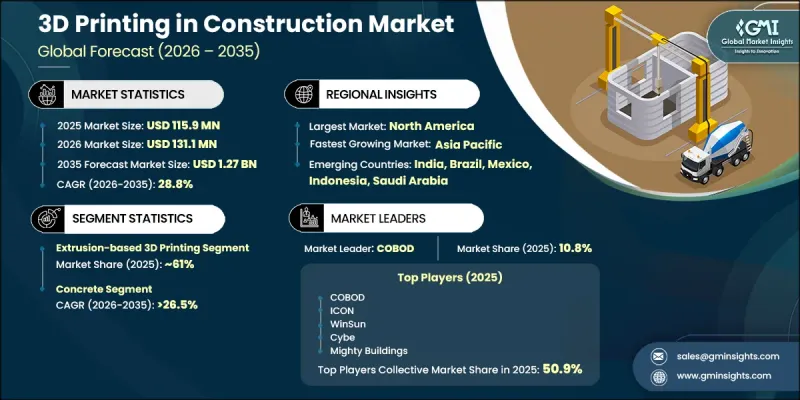
The market is gaining momentum as construction companies increasingly explore digital manufacturing technologies to improve productivity, reduce material waste, shorten project timelines, and address labor constraints. Rising infrastructure spending is creating favorable conditions for the broader deployment of automated construction solutions, while tighter equipment performance requirements are encouraging contractors to adopt technologies that provide greater operational visibility. Advances in connected equipment, remote diagnostics, telematics, and machine monitoring are also supporting this transition by allowing fleet operators to identify performance issues at an earlier stage. At the same time, increasingly stringent emissions requirements are encouraging equipment users to prioritize technologies that support regulatory compliance and more efficient machine operation. As connectivity, sensor technology, and standardized data systems become more common across construction equipment, digital monitoring is becoming more accessible to mid-sized contractors and rental fleets. These developments are helping create a stronger technological foundation for the broader adoption of 3D printing and other automated construction processes.
| Market Scope | |
|---|---|
| Start Year | 2025 |
| Forecast Year | 2026-2035 |
| Start Value | $115.9 Million |
| Forecast Value | $1.27 Billion |
| CAGR | 28.8% |
The extrusion-based 3D printing segment held a 61% share in 2025. Its strong position reflects the widespread use of extrusion technology as the primary deposition approach for large-scale construction printing. Extrusion platforms enable construction materials to be deposited in controlled layers, allowing automated systems to create walls and other structural components according to digitally defined designs. The established nature of extrusion technology gives manufacturers a practical foundation for developing construction-scale printing equipment, while its compatibility with cement-based materials supports broader commercial applications. Compared with alternative approaches that require different machine configurations and material-handling processes, extrusion offers a more established pathway for construction companies seeking to integrate additive manufacturing into conventional building operations.
The concrete segment held a 63.9% share in 2025. Concrete maintains its leading position because it is well suited to large-scale structural fabrication and can be deposited layer by layer through specialized printing systems. Its established role in conventional construction also gives contractors and material suppliers greater familiarity with its handling, mixing, placement, and curing requirements. The availability of established supply chains and construction-grade formulations further supports the integration of concrete-based printing into residential and commercial projects. Compared with printing systems that rely on more specialized materials, concrete-based processes can be incorporated more readily into existing construction workflows. These advantages are encouraging printer manufacturers and construction technology providers to continue developing equipment and material solutions around concrete, reinforcing its position as the dominant feedstock across the construction 3D printing industry.
United States 3D Printing in Construction Market accounted for 84.3% share and generated USD 37.7 million in 2025. The country continues to represent the primary market in the region because of its expanding construction technology ecosystem, strong investment activity, and increasing interest in automated building methods. Persistent housing affordability challenges are also encouraging stakeholders to investigate alternative construction approaches that can improve productivity and potentially lower building costs. In addition, increasing interest from contractors, developers, technology providers, and public-sector stakeholders is supporting the development and testing of construction-scale additive manufacturing solutions.
Major companies operating in the global 3D printing in construction market include MX3D, ICON Technology Inc., BESIX 3D, XtreeE SAS, COBOD International A/S, Apis Cor Inc., PERI 3D Construction GmbH, Branch Technology, WinSun (Yingchuang), and CyBe Construction B.V. Companies operating in the 3D printing in construction market are focusing on technology development, product innovation, strategic partnerships, geographic expansion, and commercialization initiatives to strengthen their market presence. Market participants are investing in advanced printer designs, automated material-deposition systems, software integration, and process-control capabilities to improve printing speed, precision, scalability, and reliability. Companies are also expanding their material portfolios and refining construction-grade formulations to support a wider range of applications and project requirements. Collaborations with construction firms, technology providers, material manufacturers, developers, and other industry participants are helping companies accelerate product validation and market adoption. Expanding production capabilities and entering new regional markets are additional priorities as demand for automated construction solutions increases. Businesses are also emphasizing customized solutions, technical support, and integrated digital platforms to differentiate their offerings.
Table of Contents
Chapter 1 Methodology
- 1.1 Research approach
- 1.2 Quality Commitments
- 1.2.1 GMI AI policy & data integrity commitment
- 1.2.1.1 Source consistency protocol
- 1.2.1 GMI AI policy & data integrity commitment
- 1.3 Research Trail & Confidence Scoring
- 1.3.1 Research Trail Components
- 1.3.2 Scoring Components
- 1.4 Data Collection
- 1.4.1 Partial list of primary sources
- 1.5 Data mining sources
- 1.5.1 Paid sources
- 1.5.1.1 Sources, by region
- 1.5.1 Paid sources
- 1.6 Base estimates and calculations
- 1.6.1 Base year calculation
- 1.7 Forecast Model
- 1.7.1 Quantified market impact analysis
- 1.7.1.1 Mathematical impact of growth parameters on forecast
- 1.7.1 Quantified market impact analysis
- 1.8 Research transparency addendum
- 1.8.1 Source attribution framework
- 1.8.2 Quality assurance metrics
- 1.8.3 Our commitment to trust
Chapter 2 Executive Summary
- 2.1 Industry 360° synopsis, 2022 – 2035
- 2.2 Key market trends
- 2.2.1 Regional
- 2.2.2 Construction method
- 2.2.3 Material
- 2.2.4 Process
- 2.2.5 Construction type
- 2.2.6 End use
- 2.3 TAM Analysis, 2026-2035
- 2.4 CXO perspectives: Strategic imperatives
Chapter 3 Industry Insights
- 3.1 Industry ecosystem analysis
- 3.1.1 Supplier landscape
- 3.1.2 Profit margin analysis
- 3.1.3 Cost structure
- 3.1.4 Value addition at each stage
- 3.1.5 Factor affecting the value chain
- 3.1.6 Disruptions
- 3.2 Industry impact forces
- 3.2.1 Growth drivers
- 3.2.1.1 Acute labor shortages in skilled construction trades accelerating automation adoption
- 3.2.1.2 Housing affordability crisis demanding faster, lower-cost construction methods
- 3.2.1.3 Tightening sustainability mandates incentivizing reduced material waste
- 3.2.1.4 Government-backed infrastructure modernization programs
- 3.2.2 Market Restraints
- 3.2.2.1 High upfront capital expenditure limiting SME adoption
- 3.2.2.2 Absence of globally standardized building codes for 3d-printed structures
- 3.2.3 Market Opportunities
- 3.2.3.1 Affordable & social housing programs in emerging economies
- 3.2.3.2 Disaster relief & rapid deployment construction applications
- 3.2.3.3 Integration with prefabrication & modular construction value chains
- 3.2.3.4 Space & extreme environment construction (lunar, arctic, remote sites)
- 3.2.1 Growth drivers
- 3.3 Growth potential analysis
- 3.4 Technology and Innovation landscape
- 3.4.1 Current technological trends
- 3.4.2 Emerging technologies
- 3.5 Pricing analysis (driven by primary research)
- 3.5.1 Historical price trend analysis
- 3.5.2 Pricing strategy by player type (premium / value / cost-plus)
- 3.6 Regulatory guidelines
- 3.6.1 North America
- 3.6.1.1 U.S.: ICC AC509 "3D Automated Construction Technology for 3D Concrete Walls"
- 3.6.1.2 Canada: National Building Code of Canada (NBC) Alternative Solutions Provisions
- 3.6.2 Europe
- 3.6.2.1 Germany: DIBt (Deutsches Institut fur Bautechnik) Individual Case Approval (Zustimmung im Einzelfall) & ISO/ASTM 52939:2023
- 3.6.2.2 UK: British Board of Agrement (BBA) Certification & UK Building Regulations Alternative Compliance Route
- 3.6.2.3 France: Avis Technique (CSTB Technical Approval) & EU Construction Products Regulation (CPR) 305/2011
- 3.6.2.4 Denmark/Netherlands (regional hub): European Technical Assessment (ETA) under EOTA & CE Marking Framework
- 3.6.3 Asia Pacific
- 3.6.3.1 China: GB/T National Standards for Additive Manufacturing in Construction (in development) & Ministry of Housing and Urban-Rural Development (MOHURD) Local Pilot Approvals
- 3.6.3.2 India: Bureau of Indian Standards (BIS) evaluation route & Building Materials and Technology Promotion Council (BMTPC)
- 3.6.3.3 Japan: Building Standards Act (BSA) Ministerial Approval Route & Japan Testing Center for Construction Materials (JTCCM) Evaluation
- 3.6.3.4 Singapore: Building and Construction Authority (BCA) On-Site Printing Pilot Program & BCA Structural Performance Validation
- 3.6.4 Latin America
- 3.6.4.1 Brazil: ABNT (Associacao Brasileira de Normas Tecnicas) Technical Evaluation & INMETRO Product Certification Pathway
- 3.6.4.2 Mexico: NOM (Normas Oficiales Mexicanas) Construction Materials Standards
- 3.6.5 MEA
- 3.6.5.1 UAE (Dubai): Dubai Decree No. 24 of 2021 Regulating 3D Printing in the Construction Sector & Dubai Municipality 3D Printing Building Permit Framework
- 3.6.5.2 Saudi Arabia: Saudi Building Code (SBC) Alternative Materials Approval & Vision 2030 Construction Innovation Compliance Requirements
- 3.6.1 North America
- 3.7 Porter’s analysis
- 3.8 PESTEL analysis
- 3.9 Patent landscape (driven by primary research)
- 3.10 Impact of AI & Generative AI on the market (driven by primary research)
- 3.10.1 AI-driven disruption of existing business models
- 3.10.2 GenAI use cases & adoption roadmap by segment
- 3.10.3 Risks, limitations & regulatory considerations
- 3.11 Sustainability and environmental aspects
- 3.11.1 Sustainable practices
- 3.11.2 Waste reduction strategies
- 3.11.3 Energy efficiency in production
- 3.11.4 Eco-friendly initiatives
- 3.11.5 Carbon footprint considerations
- 3.12 Forecast assumptions & scenario analysis (driven by primary research)
- 3.12.1 Base case - key macro & industry variables driving CAGR
- 3.12.2 Optimistic scenarios - favourable macro and industry tailwinds
- 3.12.3 Pessimistic scenario - macroeconomic slowdown or industry headwinds
Chapter 4 Competitive Landscape, 2025
- 4.1 Introduction
- 4.2 Company market share analysis, 2022-2025
- 4.2.1 North America
- 4.2.2 Europe
- 4.2.3 Asia Pacific
- 4.2.4 Latin America
- 4.2.5 MEA
- 4.3 Competitive analysis of major market players
- 4.4 Competitive positioning matrix
- 4.5 Key developments
- 4.5.1 Mergers & acquisitions
- 4.5.2 Partnerships & collaborations
- 4.5.3 New product launches
- 4.5.4 Expansion plans and funding
- 4.6 Company Tier Benchmarking
- 4.6.1 Tier classification criteria & qualifying thresholds
- 4.6.2 Tier positioning matrix by revenue, geography & innovation
Chapter 5 Market Estimates & Forecast, By Construction Method, 2022 - 2035 ($Bn, Units)
- 5.1 Key trends
- 5.2 Extrusion-based 3D printing
- 5.3 Powder bonding
- 5.4 Wire Arc Additive Manufacturing (WAAM)
- 5.5 Others
Chapter 6 Market Estimates & Forecast, By Material, 2022 - 2035 ($Bn)
- 6.1 Key trends
- 6.2 Concrete
- 6.3 Metals
- 6.4 Polymers
- 6.5 Composites
- 6.6 Others
Chapter 7 Market Estimates & Forecast, By Process, 2022 - 2035 ($Bn)
- 7.1 Key trends
- 7.2 On-site 3D printing
- 7.3 Off-site prefabrication
Chapter 8 Market Estimates & Forecast, By Construction Type, 2022 – 2035 ($Bn)
- 8.1 Key trends
- 8.2 Modular construction
- 8.3 Full building construction
Chapter 9 Market Estimates & Forecast, By End Use, 2022 – 2035 ($Bn)
- 9.1 Key trends
- 9.2 Residential
- 9.2.1 On-site 3D printing
- 9.2.2 Off-site prefabrication
- 9.3 Commercial
- 9.3.1 On-site 3D printing
- 9.3.2 Off-site prefabrication
- 9.4 Infrastructure
- 9.4.1 On-site 3D printing
- 9.4.2 Off-site prefabrication
- 9.5 Industrial
- 9.5.1 On-site 3D printing
- 9.5.2 Off-site prefabrication
Chapter 10 Market Estimates & Forecast, By Region, 2022 - 2035 ($Bn, Units)
- 10.1 Key trends
- 10.2 North America
- 10.2.1 US
- 10.2.2 Canada
- 10.3 Europe
- 10.3.1 Germany
- 10.3.2 UK
- 10.3.3 France
- 10.3.4 Italy
- 10.3.5 Spain
- 10.3.6 Russia
- 10.3.7 Denmark
- 10.3.8 Netherlands
- 10.3.9 Sweden
- 10.4 Asia Pacific
- 10.4.1 China
- 10.4.2 India
- 10.4.3 Japan
- 10.4.4 ANZ
- 10.4.5 South Korea
- 10.4.6 Indonesia
- 10.4.7 Thailand
- 10.4.8 Vietnam
- 10.5 Latin America
- 10.5.1 Brazil
- 10.5.2 Mexico
- 10.5.3 Argentina
- 10.6 MEA
- 10.6.1 South Africa
- 10.6.2 Saudi Arabia
- 10.6.3 UAE
Chapter 11 Company Profiles
- 11.1 Global Players
- 11.1.1 COBOD International A/S
- 11.1.2 CyBe Construction B.V.
- 11.1.3 ICON Technology Inc.
- 11.1.4 Apis Cor Inc.
- 11.1.5 WinSun (Yingchuang)
- 11.1.6 XtreeE SAS
- 11.1.7 PERI 3D Construction GmbH
- 11.1.8 BESIX 3D
- 11.1.9 MX3D
- 11.1.10 Branch Technology
- 11.1.11 Hyperion Robotics
- 11.1.12 Tvasta Manufacturing Solutions
- 11.2 Regional Players
- 11.2.1 Constructions-3D
- 11.2.2 Vertico B.V.
- 11.2.3 BetAbram d.o.o.
- 11.2.4 Twente Additive Manufacturing (TAM)
- 11.2.5 Confabric Technology
- 11.2.6 Coral Construction Technologies
- 11.2.7 INSTATIQ
- 11.2.8 SQ4D Inc.
- 11.2.9 Total Kustom LLC
- 11.2.10 Luyten 3D
- 11.2.11 Contour3D (C3D)
- 11.2.12 3DCP Group

