PUBLISHER: Global Market Insights Inc. | PRODUCT CODE: 2121188

PUBLISHER: Global Market Insights Inc. | PRODUCT CODE: 2121188
Military and Defense Semiconductor Market Opportunity, Growth Drivers, Industry Trend Analysis, and Forecast 2026 - 2035
The Global Military & Defense Semiconductor Market was valued at USD 6.2 billion in 2025 and is estimated to grow at a CAGR of 7.4% to reach USD 12.9 billion by 2035.
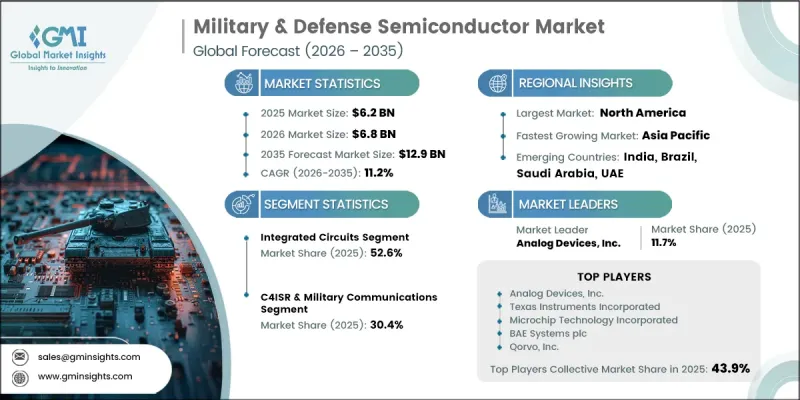
The market is expanding as defense organizations increase investments in advanced electronic systems, intelligent computing technologies, and mission-critical semiconductor solutions. Rising defense spending across multiple regions continues to accelerate the procurement of high-performance semiconductor components designed for secure, reliable, and demanding operating environments. Growing emphasis on electronic warfare capabilities, modernization of defense platforms, and deployment of advanced digital technologies is strengthening demand for specialized semiconductor devices with enhanced processing performance and durability. The integration of artificial intelligence and machine learning into modern defense equipment is further increasing the need for powerful processors, advanced memory technologies, and energy-efficient semiconductor architectures capable of supporting real-time decision-making in complex operational conditions. In addition, ongoing upgrades of existing military systems and continued development of next-generation defense technologies are encouraging greater adoption of innovative semiconductor solutions. These factors, combined with increasing focus on secure domestic semiconductor production and resilient supply chains, continue to support long-term growth across the global Military & Defense Semiconductor Market.
| Market Scope | |
|---|---|
| Start Year | 2025 |
| Forecast Year | 2026-2035 |
| Start Value | $6.2 Billion |
| Forecast Value | $12.9 Billion |
| CAGR | 7.4% |
The continued expansion of national defense budgets remains one of the primary growth drivers for the Military & Defense Semiconductor Market. Increasing adoption of artificial intelligence, machine learning, and autonomous technologies across defense applications is creating sustained demand for advanced processors, high-density memory devices, and specialized semiconductor components that deliver high computing performance while operating within strict size, weight, and power requirements. Growing investments in digital defense capabilities and advanced electronic systems are further strengthening demand for innovative semiconductor technologies that improve operational effectiveness and mission readiness.
The integrated circuits segment accounted for 52.6% share in 2025, making it the largest product category. Integrated circuits continue to play a vital role across a broad range of defense electronic systems because they provide the processing, control, communication, and signal management functions required for advanced military applications. Growing demand for highly reliable, ruggedized, and specialized integrated circuit technologies is supporting continued market expansion, while increasing qualification requirements and specialized manufacturing processes further reinforce the long-term importance of this segment.
The C4ISR & Military Communications segment held 30.4% share in 2025, holding the largest application share. Rising investments in advanced command, communication, intelligence, surveillance, and reconnaissance capabilities continue to drive demand for sophisticated semiconductor technologies that enable secure communications, rapid data processing, and reliable system interoperability. Increasing deployment of digitally connected defense platforms and advanced communication networks is further strengthening the need for high-performance semiconductor solutions that support modern military operations.
North America Military & Defense Semiconductor Market accounted for 39% share in 2025. Strong government investment in defense modernization, continued procurement of advanced electronic systems, and increasing emphasis on strengthening domestic semiconductor manufacturing capabilities continue to support regional market growth. Ongoing investments in semiconductor innovation, advanced packaging technologies, and secure production capabilities are reinforcing North America's leadership while supporting long-term expansion of the regional defense semiconductor industry.
Major companies operating in the global military & defense semiconductor market include Texas Instruments, Analog Devices, Microchip Technology, Infineon Technologies, STMicroelectronics, BAE Systems, Northrop Grumman, Raytheon Technologies, L3Harris Technologies, Qorvo, MACOM Technology Solutions, CAES (Honeywell), SkyWater Technology, GlobalFoundries, and Teledyne Technologies. Companies operating in the military & defense semiconductor market are strengthening their competitive positions by investing in advanced semiconductor technologies, secure manufacturing capabilities, and next-generation electronic solutions. Product innovation remains a key strategy, with manufacturers developing high-performance processors, specialized integrated circuits, advanced memory technologies, and energy-efficient semiconductor architectures designed for demanding defense applications. Strategic collaborations, long-term defense contracts, mergers, acquisitions, and technology partnerships are helping companies expand their capabilities and strengthen market presence. Businesses are also increasing research and development investments to improve semiconductor reliability, processing performance, cybersecurity, and system integration. Expanding domestic manufacturing capacity, strengthening supply chain resilience, and enhancing production capabilities further support long-term competitiveness.
Table of Contents
Chapter 1 Methodology and Scope
- 1.1 Market scope and definition
- 1.2 Research design
- 1.2.1 Research approach
- 1.2.2 Data collection methods
- 1.3 Data mining sources
- 1.3.1 Global
- 1.3.2 Regional/Country
- 1.4 Base estimates and calculations
- 1.4.1 Base year calculation
- 1.4.2 Key trends for market estimation
- 1.5 Primary research and validation
- 1.5.1 Primary sources
- 1.6 Forecast model
- 1.7 Research assumptions and limitations
Chapter 2 Executive Summary
- 2.1 Industry 360° synopsis, 2022 - 2035
- 2.2 Key market trends
- 2.2.1 Product type trends
- 2.2.2 Application trends
- 2.2.3 Regional trends
- 2.3 TAM Analysis, 2026-2035
- 2.4 CXO perspectives: Strategic imperatives
Chapter 3 Industry Insights
- 3.1 Industry ecosystem analysis
- 3.1.1 Supplier Landscape
- 3.1.2 Profit Margin
- 3.1.3 Cost structure
- 3.1.4 Value addition at each stage
- 3.1.5 Factor affecting the value chain
- 3.1.6 Disruptions
- 3.2 Industry impact forces
- 3.2.1 Growth drivers
- 3.2.1.1 Rising defense budgets for advanced electronic warfare and compute-enabled systems
- 3.2.1.2 Growth in demand for radiation-hardened, mission-critical semiconductors
- 3.2.1.3 Accelerated modernization of legacy defense platforms
- 3.2.1.4 Increasing need for high-performance semiconductor architectures in next-gen defense systems
- 3.2.1.5 Integration of AI/ML in defense operations and autonomous systems
- 3.2.2 Industry pitfalls and challenges
- 3.2.2.1 High R&D intensity and extended product qualification cycles for defense-grade semiconductors
- 3.2.2.2 Export control frameworks and escalating geopolitical fragmentation of semiconductor supply chains
- 3.2.3 Market opportunities
- 3.2.3.1 Expansion of space-based defense and satellite communication infrastructure
- 3.2.3.2 Development of next-generation hypersonic and advanced missile defense systems
- 3.2.1 Growth drivers
- 3.3 Growth potential analysis
- 3.4 Regulatory landscape
- 3.4.1 North America
- 3.4.2 Europe
- 3.4.3 Asia Pacific
- 3.4.4 Latin America
- 3.4.5 Middle East & Africa
- 3.5 Porter's analysis
- 3.6 PESTEL analysis
- 3.7 Technology and Innovation landscape
- 3.7.1 Current technological trends
- 3.7.2 Emerging technologies
- 3.8 Price trends
- 3.8.1 By region
- 3.8.2 By product
- 3.9 Pricing Strategies
- 3.10 Emerging Business Models
- 3.11 Compliance Requirements
- 3.12 Patent and IP analysis
Chapter 4 Competitive Landscape, 2025
- 4.1 Introduction
- 4.2 Company market share analysis
- 4.2.1 By region
- 4.2.1.1 North America
- 4.2.1.2 Europe
- 4.2.1.3 Asia Pacific
- 4.2.1.4 Latin America
- 4.2.1.5 Middle East & Africa
- 4.2.2 Market concentration analysis
- 4.2.1 By region
- 4.3 Competitive benchmarking of key players
- 4.3.1 Financial performance comparison
- 4.3.1.1 Revenue
- 4.3.1.2 Profit margin
- 4.3.1.3 R&D
- 4.3.2 Product portfolio comparison
- 4.3.2.1 Product range breadth
- 4.3.2.2 Technology
- 4.3.2.3 Innovation
- 4.3.3 Geographic presence comparison
- 4.3.3.1 Global footprint analysis
- 4.3.3.2 Service network coverage
- 4.3.3.3 Market penetration by region
- 4.3.4 Competitive positioning matrix
- 4.3.4.1 Leaders
- 4.3.4.2 Challengers
- 4.3.4.3 Followers
- 4.3.4.4 Niche players
- 4.3.5 Strategic outlook matrix
- 4.3.1 Financial performance comparison
- 4.4 Key developments
- 4.4.1 Mergers and acquisitions
- 4.4.2 Partnerships and collaborations
- 4.4.3 Technological advancements
- 4.4.4 Expansion and investment strategies
- 4.4.5 Digital transformation initiatives
- 4.5 Emerging/ startup competitors landscape
Chapter 5 Market Estimates and Forecast, By Product Type, 2022 - 2035 (USD Million)
- 5.1 Key trends
- 5.2 Discrete semiconductors
- 5.2.1 Power diodes
- 5.2.2 Rectifiers
- 5.2.3 Transistors
- 5.2.4 Thyristors & SCRs
- 5.2.5 Power modules
- 5.2.6 Others
- 5.3 Optoelectronics
- 5.3.1 LEDs & IR LEDs
- 5.3.2 Laser diodes
- 5.3.3 Photodiodes
- 5.3.4 Optocouplers / optoisolators
- 5.3.5 Infrared detectors
- 5.3.6 Others
- 5.4 Sensors
- 5.4.1 MEMS sensors
- 5.4.2 Pressure sensors
- 5.4.3 Temperature sensors
- 5.4.4 Magnetic sensors
- 5.4.5 Chemical & environmental sensors
- 5.4.6 Image sensors
- 5.4.7 Radiation sensors
- 5.4.8 Others
- 5.5 Integrated circuits
- 5.5.1 Analog
- 5.5.2 Micro
- 5.5.3 Logic
- 5.5.4 Memory
Chapter 6 Market Estimates and Forecast, By Application, 2022 - 2035 (USD Million)
- 6.1 Key trends
- 6.2 Land systems
- 6.2.1 Combat vehicles (Tanks, IFVs, APCs)
- 6.2.2 Tactical vehicles (HMMWVs, MRAPs)
- 6.2.3 Artillery & indirect fire systems
- 6.2.4 Ground-based air defense (GBAD) systems
- 6.2.5 Soldier systems & wearable electronics
- 6.2.6 Others
- 6.3 Naval systems
- 6.3.1 Surface combatants
- 6.3.2 Aircraft carriers
- 6.3.3 Submarines
- 6.3.4 Amphibious warfare ships
- 6.3.5 Unmanned surface & underwater vehicles (USV/UUV)
- 6.3.6 Others
- 6.4 Airborne systems
- 6.4.1 Fighter & attack aircraft
- 6.4.2 Transport & tanker aircraft
- 6.4.3 Helicopters (attack & transport)
- 6.4.4 UAVs & UCAVs
- 6.4.5 Others
- 6.5 Space systems
- 6.5.1 Military communications satellites
- 6.5.2 Reconnaissance & surveillance satellites
- 6.5.3 Navigation satellites (GPS/PNT)
- 6.5.4 Missile warning satellites
- 6.5.5 Space situational awareness
- 6.5.6 Others
- 6.6 Electronic warfare (EW) & SIGINT systems
- 6.6.1 Airborne EW pods & jamming systems
- 6.6.2 Naval EW suites
- 6.6.3 Ground-based EW & SIGINT stations
- 6.6.4 Directed energy weapon systems
- 6.7 Missiles & guided munitions
- 6.7.1 Ballistic & cruise missiles
- 6.7.2 Precision-guided bombs & artillery shells
- 6.7.3 Anti-missile / interceptor systems
- 6.7.4 Loitering munitions
- 6.8 C4ISR & military communications
- 6.8.1 Tactical communication networks & radios
- 6.8.2 Military satellite communication (MILSATCOM) terminals
- 6.8.3 Command & control (C2) systems
- 6.8.4 ISR ground stations & processing systems
Chapter 7 Market Estimates and Forecast, By Region, 2022 - 2035 (USD Million)
- 7.1 Key trends
- 7.2 North America
- 7.2.1 U.S.
- 7.2.2 Canada
- 7.3 Europe
- 7.3.1 Germany
- 7.3.2 UK
- 7.3.3 France
- 7.3.4 Spain
- 7.3.5 Italy
- 7.3.6 Russia
- 7.4 Asia Pacific
- 7.4.1 China
- 7.4.2 India
- 7.4.3 Japan
- 7.4.4 Australia
- 7.4.5 South Korea
- 7.5 Latin America
- 7.5.1 Brazil
- 7.5.2 Mexico
- 7.5.3 Argentina
- 7.6 Middle East and Africa
- 7.6.1 South Africa
- 7.6.2 Saudi Arabia
- 7.6.3 UAE
Chapter 8 Company Profiles
- 8.1 Global Key Players
- 8.1.1 Analog Devices, Inc.
- 8.1.2 Texas Instruments Incorporated
- 8.1.3 Microchip Technology Incorporated
- 8.1.4 BAE Systems plc
- 8.1.5 Qorvo, Inc.
- 8.2 Regional key players
- 8.2.1 North America
- 8.2.1.1 Northrop Grumman
- 8.2.1.2 Raytheon Technologies
- 8.2.1.3 L3Harris Technologies
- 8.2.1.4 MACOM Technology Solutions
- 8.2.1.5 CAES
- 8.2.1.6 SkyWater Technology
- 8.2.1.7 GlobalFoundries
- 8.2.1.8 Teledyne Technologies
- 8.2.2 Europe
- 8.2.2.1 Infineon Technologies
- 8.2.2.2 STMicroelectronics
- 8.2.1 North America

