
PUBLISHER: Mordor Intelligence | PRODUCT CODE: 2043881

PUBLISHER: Mordor Intelligence | PRODUCT CODE: 2043881
ASEAN Two-Wheeler Rental - Market Share Analysis, Industry Trends & Statistics, Growth Forecasts (2026 - 2031)
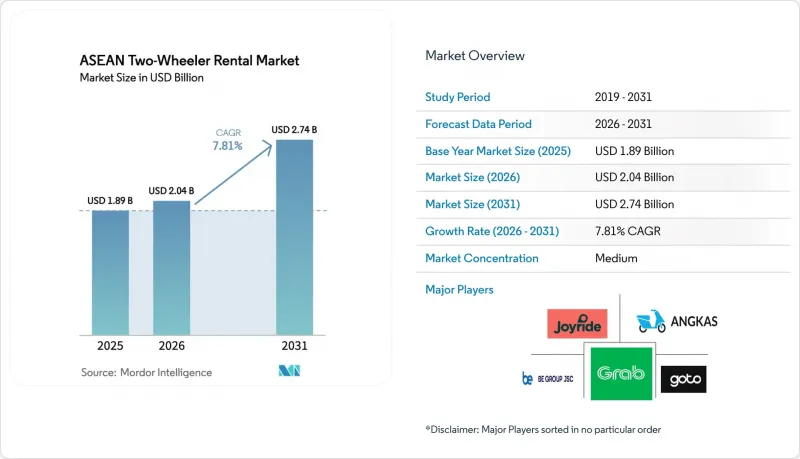
The ASEAN Two-Wheeler Rental Market size was valued at USD 1.89 billion in 2025 and is estimated to grow from USD 2.04 billion in 2026 to reach USD 2.74 billion by 2031, at a CAGR of 7.81% during the forecast period (2026-2031).
A rapid shift from ownership to access-based mobility is underway as super-apps embed rental buttons beside ride-hailing, while city-level bans on internal-combustion motorcycles accelerate electrification. Tourism arrivals across Southeast Asia have already exceeded pre-pandemic levels, reviving short-term rental demand in Bali, Phuket, and Boracay. At the same time, chronic traffic congestion in Jakarta, Bangkok, and Metro Manila pushes commuters toward cost-efficient scooters that slip through gridlock faster than cars. Battery-swap networks now allow drivers to exchange depleted packs in under a minute, cutting downtime and lifting daily trip counts by 30-40%. Consolidation is accelerating: Grab, GoTo, and Xanh SM all use embedded microlending to lock in riders, while OEMs such as VinFast and Gogoro enter the rental arena and underprice smaller shops by leveraging manufacturing scale.
ASEAN Two-Wheeler Rental Market Trends and Insights
Tourism-Led Demand Rebound Post-COVID
International arrivals surpassed 2019 levels in 2025, reigniting scooter demand in beach and island destinations. Bali's motorcycle rentals recovered to pre-pandemic volumes at daily rates of 50,000-150,000 IDR (USD 3.10-9.30), while Phuket operators charge 400-1,800 THB (USD 11-50) per day. Vietnam welcomed 17.5 million visitors in 2024, spurring fleet expansions of 25-30% in Da Nang and Nha Trang. Operators add electric scooters to appeal to eco-minded travelers, as seen in Grab Thailand's 2024 EV rollout across five cities. Average rental length is stretching from three to six days, boosting revenue per unit and stabilizing offseason cash flow.
Urban Congestion Drives Cost-Effective Commuting
Bangkok commuters lose 61 hours annually in traffic, Manila's gridlock costs USD 3.5 billion each year, and Jakarta's average commute exceeds 90 minutes. Ride-hailing motorcycle trips in Indonesia jumped 13% to 9 billion in 2024, with many gig workers shifting to rental plans to avoid upfront purchases. Ho Chi Minh City's 7 million-plus motorcycles underscore how dense fleets still beat cars in point-to-point speed. Corporate subsidies for delivery riders shrink monthly rental costs by 15-20%, making subscriptions attractive. Xanh SM's revenue-share model lets drivers keep 80% of fares, pushing their monthly income target above USD 700. These economics cement the ASEAN two-wheeler rental market as a critical pillar of last-mile logistics.
High Accident and Insurance Premiums
Motorcycles cause 43% of ASEAN road deaths, with Indonesia logging 26,000 fatalities in 2024 and Vietnam 10,500, forcing insurers to raise premiums 15-20% on risky corridors. Thailand saw 15,000 motorcycle deaths in 2024, leading insurers to add 5-10 THB per-trip surcharges that cut rental margins by up to 12%. Helmet use below 50% in rural Philippines magnifies claims, says the Asian Development Bank. Operators deploy telematics from DRVR to monitor behavior, cutting theft by 20% and fuel by 26% but also letting underwriters price risk driver-by-driver. This granular pricing can exclude high-risk, low-income riders, undercutting the inclusivity promise of embedded finance.
Other drivers and restraints analyzed in the detailed report include:
- Super-Apps Integrate Two-Wheeler Rentals
- Battery-Swap Ecosystems Slash EV Downtime
- Regulatory Patchwork Across ASEAN
For complete list of drivers and restraints, kindly check the Table Of Contents.
Segment Analysis
Scooters and mopeds accounted for 58.16% of revenue in 2025, yet electric models will post 14.92% annual growth, nearly double the ASEAN two-wheeler rental market CAGR. Internal-combustion bikes still cost less up front, but battery-swap savings and looming urban bans are pushing operators to electrify fleets quickly. Motorcycles above 150 cc remain popular for hillier tourist zones, though their 41.84% share is slipping. Grab added 8,500 electric units in Indonesia, targeting 14,000 by 2026, while VinFast plans Indonesian showrooms by mid-2026. OEM-backed platforms undercut stand-alone shops, tightening margins across the ASEAN two-wheeler rental industry.
Electric scooters commanded 62% of the ASEAN two-wheeler rental market size for scooters in 2025 and are forecast to reach 75% by 2031. Their maintenance costs are 25% below those of petrol peers, and battery-swap uptime boosts daily revenue per vehicle by roughly 35%. Operators without capital for fleet replacement risk losing share once city-level ICE bans bite, making financing partnerships critical.
Short-term products, mostly daily rentals to tourists, contributed 64.08% of revenue in 2025. However, long-term subscriptions are expanding at 11.03%, as gig riders prefer predictable weekly or monthly fees that include maintenance, swaps, and insurance. Charged Asia leases e-scooters in Jakarta at 1.2 million IDR (USD 71) per month, with 90% of its 1,500-unit fleet on subscription.
The ASEAN two-wheeler rental market size for subscriptions is projected to climb from USD 0.69 billion in 2026 to USD 1.15 billion by 2031, reflecting a 10.8% CAGR. The lifetime value per bike is 30-40% higher than for ad-hoc hires because utilization gaps shrink and debt service aligns with cash receipts. Platforms with integrated wallets automatically collect dues, slashing default risk.
The ASEAN Two-Wheeler Rental Market Report is Segmented by Vehicle Type (Motorcycles and Scooters/Mopeds), Rental Duration (Short-Term and Long-Term), Application (Tourism and Daily Commuting), End User (Individual Consumers and More), Distribution Mode (Online Platforms and More), and Geography (Indonesia, Malaysia, and More). The Market Forecasts are Provided in Terms of Value (USD) and Volume (Units).
List of Companies Covered in this Report:
- Grab Holdings Ltd.
- GoTo Group (Gojek)
- Angkas Holdings Inc.
- JoyRide Logistics and Transport Inc.
- Move It Philippines
- Be Group JSC
- Xanh SM (GSM JSC)
- Swap Energi Indonesia
- Electrum JV
- STROM EV Co. Ltd.
- Motorvina Co. Ltd.
- Viar Motor Indonesia
- Smoot (Kilats)
- Migo Bike Indonesia
- Beam Mobility Holdings
- GrabRentals Pte Ltd.
- Bird Rides Singapore Pte Ltd.
- TRYKE
- Skoot
Additional Benefits:
- The market estimate (ME) sheet in Excel format
- 3 months of analyst support
TABLE OF CONTENTS
1 Introduction
- 1.1 Study Assumptions and Market Definition
2 Research Methodology
3 Executive Summary
4 Market Landscape
- 4.1 Market Overview
- 4.2 Market Drivers
- 4.2.1 Tourism-Led Demand Rebound Post-COVID
- 4.2.2 Urban Congestion Drives Cost-Effective Commuting
- 4.2.3 Super-Apps Integrate Two-Wheeler Rentals
- 4.2.4 Battery-Swap Ecosystems Slash EV Downtime
- 4.2.5 City-Level ICE Bans Pivot Fleets to E-Scooters
- 4.2.6 Embedded Microlending Unlocks Tier-2 Driver Pool
- 4.3 Market Restraints
- 4.3.1 High Accident and Insurance Premiums
- 4.3.2 Regulatory Patchwork Across ASEAN
- 4.3.3 Non-Standard Batteries Inflate Spare-Part Costs
- 4.3.4 Monsoon-Season Utilization Dips
- 4.4 Value/Supply-Chain Analysis
- 4.5 Regulatory Landscape
- 4.6 Technological Outlook
- 4.7 Porter's Five Forces
- 4.7.1 Threat of New Entrants
- 4.7.2 Bargaining Power of Suppliers
- 4.7.3 Bargaining Power of Buyers
- 4.7.4 Threat of Substitutes
- 4.7.5 Industry Rivalry
5 Market Size and Growth Forecasts (Value (USD) and Volume (Units))
- 5.1 By Vehicle Type
- 5.1.1 Motorcycles
- 5.1.2 Scooters/Mopeds
- 5.2 By Rental Duration
- 5.2.1 Short-Term
- 5.2.2 Long-Term
- 5.3 By Application
- 5.3.1 Tourism
- 5.3.2 Daily Commuting
- 5.4 By End User
- 5.4.1 Individual Consumers
- 5.4.2 Corporate Clients
- 5.4.3 Fleet Operators
- 5.5 By Distribution Mode
- 5.5.1 Online Platforms
- 5.5.2 Offline Rental Agencies
- 5.6 By Geography
- 5.6.1 Indonesia
- 5.6.2 Malaysia
- 5.6.3 Singapore
- 5.6.4 Philippines
- 5.6.5 Thailand
- 5.6.6 Vietnam
- 5.6.7 Myanmar
- 5.6.8 Rest of ASEAN
6 Competitive Landscape
- 6.1 Market Concentration
- 6.2 Strategic Moves
- 6.3 Market Share Analysis
- 6.4 Company Profiles (Includes Global level Overview, Market level overview, Core Segments, Financials as available, Strategic Information, Market Rank/Share for key companies, Products and Services, and Recent Developments)
- 6.4.1 Grab Holdings Ltd.
- 6.4.2 GoTo Group (Gojek)
- 6.4.3 Angkas Holdings Inc.
- 6.4.4 JoyRide Logistics and Transport Inc.
- 6.4.5 Move It Philippines
- 6.4.6 Be Group JSC
- 6.4.7 Xanh SM (GSM JSC)
- 6.4.8 Swap Energi Indonesia
- 6.4.9 Electrum JV
- 6.4.10 STROM EV Co. Ltd.
- 6.4.11 Motorvina Co. Ltd.
- 6.4.12 Viar Motor Indonesia
- 6.4.13 Smoot (Kilats)
- 6.4.14 Migo Bike Indonesia
- 6.4.15 Beam Mobility Holdings
- 6.4.16 GrabRentals Pte Ltd.
- 6.4.17 Bird Rides Singapore Pte Ltd.
- 6.4.18 TRYKE
- 6.4.19 Skoot
7 Market Opportunities and Future Outlook
- 7.1 White-space and Unmet-Need Assessment

