
PUBLISHER: Mordor Intelligence | PRODUCT CODE: 2044013

PUBLISHER: Mordor Intelligence | PRODUCT CODE: 2044013
High-Resistivity Silicon Wafer - Market Share Analysis, Industry Trends & Statistics, Growth Forecasts (2026 - 2031)
The high-resistivity silicon wafer market size is expected to increase from 459.33 million square inches in 2025 to 484.95 million square inches in 2026 and reach 644.39 million square inches by 2031, growing at a CAGR of 5.85% over 2026-2031.
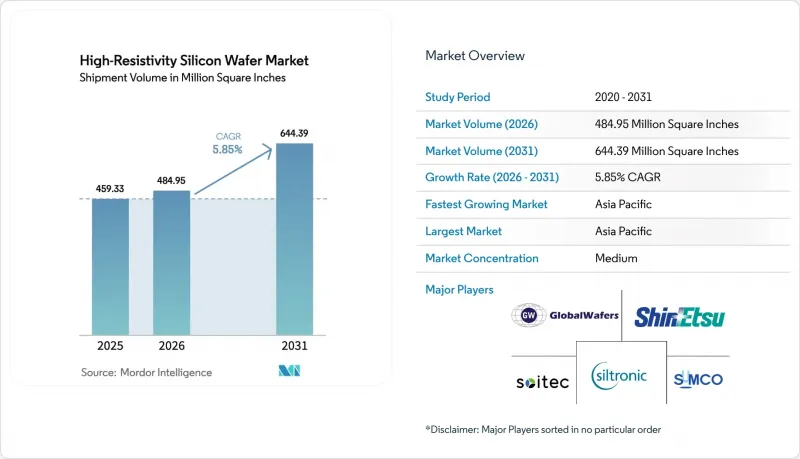
Operators rolling out 5G macro and small-cell sites have locked in multi-year purchases of RF-SOI switches and power amplifiers, guaranteeing baseline demand even as handset unit growth slows. Radar content per car is rising because Level 2+ assistance features are becoming mandatory in Europe and China, and each additional sensor requires substrates with resistivity above 1,000 ohm-cm. Photonic integrated-circuit vendors are now qualifying 300 mm high-resistivity platforms, shifting the wafer mix toward larger diameters. Finally, government incentives in the United States, Europe, and Japan are accelerating domestic capacity additions, cushioning buyers against geopolitical supply shocks.
Global High-Resistivity Silicon Wafer Market Trends and Insights
Growing Adoption of RF SOI in 5G Smartphones
Every 5G handset now ships with RF-SOI front-end circuitry, cementing a structural pull on the high-resistivity silicon wafer market. The trap-rich layer in HR-SOI limits substrate coupling above 2 GHz, letting power amplifiers meet linearity targets without external filters. Component value per phone climbed from USD 1.20 in 2020 to USD 2.10 in 2024, and designers have already reserved 200 mm capacity through 2027. As sub-6 GHz coverage broadens across India, South-East Asia, and South America, wafer demand remains resilient despite plateauing handset units.
Expansion of Automotive Radar Production
The European Union's 2024 safety regulation mandates multiple 77-81 GHz radars per new vehicle, elevating high-resistivity wafer consumption in Europe and North America. Silicon-based radar on HR-SOI delivers 15% lower phase noise than bulk CMOS at 77 GHz, supporting advanced driver-assistance functions. As China's NCAP tightens in 2025, domestic brands are adding corner and rear radar, driving double-digit substrate growth through the decade.
Complexities in Producing Defect-Free 300 mm HR Wafers
Float-zone crystal growth at 300 mm demands stringent thermal control, and initial yields trail 200 mm equivalents by up to 20 percentage points. Epitaxial uniformity within +-2 nm across a 300 mm HR-SOI wafer remains challenging, slowing customer qualifications. The USD 800 million-USD 1.2 billion price tag for a greenfield line deters new entrants, keeping supply tight and inflating spot prices until processes mature.
Other drivers and restraints analyzed in the detailed report include:
- Rising Demand for mmWave Silicon for Satellite Communications
- Integration of Adaptive Beamforming in Phased-Array Antennas
- Price Premium over Conventional Silicon Wafers
For complete list of drivers and restraints, kindly check the Table Of Contents.
Segment Analysis
The 200 mm segment held 54.68% of the high-resistivity silicon wafer market share in 2025, reflecting the installed base of RF-IC fabs built during the 2010s. Leading front-end vendors such as Qorvo and Skyworks continue to run mature 200 mm lines because die sizes for switches and low-noise amplifiers remain small. However, 300 mm fabs promise lower cost per die once yields stabilize, and early adopters saw an 85% yield by late 2025, narrowing the gap with 200 mm processes. Capital costs near USD 1 billion per facility slow the migration, yet the convergence of RF, baseband, and AI accelerators on a single die makes the larger format economically compelling.
Looking forward, the 300 mm segment is expected to grow at a 6.74% rate, gradually eroding the dominance of 200 mm in the high-resistivity silicon wafer market. Automotive radar ICs integrating digital signal processing will be among the first movers because rising channel counts drive die area beyond 120 mm2. While 150 mm substrates linger in legacy military programs, their absolute volumes are shrinking. As yield learning improves and subsidy-backed capacity ramps in Texas, Freiberg, and Gumi, 300 mm economics will turn decisively favorable for high-volume RF devices.
Polished high-resistivity silicon captured 38.86% of the market share in 2025, thanks to imaging sensors and industrial detectors that value low dark current over RF isolation. Epitaxial wafers support power devices and MEMS, where a lightly doped epi-layer offers voltage blocking or mechanical benefits. HR-SOI, however, is forecast to rise at a 6.48% CAGR as 5G, Wi-Fi 7, and phased-array radars demand enhanced linearity. The RFeSI-3 platform reduced harmonic distortion by 2 dB, making HR-SOI indispensable for 26 dBm power amplifiers.
Adoption accelerates as GlobalFoundries, TSMC, and other foundries qualify HR-SOI at 300 mm, effectively doubling usable die per wafer and shrinking cost penalties. The high-resistivity silicon wafer market size for HR-SOI substrates is therefore set to expand more quickly than the total market volume. Supply concentration remains a double-edged sword: Soitec's 60% share offers stable quality but exposes the ecosystem to single-point failures, prompting tier-1 IC houses to dual-source from Shin-Etsu and SUMCO where possible.
The High-Resistivity Silicon Wafer Market Report is Segmented by Wafer Diameter (150 Mm, 200 Mm, and 300 Mm), Wafer Type (Polished, Epitaxial, and HR-SOI), Device Application (RF Front-End Devices, Mmwave and 5G Transceiver ICs, Automotive Radar ICs, and More), End-User (Consumer Electronics, Industrial, Automotive, and More ), and Geography. The Market Forecasts are Provided in Terms of Volume (Square Inches).
Geography Analysis
Asia-Pacific dominated the high-resistivity silicon wafer market with 58.89% market share in 2025, and is projected to grow at 6.98% through 2031. Japan's Shin-Etsu and SUMCO jointly supply half the world's float-zone capacity, while Taiwan's fabless RF community converts those substrates into power amplifiers exported globally. China is investing aggressively to localize float-zone production, reducing import dependence and offering wafers 20-30% cheaper than Japanese equivalents. South Korea's SK Siltron is ramping 300 mm qualification to serve automotive radar suppliers seeking geographic diversity.
North America is adding capacity faster than historical trends because the CHIPS Act covers up to 40% of capital expenditures for specialty wafer plants. GlobalWafers broke ground in Texas with USD 400 million in federal grants, and first wafers are slated for 2027. These new lines will prioritize 300 mm HR-SOI for domestic RF-IC and automotive markets, shortening lead times and mitigating trade risks. Europe follows a similar path; Siltronic's Freiberg expansion, backed by EUR 300 million (USD 325 million) in subsidies, positions the region to support its automotive radar ecosystem without relying solely on imports.
South America and the Middle East and Africa remain nascent consumers, but policy initiatives could unlock incremental demand. Brazil's initial 5G rollout is importing RF front-ends that incorporate high-resistivity silicon, while the United Arab Emirates is studying a greenfield fab that would include specialty wafer capability. African uptake is negligible today, yet South Africa's automotive sector is narrowing technology gaps that will eventually require radar ICs and, by extension, HR substrates. Although these regions contribute minimally before 2031, they represent diversification options in the next decade.
- Shin-Etsu Handotai Co., Ltd.
- SUMCO Corporation
- Siltronic AG
- GlobalWafers Co., Ltd.
- Soitec S.A.
- Okmetic Oyj
- Wafer Works Corp.
- SK Siltron Co., Ltd.
- Zhejiang Ferrotec Semiconductor Co., Ltd.
- Addison Engineering, Inc.
- Topsil Semiconductor Materials A/S
- SINO-American Silicon Products Inc.
- Wafer World Inc.
- Virginia Semiconductor, Inc.
- Shanghai Simgui Technology Co., Ltd.
- Nova Electronic Materials, LLC
- Ferrotec Holdings Corporation
- pSemi Corporation
Additional Benefits:
- The market estimate (ME) sheet in Excel format
- 3 months of analyst support
TABLE OF CONTENTS
1 INTRODUCTION
- 1.1 Study Assumptions and Market Definition
- 1.2 Scope of the Study
2 RESEARCH METHODOLOGY
3 EXECUTIVE SUMMARY
4 MARKET LANDSCAPE
- 4.1 Market Overview
- 4.2 Market Drivers
- 4.2.1 Growing Adoption of RF SOI in 5G Smartphones
- 4.2.2 Expansion of Automotive Radar Production
- 4.2.3 Rising Demand for mmWave Silicon for Satellite Communications
- 4.2.4 Integration of Adaptive Beamforming in Phased-Array Antennas
- 4.2.5 Development of Photonic ICs on High-Resistivity Substrates
- 4.2.6 Government Incentives for On-shore Semiconductor Manufacturing
- 4.3 Market Restraints
- 4.3.1 Complexities in Producing Defect-Free 300 mm HR Wafers
- 4.3.2 Price Premium over Conventional Silicon Wafers
- 4.3.3 Supply Constraints of Ultra-High-Purity Float-Zone Silicon
- 4.3.4 Emerging GaN and SiC Substrates for RF and Power Devices
- 4.4 Industry Supply-Chain Analysis
- 4.5 Regulatory Landscape
- 4.6 Technological Outlook
- 4.7 Impact of Macroeconomic Factors on the Market
- 4.8 Porter's Five Forces Analysis
- 4.8.1 Threat of New Entrants
- 4.8.2 Bargaining Power of Suppliers
- 4.8.3 Bargaining Power of Buyers
- 4.8.4 Threat of Substitutes
- 4.8.5 Intensity of Competitive Rivalry
5 MARKET SIZE AND GROWTH FORECASTS (VOLUME)
- 5.1 By Wafer Diameter
- 5.1.1 150 mm
- 5.1.2 200 mm
- 5.1.3 300 mm
- 5.2 By Wafer Type
- 5.2.1 Polished High-Resistivity Silicon
- 5.2.2 Epitaxial High-Resistivity Silicon
- 5.2.3 High-Resistivity Silicon-on-Insulator (HR-SOI)
- 5.3 By Device Application
- 5.3.1 RF Front-End Devices (PA, Switches, LNAs)
- 5.3.2 mmWave and 5G Transceiver ICs
- 5.3.3 Automotive Radar ICs (77-81 GHz)
- 5.3.4 Photodetectors and Imaging Devices
- 5.3.5 MEMS and Advanced Sensor ICs
- 5.4 By End-user
- 5.4.1 Consumer Electronics
- 5.4.2 Industrial
- 5.4.3 Telecommunications
- 5.4.4 Automotive
- 5.4.5 Other End-user Applications
- 5.5 By Geography
- 5.5.1 North America
- 5.5.1.1 United States
- 5.5.1.2 Canada
- 5.5.1.3 Mexico
- 5.5.2 Europe
- 5.5.2.1 Germany
- 5.5.2.2 United Kingdom
- 5.5.2.3 France
- 5.5.2.4 Rest of Europe
- 5.5.3 Asia-Pacific
- 5.5.3.1 China
- 5.5.3.2 Japan
- 5.5.3.3 India
- 5.5.3.4 South Korea
- 5.5.3.5 Rest of Asia-Pacific
- 5.5.4 South America
- 5.5.5 Middle East and Africa
- 5.5.1 North America
6 COMPETITIVE LANDSCAPE
- 6.1 Market Concentration
- 6.2 Strategic Moves
- 6.3 Market Share Analysis
- 6.4 Company Profiles (includes Global level Overview, Market Level Overview, Core Segments, Financials as Available, Strategic Information, Market Rank/Share for Key Companies, Products and Services, and Recent Developments)
- 6.4.1 Shin-Etsu Handotai Co., Ltd.
- 6.4.2 SUMCO Corporation
- 6.4.3 Siltronic AG
- 6.4.4 GlobalWafers Co., Ltd.
- 6.4.5 Soitec S.A.
- 6.4.6 Okmetic Oyj
- 6.4.7 Wafer Works Corp.
- 6.4.8 SK Siltron Co., Ltd.
- 6.4.9 Zhejiang Ferrotec Semiconductor Co., Ltd.
- 6.4.10 Addison Engineering, Inc.
- 6.4.11 Topsil Semiconductor Materials A/S
- 6.4.12 SINO-American Silicon Products Inc.
- 6.4.13 Wafer World Inc.
- 6.4.14 Virginia Semiconductor, Inc.
- 6.4.15 Shanghai Simgui Technology Co., Ltd.
- 6.4.16 Nova Electronic Materials, LLC
- 6.4.17 Ferrotec Holdings Corporation
- 6.4.18 pSemi Corporation
7 MARKET OPPORTUNITIES AND FUTURE OUTLOOK
- 7.1 White-space and Unmet-Need Assessment

