
PUBLISHER: Mordor Intelligence | PRODUCT CODE: 2044060

PUBLISHER: Mordor Intelligence | PRODUCT CODE: 2044060
Houston Data Center - Market Share Analysis, Industry Trends & Statistics, Growth Forecasts (2026 - 2032)
The Houston data center market size was valued at 800.10 MW in 2025 and estimated to grow from 819.62 MW in 2026 to reach 946.99 MW by 2032, at a CAGR of 2.44% during the forecast period (2026-2032).
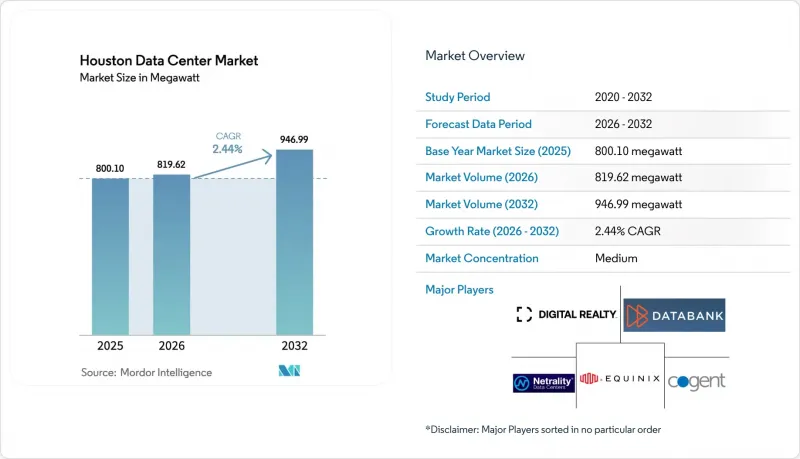
CenterPoint Energy's interconnection queue jumped from 1 GW to 8 GW in less than one year, signaling demand that already dwarfs installed capacity and pointing to a potential 50% rise in electric load across Houston by 2031.
Mega facilities held the dominant 38.4% share of the Houston data center market in 2024, yet Massive facilities are advancing fastest at 10.2% CAGR as both hyperscale and energy-sector HPC projects consolidate into fewer, larger campuses. Market differentiation stems from the city's 3,600-plus energy organizations that require edge sites for digital-twin analytics, specialized cooling, and elevated power density, all of which separate Houston from traditional hyperscale-centric metros. Competitive intensity is heightening: hyperscale newcomers such as Google invested more than USD 1 billion statewide in 2024 alone, even as established energy-focused operators race to lock in land and power, particularly in West Houston, where land costs jumped 20-25% since 2024.
Houston Data Center Market Trends and Insights
Fast-growing Edge-Compute Demand from Oil and Gas Digital Twins
Energy operators are redesigning field architecture around real-time digital-twin analytics that require placing compute nodes close to wells, refineries, and pipelines. Texmark Chemicals' IoT deployment demonstrated that relocating analytics to the edge lets technicians pre-empt equipment failure and save tens of millions annually through optimized maintenance. ExxonMobil and Halliburton are pursuing subsea fiber and edge-HPC builds to stream sensor data back to Houston with sub-10 ms latency, reinforcing the city's role as an industrial analytics nerve center . High-density GPU clusters needed for reservoir modeling raised hardware outlays by roughly 15-20% since 2024, yet operators still prioritize these deployments because each avoided hour of downtime can exceed USD 100,000. The clustering effect of 3,600-plus energy entities allows vendors to pool edge resources, further accelerating Houston data center market growth.
Influx of Hyperscale Cloud Campuses (AWS, Google, Microsoft)
Google's USD 1 billion Texas build combined with a 375 MW solar PPA from Houston-based Engie paved the way for similar moves by Microsoft and AWS, confirming that hyperscale capital is now firmly aimed at the Houston data center market. Long equipment lead times-electrical switchgear can take up to 24 months-are forcing providers to pre-order gear, inflating cost baselines by USD 200-300 per kW. CyrusOne answered with a USD 12 billion sustainability-linked debt program earmarked for large-scale Texas sites. Hyperscale builders now pay premiums for plots that guarantee immediate power and future substation expansion, a trend expected to keep West Houston land prices climbing.
Rising Power-Grid Congestion in West Houston
ERCOT congestion charges ballooned five-fold between 2016 and 2022, reflecting transmission bottlenecks that add USD 10-15 per MWh to spot prices in West Houston CenterPoint invested USD 285 million on the Brazos Valley Connection line, but its own forecast shows a 50% load surge by 2031, indicating that line additions will trail demand. Prefabricated substation packages now cost 30% more than in 2024 due to commodity inflation, limiting rapid power roll-outs. These dynamics make power the gating factor on campus scale rather than land or fiber, constraining near-term Houston data center market growth in the west.
Other drivers and restraints analyzed in the detailed report include:
- ERCOT Renewable PPAs Unlocking Green-Powered Capacity
- Tax Incentives Under Texas JETI Act
- Hurricane and Flood-Zone Insurance Cost Premiums
For complete list of drivers and restraints, kindly check the Table Of Contents.
Segment Analysis
Mega campuses commanded 37.95% of 2025 installed power, underscoring a pivot toward large contiguous footprints that accommodate multi-tenant hyperscale halls and energy-sector HPC cages. Massive campuses, however, surface as the volume story, advancing at 9.65% CAGR thanks to efficiencies that cut unitary OPEX by roughly 15% compared with standalone Mega builds. The Houston data center market size for Massive facilities is projected to surpass 42.3 MW by 2032, and Data Foundry's 60 MW Houston 2 campus illustrates how high-density racks (>=50 kW) coupled with 185 mph wind-rated envelopes entice petrochemical users seeking flood resilience. Land scarcity downtown pushes operators to suburban mega-sites where lower real-estate cost offsets higher transmission-upgrade spend. Medium and Small footprints serve edge hubs near refineries, but their Houston data center market share is expected to decline as digital-twin workloads consolidate into central locations that offer advanced liquid cooling.
Second-tier campuses function as testbeds for new vendors gauging Houston demand before leveling up to Massive investments. Skybox Houston I, a Large-class campus on a 20-acre private tract with 300 MVA potential, typifies the step-up model favored by energy clients anxious for bespoke security. Construction-material inflation lifted chilled-water plant costs by USD 300-400 per kW since 2024, yet operators still green-light these builds because each new 10 MW hall can absorb a single cloud anchor. Over the forecast period, Massive facilities are likely to secure the highest Houston data center market share gains as hyperscalers co-locate AI training clusters with energy-industry partners.
The Houston Data Center Market Report is Segmented by Data Center Size (Small, Medium, Large, Mega, Massive), Tier Standard (Tier I and II, Tier III, Tier IV), Absorption (Non-Utilized, Utilized), and by Hotspot. The Market Forecasts are Provided in Terms of Volume (MW).
List of Companies Covered in this Report:
- Netrality Data Centers
- Data Foundry, Inc. (Data Foundry, LLC)
- DataBank Holdings Ltd.
- Equinix Inc.
- Quasar Data Center, Ltd.
- TRG Datacenters
- Digital Realty Trust Inc.
- LOGIX Communications, L.P.
- Lumen Technologies
- Cogent Communications Holdings, Inc.
- Navisite, Inc. (Navisite LLC)
- Fibertown Data Center
- Enzu Inc.
- Crown Castle Inc.
- Serverfarm LLC
Additional Benefits:
- The market estimate (ME) sheet in Excel format
- 3 months of analyst support
TABLE OF CONTENTS
1 INTRODUCTION
- 1.1 Study Assumptions and Market Definition
- 1.2 Scope of the Study
- 1.3 Study Methodology
2 RESEARCH METHODOLOGY
3 EXECUTIVE SUMMARY
4 MARKET LANDSCAPE
- 4.1 Market Overview
- 4.2 Market Drivers
- 4.2.1 Fast-growing edge-compute demand from Oil and Gas digital twins
- 4.2.2 Influx of hyperscale cloud campuses (AWS, Google, Microsoft)
- 4.2.3 5G private-network roll-outs at Port Houston and airports
- 4.2.4 ERCOT renewable PPAs unlocking green-powered capacity
- 4.2.5 Tax incentives under Texas Chapter 313 replacement programs
- 4.2.6 Low-latency financial-trading corridors to Mexico and LATAM
- 4.3 Market Restraints
- 4.3.1 Rising power-grid congestion in West Houston
- 4.3.2 Hurricane and flood-zone insurance cost premiums
- 4.3.3 Talent scarcity for high-density liquid-cooling operations
- 4.3.4 Water-use restrictions during Gulf-Coast drought periods
- 4.4 Value / Supply-Chain Analysis
- 4.5 Regulatory Landscape
- 4.6 Technological Outlook
5 MARKET SIZE and GROWTH FORECASTS (MW)
- 5.1 By Data Center Size
- 5.1.1 Small
- 5.1.2 Medium
- 5.1.3 Large
- 5.1.4 Mega
- 5.1.5 Massive
- 5.2 By Tier Standard
- 5.2.1 Tier I and II
- 5.2.2 Tier III
- 5.2.3 Tier IV
- 5.3 By Absorption
- 5.3.1 Non-Utilised
- 5.3.2 Utilised
- 5.3.2.1 By Colocation Type
- 5.3.2.1.1 Hyperscale
- 5.3.2.1.2 Retail
- 5.3.2.1.3 Wholesale
- 5.3.2.2 By End-User Industry
- 5.3.2.2.1 BFSI
- 5.3.2.2.2 Cloud Service Providers
- 5.3.2.2.3 E-Commerce
- 5.3.2.2.4 Government
- 5.3.2.2.5 Manufacturing
- 5.3.2.2.6 Media and Entertainment
- 5.3.2.2.7 Telecom
- 5.3.2.2.8 Other End Users
- 5.3.2.1 By Colocation Type
- 5.4 By Hotspot
- 5.4.1 Downtown CBD
- 5.4.2 West Houston (Katy)
- 5.4.3 Rest of Houston
6 COMPETITIVE LANDSCAPE
- 6.1 Market Share Analysis
- 6.2 Company Profiles (includes Global level Overview, Market level overview, Core Segments, Financials as available, Strategic Information, Market Rank/Share for key companies, Products and Services, and Recent Developments)
- 6.2.1 Netrality Data Centers
- 6.2.2 Data Foundry, Inc. (Data Foundry, LLC)
- 6.2.3 DataBank Holdings Ltd.
- 6.2.4 Equinix Inc.
- 6.2.5 Quasar Data Center, Ltd.
- 6.2.6 TRG Datacenters
- 6.2.7 Digital Realty Trust Inc.
- 6.2.8 LOGIX Communications, L.P.
- 6.2.9 Lumen Technologies
- 6.2.10 Cogent Communications Holdings, Inc.
- 6.2.11 Navisite, Inc. (Navisite LLC)
- 6.2.12 Fibertown Data Center
- 6.2.13 Enzu Inc.
- 6.2.14 Crown Castle Inc.
- 6.2.15 Serverfarm LLC
7 MARKET OPPORTUNITIES and FUTURE OUTLOOK
- 7.1 White-Space and Unmet-Need Assessment

