
PUBLISHER: Mordor Intelligence | PRODUCT CODE: 2044249

PUBLISHER: Mordor Intelligence | PRODUCT CODE: 2044249
France Adhesives - Market Share Analysis, Industry Trends & Statistics, Growth Forecasts (2026 - 2031)
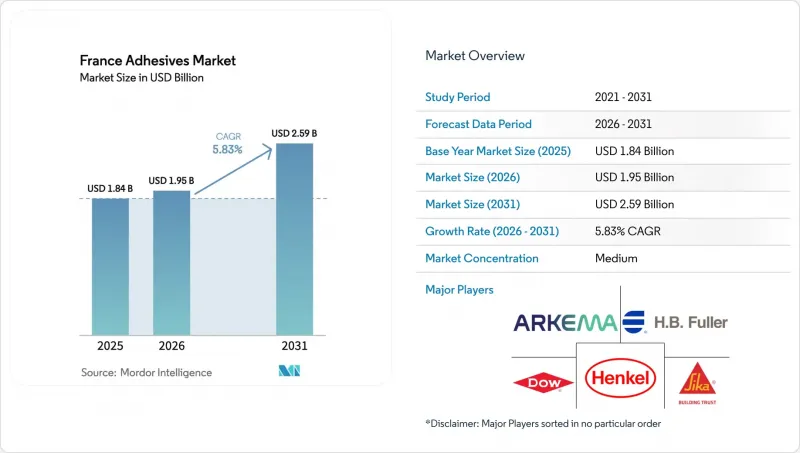
The France Adhesives Market size is projected to be USD 1.84 billion in 2025, USD 1.95 billion in 2026, and reach USD 2.59 billion by 2031, growing at a CAGR of 5.83% from 2026 to 2031. The France adhesives market is riding a renovation-led construction rebound, accelerating substitution toward water-borne and bio-based chemistries that comply with REACH and RE2020 mandates while buffering the hit from a 60-year low in domestic vehicle production. Volume growth is strongest in thermal-insulation tapes, tile adhesives, and structural glazing sealants used in the nation's EUR 32.2 billion energy-retrofit pipeline, yet raw-material inflation and titanium-dioxide costs remain 70% higher than pre-2020, keeping margins tight. At the same time, electric-vehicle (EV) assembly lines are pulling demand toward high-performance epoxy and polyurethane bonds that cut weight and extend battery range, with an average EV already using nearly 8 lb of adhesives and sealants in its battery pack and motor interfaces. Competitive intensity is rising as global strategics execute bolt-on deals. Arkema bought Dow's packaging-lamination line in December 2024, and Henkel signed to acquire ATP in January 2026, to lock in low-VOC portfolios and deeper access to renovation projects.
France Adhesives Market Trends and Insights
Renovation and Energy-Efficiency Construction Demand
Energy-retrofit incentives, led by MaPrimeRenov', disbursed EUR 1.95 billion to 505,126 projects in 2023 and generated EUR 32.2 billion of cumulative works between 2020 and mid-2024, driving sustained pull for low-VOC sealants, airtightness tapes, and bio-based panel adhesives. Embodied-carbon caps under RE2020 are tightening from 640 kg CO2e/m2 in 2022 to 415 kg CO2e/m2 by 2031, pushing formulators to swap UF and phenolic resins for bio-sourced alternatives. Continuous-insulation systems using 160 mm mineral wool, prefabricated CLT walls, and vapor-barrier membranes all rely on adhesives with superior freeze-thaw stability and low emissions. Funding from Certificats d'Economies d'Energie hit EUR 4.15 billion in 2024, further accelerating retrofit activity. Factory-built elements already cut on-site waste by roughly 30%, increasing demand for fast-curing panel bonds that keep assembly lines moving.
Automotive Lightweighting and EV Assembly Needs
Electric-vehicle programs depend on structural epoxy and polyurethane adhesives that distribute loads, bond dissimilar metals to composites, and survive 180-250°C paint-bake cycles. Stellantis invested over USD 40 million in a Turin battery technology center aiming to halve battery weight by 2030, a goal linked directly to replacing rivets and welds with adhesives that avoid brittle intermetallics. Hybrid joints, adhesive plus rivet, are becoming the new norm in battery housings, providing peel resistance plus sealing. Although France's vehicle output slumped to a six-decade low in 2024, the long-run shift to EVs is expected to restore volume. Short-run softness in automotive trim and interior adhesives, down 4.5% in 2024, masks a structural upswing in high-value battery applications primed to lift the France Adhesives market over the forecast horizon.
REACH Tightening on Isocyanates and Solvents
Since August 24, 2023, industrial use of polyurethane adhesives with more than 0.1% free diisocyanate requires certified worker training, documentation, and periodic renewals. Small converters shoulder disproportionate compliance costs as they retrofit lines or reformulate into "micro-emission" grades. Reformulations often span a full year, delaying product launches and tying up research and development budgets. The rule covers MDI, TDI, HDI, and IPDI across structural, flooring, and flexible-packaging segments. Although ECHA forecasts 3,000 fewer asthma cases annually, near-term disruption clips volume growth in the France Adhesives market until exempt blends gain scale.
Other drivers and restraints analyzed in the detailed report include:
- Rising Demand for Water-Borne/Low-VOC Systems
- EU Green-Taxonomy Incentives for Bio-Based Formulas
- Escalating Compliance Cost for SME Converters
For complete list of drivers and restraints, kindly check the Table Of Contents.
Segment Analysis
Water-borne platforms retained the largest 44.68% France adhesives market share in 2025 due to their compliance with VOC legislation and compatibility with cementitious substrates in tile adhesives and paper lamination. Hot-melt systems are forecast to expand at a 6.74% CAGR, lifting their slice of the France Adhesives market size as packaging lines invest in fast-setting, pressure-sensitive grades that reduce clamp time and energy use. Demand for ultra-low-monomer polyurethane hot melts is rising in flexible food packaging because they meet 0.1% isocyanate thresholds without curing delays. On the commodity end, water-borne acrylics cover bookbinding, labeling, and interior wood panels where E0 emissions rules apply. Reactive epoxies and polyurethanes occupy structural niches, EV battery packs, wind turbine blades, and aircraft interiors, where lap-shear strengths of 20-35 MPa justify premium pricing.
Hot-melt suppliers are deepening vertical ties with equipment OEMs so converters can run at line speeds above 400 m/min, critical for e-commerce corrugated plants upgrading box-on-demand cells. Water-borne formulators invest in high-solid dispersion tech that boosts solids to 65% without viscosity spikes, improving coat-weight economics. UV-cured volumes, though niche, post double-digit growth in electronics and medical devices where sub-second cure avoids thermal stress. Solvent-borne usage continues to shrink as converters phase out toluene carriers in shoe and furniture lines. Combined, technology shifts underpin medium-term upswing in the France adhesives market despite cyclical bumps.
The France Adhesives Market Report is Segmented by Technology (Water-Borne, Solvent-Borne, Reactive, Hot Melt, and UV Cured Adhesives), Resin (Polyurethane, Epoxy, Acrylic, Cyanoacrylate, VAE/EVA, Silicone, and Other Resins), and End-User Industry (Building and Construction, Packaging, Automotive, Aerospace, Woodworking and Joinery, Footwear, Healthcare, and More). The Market Forecasts are Provided in Terms of Value (USD).
List of Companies Covered in this Report:
- 3M
- Arkema
- Avery Dennison Corporation
- Bolton Adhesives
- Dow
- H.B. Fuller Company
- Henkel AG & Co. KGaA
- Huntsman International LLC
- MAPEI S.p.A.
- Sika AG
- ADERIS Specialities
- ITW Performance Polymers
- Wacker Chemie AG
- BASF SE
- Dymax Corporation
- Parker Hannifin Corp
- KLEIBERIT SE & CO. KG
- RAMSA France
- Pidilite Industries Ltd.
Additional Benefits:
- The market estimate (ME) sheet in Excel format
- 3 months of analyst support
TABLE OF CONTENTS
1 Introduction
- 1.1 Study Assumptions and Market Definition
- 1.2 Scope of the Study
2 Research Methodology
3 Executive Summary
4 Market Landscape
- 4.1 Market Overview
- 4.2 Market Drivers
- 4.2.1 Renovation and energy-efficiency construction demand
- 4.2.2 Automotive lightweighting and EV assembly needs
- 4.2.3 Rising demand for water-borne/low-VOC systems
- 4.2.4 EU green-taxonomy incentives for bio-based formulas
- 4.2.5 Paris-2024 retrofits and heritage-building restorations
- 4.3 Market Restraints
- 4.3.1 REACH tightening on isocyanates and solvents
- 4.3.2 Escalating compliance cost for SME converters
- 4.3.3 Laser-welding substitution in selected auto parts
- 4.4 Value Chain Analysis
- 4.5 Porter's Five Forces
- 4.5.1 Threat of New Entrants
- 4.5.2 Bargaining Power of Suppliers
- 4.5.3 Bargaining Power of Buyers
- 4.5.4 Threat of Substitutes
- 4.5.5 Competitive Rivalry
5 Market Size and Growth Forecasts (Value)
- 5.1 By Technology
- 5.1.1 Water-borne
- 5.1.2 Solvent-borne
- 5.1.3 Reactive
- 5.1.4 Hot Melt
- 5.1.5 UV Cured Adhesives
- 5.2 By Resin
- 5.2.1 Polyurethane
- 5.2.2 Epoxy
- 5.2.3 Acrylic
- 5.2.4 Cyanoacrylate
- 5.2.5 VAE/EVA
- 5.2.6 Silicone
- 5.2.7 Other Resins
- 5.3 By End-user Industry
- 5.3.1 Building and Construction
- 5.3.2 Packaging
- 5.3.3 Automotive
- 5.3.4 Aerospace
- 5.3.5 Woodworking and Joinery
- 5.3.6 Footwear
- 5.3.7 Healthcare
- 5.3.8 Other End-user Industries
6 Competitive Landscape
- 6.1 Market Concentration
- 6.2 Strategic Moves
- 6.3 Market Share(%)/Ranking Analysis
- 6.4 Company Profiles (includes Global Overview, Market Overview, Core Segments, Financials, Strategic Information, Products and Services, Recent Developments)
- 6.4.1 3M
- 6.4.2 Arkema
- 6.4.3 Avery Dennison Corporation
- 6.4.4 Bolton Adhesives
- 6.4.5 Dow
- 6.4.6 H.B. Fuller Company
- 6.4.7 Henkel AG & Co. KGaA
- 6.4.8 Huntsman International LLC
- 6.4.9 MAPEI S.p.A.
- 6.4.10 Sika AG
- 6.4.11 ADERIS Specialities
- 6.4.12 ITW Performance Polymers
- 6.4.13 Wacker Chemie AG
- 6.4.14 BASF SE
- 6.4.15 Dymax Corporation
- 6.4.16 Parker Hannifin Corp
- 6.4.17 KLEIBERIT SE & CO. KG
- 6.4.18 RAMSA France
- 6.4.19 Pidilite Industries Ltd.
7 Market Opportunities and Future Outlook
- 7.1 White-space and Unmet-Need Assessment

