
PUBLISHER: Mordor Intelligence | PRODUCT CODE: 2044256

PUBLISHER: Mordor Intelligence | PRODUCT CODE: 2044256
Spain Adhesives - Market Share Analysis, Industry Trends & Statistics, Growth Forecasts (2026 - 2031)
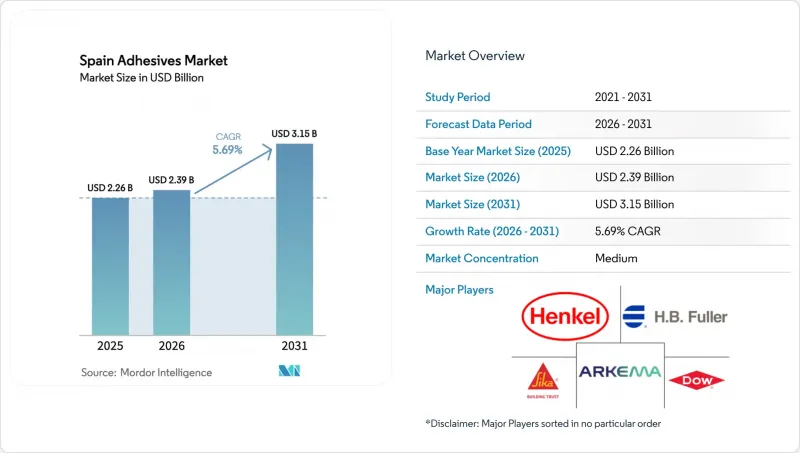
The Spain Adhesives Market size was valued at USD 2.26 billion in 2025 and is estimated to grow from USD 2.39 billion in 2026 to reach USD 3.15 billion by 2031, at a CAGR of 5.69% during the forecast period (2026-2031). Spain's construction retrofits, fast-growing EV battery plants, and sweeping EU VOC caps are steering demand toward water-borne emulsions, reactive hybrids, and next-generation hot melts. Builders specifying thicker insulation and airtight membranes need breathable yet durable bonding agents, lifting consumption of polyurethane foams and MS-polymer sealants relative to solvent systems. Automotive manufacturers are shifting to structural and thermal adhesives for cell-to-pack architecture, while packaging converters automate linerless labels that rely on low-temperature hot melts. Multinational suppliers dominate, but regional specialists defend share by customizing formulations for Spain's diverse climate zones and tight repair-and-maintenance cycles. Feedstock volatility, labor shortages in structural bonding, and the emergence of plasma bonding in footwear temper the long-term outlook, yet the overall Spain adhesives market retains healthy momentum toward mid-decade.
Spain Adhesives Market Trends and Insights
Rising Residential Renovation and Green-Build Mandates
Spain's PNRE 2026 roadmap obliges residential buildings to trim primary energy use 16% below 2020 levels by 2030, triggering an upswing in internal insulation bonded with vapor-open MS-polymer and dispersion adhesives. Heritage properties that cannot receive external insulation now favor capillary-active systems, widening the addressable base for breathable adhesive chemistries. Digital Product Passports, phased in from 2026, demand batch-level traceability and LCA data, rewarding suppliers with ISO 14025 EPD credentials. Insurers are discouraging combustible spray foams after facade fire incidents, further tilting preference toward mineral-wool panels fixed with low-VOC water-borne adhesives. Together, these forces underpin steady growth for the Spain adhesives market in residential retrofits.
Automotive Lightweighting and EV Shift
PowerCo's 40 GWh gigafactory in Sagunto will start output in 2026 and feed unified prismatic cells to SEAT Martorell's cell-to-pack lines, where structural adhesives, thermal interface materials, and potting compounds replace 100 fasteners per pack. Adhesive formulations must combine low outgassing, high thermal conductivity, and robotic dispensability under clean-room protocols. Henkel's AI-assisted battery labs shorten debonding-solution development for end-of-life recovery, aligning with Spain's circular-economy policies. The Stellantis/CATL plan for a 50 GWh LFP plant in Zaragoza adds a second demand node, concentrating Spain adhesives market opportunities along the Valencia-Zaragoza corridor.
Volatile Petrochemical Feedstock Prices
Acrylates, styrene, EVA, and polyurethane polyols track Brent crude, which climbed in the low single digits during 2025 and faces upside risk in 2026. Spain imports most intermediates, exposing formulators to EUR/USD swings and Mediterranean refinery outages. Smaller firms such as QS Adhesives lack hedging muscle and must pass costs to footwear and furniture OEMs that already battle Asian competition. Bio-based mass-balance inputs cushion exposure but carry 10-20% premiums, squeezing margins across the Spain adhesives market.
Other drivers and restraints analyzed in the detailed report include:
- EU Push Toward Low-VOC, Water-Borne Chemistries
- Wind-Turbine Blade Clusters in Aragon and Navarre
- Stringent VOC Limits for Solvent-Borne Systems
For complete list of drivers and restraints, kindly check the Table Of Contents.
Segment Analysis
Water-borne systems accounted for 43.44% of the Spain adhesives market in 2025 as EU VOC rules favored emulsions in construction and packaging. Hot melts are projected to register a 6.26% CAGR to 2031, reflecting linerless label automation and footwear's pivot from solvent contact cements. Henkel's EUR 20 million Bopfingen upgrade adds capacity for sustainable polyolefin hot melts, and Ravenwood's Com500 coaters rely exclusively on dedicated hot-melt PSAs. The Spain adhesives market size for hot melts could exceed USD 920 million by 2031 if adoption rates match current purchase commitments.
Solvent-borne share keeps eroding under Royal Decree 117/2003 caps, while reactive adhesives - epoxy, polyurethane, cyanoacrylate - retain high-value niches in aerospace and EV batteries. Henkel's new Montornes hub supplies structural epoxies to Airbus, and dual-cure UV/hot-melt systems gain traction in interior automotive trim. UV-cure volumes remain small but double-digit growth is visible in electronics assembly lines in Catalonia. Collectively, technology shifts reinforce the Spain adhesives market as a testbed for greener chemistries.
The Spain Adhesives Market Report is Segmented by Technology (Water-Borne, Solvent-Borne, Reactive, Hot Melt, and UV Cured Adhesives), Resin (Polyurethane, Epoxy, Acrylic, Cyanoacrylate, VAE/EVA, Silicone, and Other Resins), and End-User Industry (Building and Construction, Packaging, Automotive, Aerospace, Woodworking and Joinery, Footwear, and More). Market Forecasts are Provided in Terms of Value (USD).
List of Companies Covered in this Report:
- 3M
- AC Marca
- Arkema
- Avery Dennison Corporation
- Beardow Adams
- CEYS
- Dow
- Dymax
- H.B. Fuller Company
- Henkel AG & Co. KGaA
- Huntsman International LLC
- ITW Performance Polymers
- MAPEI S.p.A.
- Nitto Denko Corporation
- Permabond
- Quilosa
- Sika AG
- Soudal N.V.
- Tesa tape S.A.
Additional Benefits:
- The market estimate (ME) sheet in Excel format
- 3 months of analyst support
TABLE OF CONTENTS
1 Introduction
- 1.1 Study Assumptions and Market Definition
- 1.2 Scope of the Study
2 Research Methodology
3 Executive Summary
4 Market Landscape
- 4.1 Market Overview
- 4.2 Market Drivers
- 4.2.1 Rising residential renovation and green-build mandates
- 4.2.2 Automotive lightweighting and EV shift
- 4.2.3 EU push toward low-VOC, water-borne chemistries
- 4.2.4 Wind-turbine blade manufacturing clusters in Aragon and Navarre
- 4.2.5 Gigafactory subsidies driving battery-assembly adhesive demand
- 4.3 Market Restraints
- 4.3.1 Volatile petrochemical feed-stock prices
- 4.3.2 Stringent VOC limits for solvent-borne systems
- 4.3.3 Shortage of skilled applicators for structural bonding
- 4.4 Value Chain Analysis
- 4.5 Porter's Five Forces
- 4.5.1 Threat of New Entrants
- 4.5.2 Bargaining Power of Suppliers
- 4.5.3 Bargaining Power of Buyers
- 4.5.4 Threat of Substitutes
- 4.5.5 Competitive Rivalry
5 Market Size and Growth Forecasts (Value)
- 5.1 By Technology
- 5.1.1 Water-borne
- 5.1.2 Solvent-borne
- 5.1.3 Reactive
- 5.1.4 Hot Melt
- 5.1.5 UV Cured Adhesives
- 5.2 By Resin
- 5.2.1 Polyurethane
- 5.2.2 Epoxy
- 5.2.3 Acrylic
- 5.2.4 Cyanoacrylate
- 5.2.5 VAE/EVA
- 5.2.6 Silicone
- 5.2.7 Other Resins
- 5.3 By End-User Industry
- 5.3.1 Building and Construction
- 5.3.2 Packaging
- 5.3.3 Automotive
- 5.3.4 Aerospace
- 5.3.5 Woodworking and Joinery
- 5.3.6 Footwear
- 5.3.7 Healthcare
- 5.3.8 Other End-user Industries
6 Competitive Landscape
- 6.1 Market Concentration
- 6.2 Strategic Moves
- 6.3 Market Share(%)/Ranking Analysis
- 6.4 Company Profiles (includes Global Overview, Market Overview, Core Segments, Financials, Strategic Information, Products and Services, Recent Developments)
- 6.4.1 3M
- 6.4.2 AC Marca
- 6.4.3 Arkema
- 6.4.4 Avery Dennison Corporation
- 6.4.5 Beardow Adams
- 6.4.6 CEYS
- 6.4.7 Dow
- 6.4.8 Dymax
- 6.4.9 H.B. Fuller Company
- 6.4.10 Henkel AG & Co. KGaA
- 6.4.11 Huntsman International LLC
- 6.4.12 ITW Performance Polymers
- 6.4.13 MAPEI S.p.A.
- 6.4.14 Nitto Denko Corporation
- 6.4.15 Permabond
- 6.4.16 Quilosa
- 6.4.17 Sika AG
- 6.4.18 Soudal N.V.
- 6.4.19 Tesa tape S.A.
7 Market Opportunities and Future Outlook
- 7.1 White-space and Unmet-Need Assessment

