PUBLISHER: Mordor Intelligence | PRODUCT CODE: 2062323

PUBLISHER: Mordor Intelligence | PRODUCT CODE: 2062323
Europe Sesame Seeds - Market Share Analysis, Industry Trends & Statistics, Growth Forecasts (2026 - 2031)
According to Mordor Intelligence, the europe sesame seeds market size is projected to expand from USD 2.39 billion in 2025 and reach USD 2.58 billion in 2026 and USD 3.71 billion by 2031, registering a CAGR of 7.55% between 2026 and 2031.
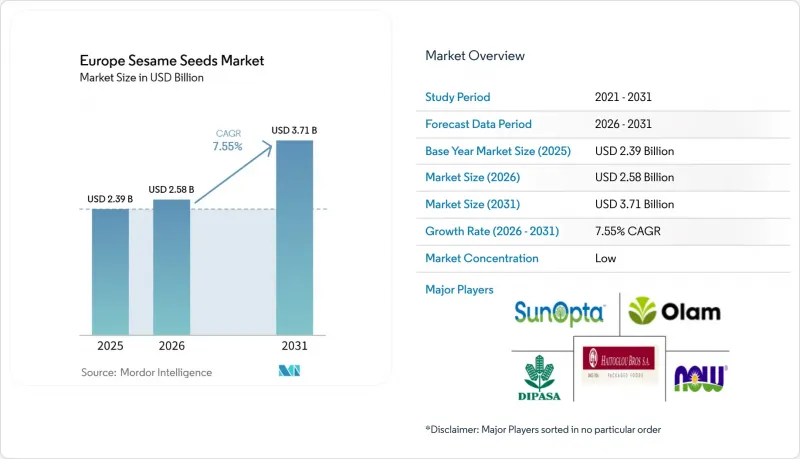
This report is Segmented by Product Type (White, Black, and Others), Category (Organic and Conventional), End-Use Segment (Horeca/Foodservice, Industrial, and Off-Trade/Retail), Geography (Germany, United Kingdom, Italy, France, Spain, Netherlands, Poland, Belgium, Sweden, and Rest of Europe). The Market Forecasts are Provided in Terms of Value (USD).
Europe Sesame Seeds Market Trends and Insights
Growth in antioxidant-rich superfood demand
European consumers increasingly prioritize functional foods that deliver measurable health benefits, positioning sesame seeds as a strategic ingredient for manufacturers targeting the wellness segment. Sesame's rich profile of lignans, healthy fats, and plant proteins aligns with consumer demands for natural alternatives to synthetic supplements. The shift toward plant-based diets has elevated sesame from a garnish to a core ingredient in protein-rich formulations, particularly in Germany and the Netherlands, where health-conscious consumption patterns are most established. Research indicates that sesame's unique combination of sesamin and sesamolin compounds provides cardiovascular benefits that resonate with aging European populations. This health positioning creates pricing power for premium sesame products, enabling suppliers to capture higher margins while expanding market penetration beyond traditional ethnic food channels.
Expanding use in bakery and confectionery items within foodservice
The European foodservice sector's embrace of sesame seeds reflects broader menu diversification strategies aimed at differentiating offerings in competitive urban markets. Artisanal bakeries increasingly incorporate sesame into signature bread formulations, while confectionery manufacturers leverage sesame's nutty flavor profile to create premium chocolate and dessert products. This trend extends beyond traditional Mediterranean markets into Northern European cities, where Asian fusion concepts drive sesame adoption in unexpected applications. McCormick & Company's 2024 SEC filing highlights significant EMEA operations growth, with the company noting increased demand for specialty seeds and spices across European foodservice channels. The foodservice channel's willingness to pay premium prices for consistent quality creates opportunities for suppliers to establish long-term partnerships that stabilize revenue streams while building brand recognition among end consumers.
Climate change and weather variability impacting crop yields
Climate variability increasingly disrupts sesame production in key supply regions, creating price volatility that constrains European market growth by making sesame less competitive against stable-priced alternatives. Research indicates that climate change affects seed morphological, physiological, and biochemical quality, with dicotyledonous crops like sesame showing particular vulnerability to temperature and drought stresses. Poland's agricultural sector faces drought risks affecting a significant portion of farmland, illustrating the broader European vulnerability to climate impacts that could affect future local sesame cultivation attempts. Production disruptions in major exporting countries like India and Nigeria create supply chain uncertainties that European buyers increasingly factor into procurement strategies, potentially favoring more expensive but reliable suppliers. The resulting price premiums may limit sesame adoption in price-sensitive applications, constraining overall market expansion despite growing demand for healthy ingredients.
Other drivers and restraints analyzed in the detailed report include:
- Surge in demand for sesame oil
- Rising demand for organic and sustainable products
- Strict international food safety and quality standards
For complete list of drivers and restraints, kindly check the Table Of Contents.
Segment Analysis
Black sesame seeds drive the fastest segment growth at 7.76% CAGR through 2031, despite white sesame maintaining a dominant 64.11% market share in 2025. The premium positioning of black sesame reflects consumer perception of superior nutritional density and antioxidant content, enabling price premiums that attract quality-focused suppliers. White sesame's market leadership stems from its versatility across applications, from traditional Mediterranean tahini production to modern bakery formulations where neutral color profiles are preferred. Brown and mixed varieties occupy niche positions, primarily serving specialty ethnic food channels and artisanal producers seeking differentiated offerings.
The color-based segmentation reveals strategic opportunities for suppliers to capture value through product positioning rather than volume competition. Research on sesame oil cake applications in pasta demonstrates how even by-products from sesame processing can enhance nutritional profiles, with sesame oil cake addition significantly increasing protein and fiber content while maintaining acceptable sensory characteristics. This innovation potential extends across the product spectrum, where black sesame's visual appeal and perceived health benefits create opportunities for premium product development in categories ranging from confectionery to functional foods.
List of Companies Covered in this Report:
- Dipasa Europe B.V.
- SunOpta Inc.
- Olam International
- Haitoglou Bros S.A.
- NOW(R) Foods
- Borges Agricultural & Industrial Nuts
- ETG Inputs Holdings
- Sesajal S.A. de C.V.
- Simsum Foods Ltd.
- McCormick & Company
- AAK AB
- Hutslands GmbH
- Sarrafi Agro
- Cargill, Incorporated
- Tradin Organic (Aldi-Group)
- Biona Organic
- Sunita Foods
- Maviga PLC
- Sesaco Corporation
- Samo Sesame Greece
Additional Benefits:
- The market estimate (ME) sheet in Excel format
- 3 months of analyst support
TABLE OF CONTENTS
1 INTRODUCTION
- 1.1 Study Assumptions and Market Definition
- 1.2 Scope of the Study
2 RESEARCH METHODOLOGY
3 EXECUTIVE SUMMARY
4 MARKET LANDSCAPE
- 4.1 Market Overview
- 4.2 Market Drivers
- 4.2.1 Growth in antioxidant-rich superfood demand
- 4.2.2 Expanding use in bakery and confectionery items within foodservice
- 4.2.3 Rising demand for organic and sustainable products
- 4.2.4 Surge in demand for sesame oil
- 4.2.5 Rising demand for tahini and sesame paste
- 4.2.6 Increasing investment in modern processing facilities
- 4.3 Market Restraints
- 4.3.1 Climate change and weather variability impacting crop yields
- 4.3.2 Strict international food safety and quality standards
- 4.3.3 Competition from alternative plant-based seeds and oils
- 4.3.4 Consumers have concerns over potential contamination
- 4.4 Supply Chain Analysis
- 4.5 Regulatory Landscape
- 4.6 Technological Outlook
- 4.7 Porter's Five Forces
- 4.7.1 Threat of New Entrants
- 4.7.2 Bargaining Power of Buyers
- 4.7.3 Bargaining Power of Suppliers
- 4.7.4 Threat of Substitutes
- 4.7.5 Competitive Rivalry
5 MARKET SIZE AND GROWTH FORECASTS (VALUE)
- 5.1 By Product Type
- 5.1.1 White
- 5.1.2 Black
- 5.1.3 Others
- 5.2 By Category
- 5.2.1 Organic
- 5.2.2 Conventional
- 5.3 By End-Use Segment
- 5.3.1 Foodservice/HoReCa
- 5.3.2 Industrial
- 5.3.3 Retail
- 5.3.3.1 Supermarkets/Hypermarkets
- 5.3.3.2 Specialty Stores
- 5.3.3.3 Online Retail Stores
- 5.3.3.4 Other Distribution Channels
- 5.4 By Geography
- 5.4.1 Germany
- 5.4.2 United Kingdom
- 5.4.3 Italy
- 5.4.4 France
- 5.4.5 Spain
- 5.4.6 Netherlands
- 5.4.7 Poland
- 5.4.8 Belgium
- 5.4.9 Sweden
- 5.4.10 Rest of Europe
6 COMPETITIVE LANDSCAPE
- 6.1 Market Concentration
- 6.2 Strategic Moves
- 6.3 Market Ranking
- 6.4 Company Profiles (includes Global level Overview, Market level overview, Core Segments, Financials as available, Strategic Information, Market Rank/Share for key companies, Products and Services, and Recent Developments)
- 6.4.1 Dipasa Europe B.V.
- 6.4.2 SunOpta Inc.
- 6.4.3 Olam International
- 6.4.4 Haitoglou Bros S.A.
- 6.4.5 NOW(R) Foods
- 6.4.6 Borges Agricultural & Industrial Nuts
- 6.4.7 ETG Inputs Holdings
- 6.4.8 Sesajal S.A. de C.V.
- 6.4.9 Simsum Foods Ltd.
- 6.4.10 McCormick & Company
- 6.4.11 AAK AB
- 6.4.12 Hutslands GmbH
- 6.4.13 Sarrafi Agro
- 6.4.14 Cargill, Incorporated
- 6.4.15 Tradin Organic (Aldi-Group)
- 6.4.16 Biona Organic
- 6.4.17 Sunita Foods
- 6.4.18 Maviga PLC
- 6.4.19 Sesaco Corporation
- 6.4.20 Samo Sesame Greece
7 MARKET OPPORTUNITIES AND FUTURE OUTLOOK

