PUBLISHER: Mordor Intelligence | PRODUCT CODE: 2097062

PUBLISHER: Mordor Intelligence | PRODUCT CODE: 2097062
MEA Automotive EPS - Market Share Analysis, Industry Trends & Statistics, Growth Forecasts (2026 - 2031)
According to Mordor Intelligence, the MEA automotive EPS market size is projected to expand from USD 0.41 billion in 2025 and USD 0.44 billion in 2026, reaching USD 0.67 billion by 2031, registering a CAGR of 8.41% between 2026 and 2031.
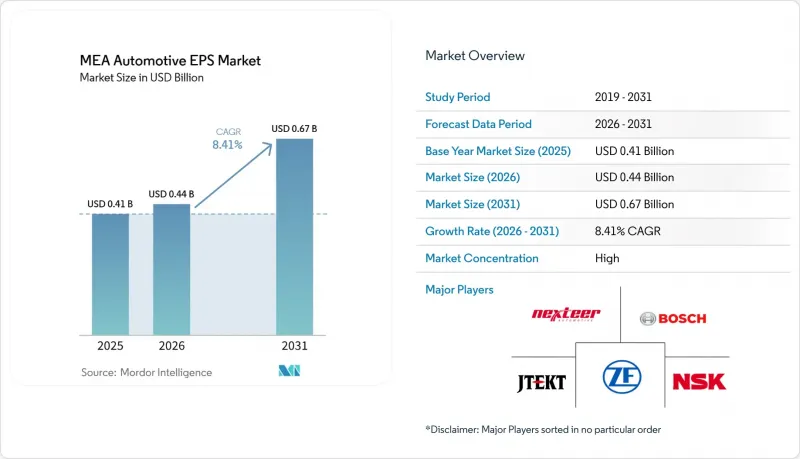
This report is Segmented Based On Type (Column EPS, Rack EPS, and More), Component Type (Steering Wheel and Column, Sensors, and More), Vehicle Type (Passenger Cars and Commercial Vehicles), and by Country (United Arab Emirates, Saudi Arabia, and More). Market Size and Forecasts are Provided in Value (USD) and Volume (Units).
MEA Automotive EPS Market Trends and Insights
Shift From Hydraulic Steering to Electric Power Steering for Fuel Efficiency and Lower CO2 Emissions
EPS is gaining ground because it removes the efficiency loss that comes with hydraulic pump operation. That matters in fleet-heavy markets where fuel use, maintenance, and lifecycle cost are reviewed closely before purchase decisions are made. In the Gulf, centralized buying by public fleets and large operators makes that cost logic even more influential. It is also speeding up the move away from electro-hydraulic systems, which many buyers now see as a short-lived compromise rather than a lasting solution. This is why the MEA automotive EPS market is moving through the transition faster than a simple replacement cycle would suggest.
Rising ADAS Penetration in Passenger Cars and Light Commercial Vehicles
ADAS requirements in the Gulf are making EPS a practical necessity for new vehicle platforms. Hydraulic steering does not align well with lane support and automated braking functions that depend on electronic steering response. This is pushing OEMs to lock in EPS specifications well before enforcement dates arrive. Fleet procurement also plays a role because buyers linked to large logistics and transport programs are increasingly asking for ADAS-ready vehicles at the order stage. As a result, the MEA automotive EPS market is being pulled forward by regulation and procurement at the same time.
Higher Upfront System Cost Versus Conventional Steering Architectures
Higher system cost remains a real barrier outside the richer Gulf markets. In many African countries, the vehicle base is still shaped by used imports, which slows the share of new models carrying modern EPS setups. Currency pressure adds another problem because most EPS modules are still imported into the region. That raises landed costs and makes local buyers more sensitive to upfront pricing. This is likely to leave lower-cost Chinese configurations in a stronger position in the most price-sensitive parts of the MEA automotive EPS market.
Other drivers and restraints analyzed in the detailed report include:
- Growth of EV and Hybrid Vehicle Platforms
- Software-Defined Steering Calibration for Harsh Roads, High Heat, and Mixed Vehicle Duty Cycles
- Vulnerability of Electronics to Heat, Dust, Voltage Variability, and Road Shock
For complete list of drivers and restraints, kindly check the Table Of Contents.
Segment Analysis
Column EPS held 51.53% of the MEA automotive EPS market share in 2025. Its lead reflects the strong presence of imported mass-market passenger cars across Saudi Arabia, the UAE, and Egypt. This type fits well with compact packaging needs, cost control, and the electronic compatibility needed for modern driver support features. It also remains a familiar and practical configuration for high-volume vehicle programs entering the region. For that reason, column systems continue to anchor the present demand structure of the MEA automotive EPS market.
The fastest growth within this category is expected from pinion EPS, which is projected to expand at a 10.47% CAGR through 2031. This reflects the rising presence of newer vehicle platforms that need a balance between efficiency, responsiveness, and packaging flexibility. Chinese OEMs are important here because many of their newer electric and mid-segment models already use pinion-oriented steering layouts. The growing SUV mix in Gulf markets also supports this shift because buyers increasingly expect a more refined steering response without moving into premium rack-based systems. Over time, this should allow pinion systems to build share without immediately displacing column systems from their core role.
Steering wheel and column assemblies held 40.49% of the market in 2025. Their lead stems from their central role in every EPS architecture, regardless of propulsion type or vehicle class. The current installed base in the region still leans heavily toward column-assist systems, and that naturally supports demand for this component group. These assemblies also sit at the center of cost, packaging, and integration decisions for OEM steering programs. That keeps them closely tied to volume production across the MEA automotive EPS market.
Sensors are projected to record the fastest CAGR of 9.98% through 2031. The reason is straightforward because modern EPS systems need increasingly accurate torque, angle, and position sensing to work with ADAS and software-based control logic. As steering systems become more electronic, value creation shifts toward the sensing and control layer rather than only the mechanical layer. This is especially relevant for suppliers targeting vehicles with lane support, automated braking, and connected software functions. In practical terms, the fastest-growing opportunity inside the MEA automotive EPS market is moving toward sensor-rich steering platforms rather than basic structural assemblies.
Complete Report Scope:
- By Type
- Column EPS
- Rack EPS
- Pinion EPS
- By Component Type
- Steering Wheel and Column
- Sensors
- Electronic Control Unit
- Motor and Actuation Module
- Rack and Pinion Assembly
- Other Component Type
- By Vehicle Type
- Passenger Cars
- Commercial Vehicles
- By Propulsion Type
- Internal Combustion Engine (ICE) Vehicles
- Hybrid Vehicles
- Battery Electric Vehicles
- By Country
- United Arab Emirates
- Saudi Arabia
- Iran
- Egypt
- South Africa
- Nigeria
- Morocco
- Rest of the Middle East and Africa
List of Companies Covered in this Report:
- Robert Bosch GmbH
- JTEKT Corporation
- ZF Friedrichshafen AG
- Nexteer Automotive
- NSK Ltd.
- Mando Corporation
- Hitachi Astemo, Ltd.
- Denso Corporation
- Hyundai Mobis Co., Ltd.
- Mitsubishi Electric Corporation
- Thyssenkrupp AG
- Valeo SE
- Continental AG
- Nidec Corporation
- Magna International Inc.
- Schaeffler AG
- Aptiv PLC
- BorgWarner Inc.
Additional Benefits:
- The market estimate (ME) sheet in Excel format
- 3 months of analyst support
TABLE OF CONTENTS
1 Introduction
- 1.1 Study Assumptions and Market Definition
- 1.2 Scope of the Study
2 Research Methodology
3 Executive Summary
4 Market Landscape
- 4.1 Market Overview
- 4.2 Market Drivers
- 4.2.1 Shift From Hydraulic Steering to Electric Power Steering for Fuel Efficiency and Lower CO2 Emissions
- 4.2.2 Rising ADAS Penetration in Passenger Cars and Light Commercial Vehicles
- 4.2.3 Growth of EV and Hybrid Vehicle Platforms
- 4.2.4 Software-Defined Steering Calibration for Harsh Roads, High Heat, and Mixed Vehicle Duty Cycles
- 4.2.5 Lower Fleet Total Cost of Ownership Through Reduced Maintenance and Better Energy Efficiency
- 4.2.6 OEM Platform Localization and Electrification of New Vehicle Architectures
- 4.3 Restraints
- 4.3.1 Higher Upfront System Cost Versus Conventional Steering Architectures
- 4.3.2 Vulnerability of Electronics to Heat, Dust, Voltage Variability, and Road Shock
- 4.3.3 Weak Aftermarket Calibration, Diagnostics, and Repair Capability in Parts of MEA
- 4.3.4 Limited Steering Feel Acceptance in Price-Sensitive Segments
- 4.4 Value Chain Analysis
- 4.5 Regulatory Landscape
- 4.6 Technological Outlook
- 4.7 Porter's Five Forces Analysis
- 4.7.1 Threat of New Entrants
- 4.7.2 Bargaining Power of Buyers
- 4.7.3 Bargaining Power of Suppliers
- 4.7.4 Threat of Substitutes
- 4.7.5 Competitive Rivalry
5 Market Size and Growth Forecasts (Value (USD) and Volume (Units))
- 5.1 By Type
- 5.1.1 Column EPS
- 5.1.2 Rack EPS
- 5.1.3 Pinion EPS
- 5.2 By Component Type
- 5.2.1 Steering Wheel and Column
- 5.2.2 Sensors
- 5.2.3 Electronic Control Unit
- 5.2.4 Motor and Actuation Module
- 5.2.5 Rack and Pinion Assembly
- 5.2.6 Other Component Type
- 5.3 By Vehicle Type
- 5.3.1 Passenger Cars
- 5.3.2 Commercial Vehicles
- 5.4 By Propulsion Type
- 5.4.1 Internal Combustion Engine (ICE) Vehicles
- 5.4.2 Hybrid Vehicles
- 5.4.3 Battery Electric Vehicles
- 5.5 By Country
- 5.5.1 United Arab Emirates
- 5.5.2 Saudi Arabia
- 5.5.3 Iran
- 5.5.4 Egypt
- 5.5.5 South Africa
- 5.5.6 Nigeria
- 5.5.7 Morocco
- 5.5.8 Rest of the Middle East and Africa
6 Competitive Landscape
- 6.1 Market Concentration
- 6.2 Strategic Moves
- 6.3 Market Share Analysis
- 6.4 Company Profiles (Includes Global level Overview, Market level overview, Core Segments, Financials as available, Strategic Information, Market Rank/Share for key companies, Products and Services, and Recent Developments)
- 6.4.1 Robert Bosch GmbH
- 6.4.2 JTEKT Corporation
- 6.4.3 ZF Friedrichshafen AG
- 6.4.4 Nexteer Automotive
- 6.4.5 NSK Ltd.
- 6.4.6 Mando Corporation
- 6.4.7 Hitachi Astemo, Ltd.
- 6.4.8 Denso Corporation
- 6.4.9 Hyundai Mobis Co., Ltd.
- 6.4.10 Mitsubishi Electric Corporation
- 6.4.11 Thyssenkrupp AG
- 6.4.12 Valeo SE
- 6.4.13 Continental AG
- 6.4.14 Nidec Corporation
- 6.4.15 Magna International Inc.
- 6.4.16 Schaeffler AG
- 6.4.17 Aptiv PLC
- 6.4.18 BorgWarner Inc.
7 Market Opportunities and Future Outlook
- 7.1 White-space and Unmet-need Assessment

