PUBLISHER: Mordor Intelligence | PRODUCT CODE: 2097459

PUBLISHER: Mordor Intelligence | PRODUCT CODE: 2097459
Spain AI-powered Energy Management Software - Market Share Analysis, Industry Trends & Statistics, Growth Forecasts (2026 - 2031)
According to Mordor Intelligence, the Spain AI-powered energy management software market size was valued at USD 93.1 million in 2025 and estimated to grow from USD 111.8 million in 2026 to reach USD 296.9 million by 2031, at a CAGR of 21.57% during the forecast period (2026-2031).
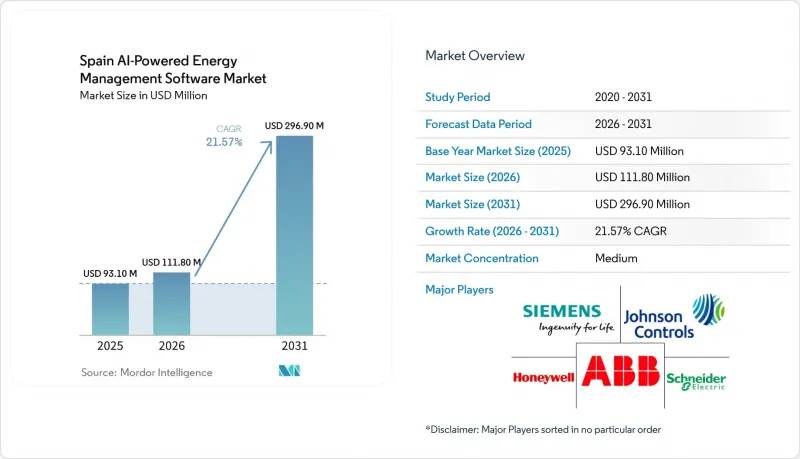
This report is Segmented by Component (Software, and Services), Deployment Mode (Cloud-Based, On-Premises, and Hybrid), Application (Energy Consumption and Demand Optimization, Asset Performance and Predictive Maintenance, and More), and End User (Utilities, Commercial Buildings, Industrial Facilities, and More). The Market Forecasts are Provided in Terms of Value (USD).
Spain AI-powered Energy Management Software Market Trends and Insights
Rising Need for Real-Time Energy Optimization in Commercial and Industrial Facilities
Commercial and industrial operators in Spain have remained under pressure to control energy costs following the price disruptions seen over recent years. That pressure is making real-time monitoring and automated control more useful, because AI platforms can detect peaks, adjust setpoints, and improve daily operating efficiency without waiting for manual review. Large venues have already shown the value of this approach, including the deployment of Sener's AI platform at Fira de Barcelona, where the target was to reduce energy use by up to 30%. The Spain AI-powered Energy Management Software Market is also benefiting from the growing need to manage multi-tariff contracts, peak-demand penalties, and reactive power charges through software rather than through manual energy oversight. This is becoming increasingly important as industrial sites add rooftop solar, combined heat and power, and storage, making local energy decisions more complex and strengthening demand for automation.
AI Integration with Smart Grids and Distributed Energy Resources
The Spain AI-powered Energy Management Software Market is gaining traction amid the country's need to manage a more complex, renewable-heavy grid. Spain reached 100 GW of installed renewable capacity in 2025, increasing the need for software that can coordinate forecasting, storage dispatch, flexible demand, and distributed assets at much higher speeds. The European Investment Bank and Endesa signed two loans totaling EUR 650 million (USD 702 million) in September 2025 to support smart meters, advanced transformers, and full grid digitalization during 2025-2027, which confirms strong institutional backing for grid intelligence in Spain. Spain's S2F project, approved by the Ministry for Ecological Transition and the Demographic Challenge, is also testing flexibility pilots that support nationwide AI-enabled demand aggregation and DER balancing. These developments are pushing utilities toward platforms that combine real-time operational control with market-facing optimization, thereby raising the strategic role of software in the Spain AI-powered Energy Management Software Market.
High Integration Complexity With Legacy OT and IT Systems
A major challenge in the Spain AI-powered Energy Management Software Market is the large installed base of older OT, SCADA, and control systems across utilities and industrial sites. These environments were not designed for modern APIs or direct AI integration, so deployments often need middleware, protocol conversion, and long validation cycles. That raises both cost and implementation time, especially for sites with multiple legacy assets and uneven digital readiness. This issue has been highlighted by Spain's industrial cybersecurity laboratory for strategic energy infrastructure, which reflects how seriously the country is treating the risk posed by OT convergence with newer digital layers. The result is that large utilities and multinational operators can often move ahead, while many mid-sized industrial users delay projects until integration risk becomes easier to manage.
Other drivers and restraints analyzed in the detailed report include:
- Increasing Demand for Automated Demand Response and Peak Load Management
- Expansion of ESG Reporting and Carbon Accounting Workflows
- Data Quality and Interoperability Gaps Across Metering and Sensor Layers
For complete list of drivers and restraints, kindly check the Table Of Contents.
Segment Analysis
Software accounted for 66.18% of the Spain AI-powered Energy Management Software Market in 2025, keeping this segment at the center of customer spending. Buyers continue to prefer software-led solutions because they can combine monitoring, forecasting, DER coordination, and reporting into a single operating layer. This model meets the needs of utilities, industrial groups, and multi-site building operators seeking stronger visibility across dispersed assets. It also supports faster feature updates and easier scaling than hardware-dependent approaches.
The Spain AI-powered Energy Management Software Market is still seeing faster growth in services, with this segment projected to expand at a CAGR of 22.61% through 2031. Service demand is rising because many deployments now need integration support, AI model maintenance, site onboarding, and managed optimization after the platform goes live. Outcome-based contracts are also becoming more attractive as customers ask vendors to share responsibility for measured savings and system performance. Schneider Electric's 2025 multi-year initiative to build a next-generation agentic AI ecosystem for sustainability and energy management shows how major suppliers are broadening their revenue focus beyond licenses and into longer service relationships. This shift means service depth is becoming a competitive factor across the Spain AI-powered Energy Management Software Market, not just an add-on to the initial software sale.
Cloud-based deployment held 57.12% of the Spain AI-powered Energy Management Software Market share in 2025, reflecting its scale, lower upfront costs, and easier remote management. Cloud tools remain attractive for operators with multiple facilities because they simplify updates, enable centralized oversight, and provide access to new AI capabilities. They also align well with digital data sources such as DATADIS, where external connectivity improves the value of continuous analytics. These advantages keep cloud platforms important for commercial buildings, multi-site operators, and mid-sized utilities.
Hybrid deployment is projected to record the fastest CAGR of 22.73% through 2031, indicating that the market is moving toward more flexible architectural choices. This model appeals to utilities and industrial operators that need local control over sensitive operational data while still using cloud analytics, where it adds value. Spain's NIS2 enforcement environment and broader critical infrastructure requirements are strengthening that preference, because buyers want both performance and local governance. The Spain AI-powered Energy Management Software Market is, therefore, rewarding vendors that can support edge-plus-cloud deployments rather than a cloud-only approach. That change is important because it shifts the focus to architectural flexibility, cybersecurity fit, and site-specific compliance readiness.
Complete Report Scope:
- By Component
- Software
- Services
- By Deployment Mode
- Cloud-Based
- On-Premises
- Hybrid
- By Application
- Energy Consumption and Demand Optimization
- Asset Performance and Predictive Maintenance
- Smart Grid and Distributed Energy Resource (DER) Management
- Renewable Energy Forecasting and Integration
- Energy Trading, Pricing and Market Intelligence
- By End User
- Utilities
- Commercial Buildings
- Industrial Facilities
- Residential Buildings
List of Companies Covered in this Report:
- Schneider Electric SE
- Siemens AG
- Honeywell International Inc.
- Johnson Controls International plc
- ABB Ltd.
- IBM Corporation
- C3.AI, Inc.
- Uplight, Inc.
- Kraken Technologies Limited
- AutoGrid Systems, Inc.
- EnergyCAP, LLC
- Enel X S.r.l.
- Emerson Electric Co.
- Itron, Inc.
- GE Vernova Inc.
- Delta Electronics, Inc.
- DEXMA Sensors, S.L.U.
- Smarkia, S.L.
- Linkener, S.L.
- Neuro Energy, S.L.
Additional Benefits:
- The market estimate (ME) sheet in Excel format
- 3 months of analyst support
TABLE OF CONTENTS
1 INTRODUCTION
- 1.1 Study Assumptions and Market Definition
- 1.2 Scope of the Study
2 RESEARCH METHODOLOGY
3 EXECUTIVE SUMMARY
4 MARKET LANDSCAPE
- 4.1 Market Overview
- 4.2 Market Drivers
- 4.2.1 Rising Need for Real-Time Energy Optimization in Commercial and Industrial Facilities
- 4.2.2 AI Integration With Smart Grids and Distributed Energy Resources
- 4.2.3 Increasing Demand for Automated Demand Response and Peak Load Management
- 4.2.4 Expansion of ESG Reporting and Carbon Accounting Workflows
- 4.2.5 Edge AI Adoption for Site-Level Energy Control and Fault Detection
- 4.2.6 Retrofit Demand From Aging Building and Industrial Infrastructure
- 4.3 Market Restraints
- 4.3.1 High Integration Complexity With Legacy OT and IT Systems
- 4.3.2 Data Quality and Interoperability Gaps Across Metering and Sensor Layers
- 4.3.3 Cybersecurity and Data Sovereignty Concerns for Critical Energy Assets
- 4.3.4 Payback Uncertainty in Small and Mid-Sized Sites With Limited Load Density
- 4.4 Impact of Macroeconomic Factors on the Market
- 4.5 Industry Value-Chain Analysis
- 4.6 Regulatory Landscape
- 4.7 Technological Outlook
- 4.8 Porter's Five Forces Analysis
- 4.8.1 Bargaining Power of Buyers
- 4.8.2 Bargaining Power of Suppliers
- 4.8.3 Threat of New Entrants
- 4.8.4 Threat of Substitutes
- 4.8.5 Intensity of Competitive Rivalry
5 MARKET SIZE AND GROWTH FORECASTS (VALUE)
- 5.1 By Component
- 5.1.1 Software
- 5.1.2 Services
- 5.2 By Deployment Mode
- 5.2.1 Cloud-Based
- 5.2.2 On-Premises
- 5.2.3 Hybrid
- 5.3 By Application
- 5.3.1 Energy Consumption and Demand Optimization
- 5.3.2 Asset Performance and Predictive Maintenance
- 5.3.3 Smart Grid and Distributed Energy Resource (DER) Management
- 5.3.4 Renewable Energy Forecasting and Integration
- 5.3.5 Energy Trading, Pricing and Market Intelligence
- 5.4 By End User
- 5.4.1 Utilities
- 5.4.2 Commercial Buildings
- 5.4.3 Industrial Facilities
- 5.4.4 Residential Buildings
6 COMPETITIVE LANDSCAPE
- 6.1 Market Concentration
- 6.2 Strategic Moves
- 6.3 Market Share Analysis
- 6.4 Company Profiles (includes Global Level Overview, Market Level Overview, Core Segments, Financials as available, Strategic Information, Market Rank/Share, Products and Services, Recent Developments)
- 6.4.1 Schneider Electric SE
- 6.4.2 Siemens AG
- 6.4.3 Honeywell International Inc.
- 6.4.4 Johnson Controls International plc
- 6.4.5 ABB Ltd.
- 6.4.6 IBM Corporation
- 6.4.7 C3.ai, Inc.
- 6.4.8 Uplight, Inc.
- 6.4.9 Kraken Technologies Limited
- 6.4.10 AutoGrid Systems, Inc.
- 6.4.11 EnergyCAP, LLC
- 6.4.12 Enel X S.r.l.
- 6.4.13 Emerson Electric Co.
- 6.4.14 Itron, Inc.
- 6.4.15 GE Vernova Inc.
- 6.4.16 Delta Electronics, Inc.
- 6.4.17 DEXMA Sensors, S.L.U.
- 6.4.18 Smarkia, S.L.
- 6.4.19 Linkener, S.L.
- 6.4.20 Neuro Energy, S.L.
7 MARKET OPPORTUNITIES AND FUTURE OUTLOOK
- 7.1 White-Space and Unmet-Need Assessment

