PUBLISHER: Mordor Intelligence | PRODUCT CODE: 2098568

PUBLISHER: Mordor Intelligence | PRODUCT CODE: 2098568
East Africa Automotive Lubricants - Market Share Analysis, Industry Trends & Statistics, Growth Forecasts (2026 - 2031)
According to Mordor Intelligence, the east Africa automotive lubricants market size is expected to increase from 148.57 million liters in 2025 to 154.06 million liters in 2026 and reach 182.74 million liters by 2031, growing at a CAGR of 3.47% over 2026-2031.
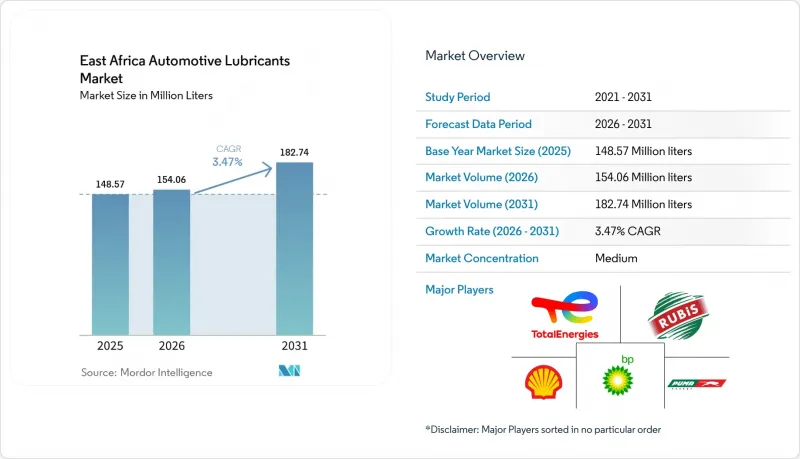
This report is Segmented by Product Type (Automotive Engine Oil, Manual Transmission, Fluids (MTF), and More), Vehicle Type (Passenger Vehicles, Commercial Vehicles, and Two-Wheelers), and Geography (Kenya, Tanzania, Uganda, Ethiopia, Rwanda, Burundi, and Democratic Republic of Congo). The Market Sizes and Forecasts are Provided in Terms of Volume (Liters).
East Africa Automotive Lubricants Market Trends and Insights
High Average Vehicle Age and Surge of Used-Vehicle Imports
Approximately 90% of light vehicles in circulation across East Africa are pre-owned imports. Older powertrains contribute to increased oil consumption due to worn piston rings and higher operating temperatures. Between January and August 2024, Tanzania processed 46,944 Japanese vehicle imports, while Kenya handled 38,861 units during the same period, supporting a replacement market that prioritizes affordable mineral multigrades. Uganda's decision in 2025 to reduce the import-age ceiling to 10 years slightly improves fleet quality but shortens turnover intervals, maintaining lubricant demand. The import mix is increasingly shifting toward automatic and hybrid vehicles, driving demand for automatic transmission fluids (ATF) and low-viscosity synthetic oils. Suppliers offering competitively priced, original equipment manufacturer (OEM)-approved formulations are positioned to secure consistent repeat business as the influx of used vehicles continues.
Rapid Growth of Motorcycle Parc in Kenya, Uganda, and Tanzania
Motorcycle registrations in Kenya more than doubled year-on-year, reaching 145,714 units in the first 11 months of 2025. Formal asset-finance models are improving maintenance compliance among boda-boda operators. The two-wheeler segment drives demand for small-pack sales of 2-stroke and 4-stroke oils. However, the segment faces challenges from electrification, with electric motorcycles already accounting for over 15% of Kenyan registrations and requiring minimal lubrication beyond chain grease. While internal-combustion motorcycles provide a short-term boost in lubricant volumes, marketers must diversify into greases and specialty fluids to mitigate long-term declines in engine oil demand. Key success factors include appropriate package sizing, rural distribution networks, and retailer education.
Proliferation of Counterfeit and Sub-Standard Lubricants
Kenya's Anti-Counterfeit Authority seized products worth significant amounts at the Busia border in February 2026. Despite such efforts, counterfeit oils still account for approximately 20% of national consumption and over half of Tanzania's volume. Counterfeiters often refill used bottles or dilute genuine stocks, leading to engine failures that affect consumer trust. In response, TotalEnergies introduced tamper-proof seals with Unstructured Supplementary Service Data (USSD) validation codes, while several Chinese brands implemented blockchain-based track-and-trace packaging. Although enforcement gaps remain, increasing consumer awareness and the adoption of digital verification tools are gradually reducing the prevalence of counterfeit products.
Other drivers and restraints analyzed in the detailed report include:
- Expansion of Road Infrastructure and Cross-Border Trade Corridors
- Logistics, Mining, and Agriculture Boom Boosting Commercial Vehicles
- Extreme Price Sensitivity Favoring Low-Cost Mineral Oils
For complete list of drivers and restraints, kindly check the Table Of Contents.
Segment Analysis
Automotive engine oil accounted for 47.72% of the 2025 volume in the East Africa automotive lubricants market, driven by the high drain frequency required for cars, trucks, and motorcycles. The market size for automatic transmission fluids (ATF) in East Africa is projected to grow at a compound annual growth rate (CAGR) of 3.76% through 2031, as automatic gearboxes gain popularity in cities like Nairobi and Dar es Salaam, where stop-and-go traffic is common. Legacy grades such as 15W-40 and 20W-50 continue to dominate due to consistently high ambient temperatures. However, premium 5W-30 synthetic oils are gradually gaining traction, particularly in newer Japanese and European vehicle imports that require low-viscosity oils for tighter engine tolerances.
Manual transmission fluids are experiencing modest growth as manual gearboxes remain prevalent in passenger vehicles, although their market share is gradually declining. Brake fluids and automotive greases follow standard maintenance schedules, while power steering fluids and coolants are increasingly included in bundled service kits offered at original equipment manufacturer (OEM) workshops. A diverse product portfolio has become essential for market players. For instance, National Oil Ethiopia offers a range of products, including Havoline mineral and synthetic grades, GL-4 and GL-5 gear oils, DOT 4 brake fluids, and lithium or molybdenum disulfide greases, distributed across eight regional depots. Suppliers that expand their offerings beyond basic engine oils are better positioned to maintain margins as demand for automatic transmission fluid (ATF) and synthetic lubricants continues to grow.
Complete Report Scope:
- By Product Type
- Automotive Engine Oil
- 0W-XX
- 5W-XX
- 10W-XX
- 15W-XX
- Monogrades
- Other Grades
- Manual Transmission Fluids (MTF)
- Automatic Transmission Fluids (ATF)
- Brake Fluids
- Automotive Greases
- Other Product Types (Power-steering fluids etc.)
- Automotive Engine Oil
- By Vehicle Type
- Passenger Vehicles
- Commercial Vehicles
- Two-Wheelers
- By Geography
- Kenya
- Tanzania
- Uganda
- Ethiopia
- Rwanda
- Burundi
- Democratic Republic of Congo
List of Companies Covered in this Report:
- AMSOIL Inc.
- BP p.l.c. (Castrol)
- Chevron Corporation
- Exxon Mobil Corporation
- FUCHS
- Lake Oil Group
- Motul SA
- National Oil Corporation of Kenya (NOC)
- OLA Energy
- Oryx Energies
- Petroliam Nasional Berhad (PETRONAS)
- Phillips 66 Company
- Puma Energy
- Repsol S.A.
- Rubis Energy Kenya (KenolKobil PLC)
- Shell plc
- TotalEnergies
- Veedol Corporation Limited
Additional Benefits:
- The market estimate (ME) sheet in Excel format
- 3 months of analyst support
TABLE OF CONTENTS
1 Introduction
- 1.1 Study Assumptions and Market Definition
- 1.2 Scope of the Study
2 Research Methodology
3 Executive Summary
4 Market Landscape
- 4.1 Market Overview
- 4.2 Market Drivers
- 4.2.1 High average vehicle age and surge of used-vehicle imports
- 4.2.2 Rapid growth of motorcycle parc in Kenya, Uganda and Tanzania
- 4.2.3 Expansion of road-infrastructure and cross-border trade corridors
- 4.2.4 Logistics, mining and agriculture boom boosting commercial vehicles demand
- 4.2.5 Telematics-driven fleet maintenance raising oil-change compliance
- 4.3 Market Restraints
- 4.3.1 Proliferation of counterfeit and sub-standard lubricants
- 4.3.2 Extreme price sensitivity favouring low-cost mineral oils
- 4.3.3 Weak regulatory enforcement and fragmented quality standards
- 4.4 Value Chain Analysis
- 4.5 Porter's Five Forces
- 4.5.1 Bargaining Power of Suppliers
- 4.5.2 Bargaining Power of Buyers
- 4.5.3 Threat of New Entrants
- 4.5.4 Threat of Substitutes
- 4.5.5 Degree of Competition
5 Market Size and Growth Forecasts (Volume)
- 5.1 By Product Type
- 5.1.1 Automotive Engine Oil
- 5.1.1.1 0W-XX
- 5.1.1.2 5W-XX
- 5.1.1.3 10W-XX
- 5.1.1.4 15W-XX
- 5.1.1.5 Monogrades
- 5.1.1.6 Other Grades
- 5.1.2 Manual Transmission Fluids (MTF)
- 5.1.3 Automatic Transmission Fluids (ATF)
- 5.1.4 Brake Fluids
- 5.1.5 Automotive Greases
- 5.1.6 Other Product Types (Power-steering fluids etc.)
- 5.1.1 Automotive Engine Oil
- 5.2 By Vehicle Type
- 5.2.1 Passenger Vehicles
- 5.2.2 Commercial Vehicles
- 5.2.3 Two-Wheelers
- 5.3 By Geography
- 5.3.1 Kenya
- 5.3.2 Tanzania
- 5.3.3 Uganda
- 5.3.4 Ethiopia
- 5.3.5 Rwanda
- 5.3.6 Burundi
- 5.3.7 Democratic Republic of Congo
6 Competitive Landscape
- 6.1 Market Concentration
- 6.2 Strategic Moves
- 6.3 Market Share(%)/Ranking Analysis
- 6.4 Company Profiles {(includes Global level Overview, Market level overview, Core Segments, Financials as available, Strategic Information, Products and Services, and Recent Developments)}
- 6.4.1 AMSOIL Inc.
- 6.4.2 BP p.l.c. (Castrol)
- 6.4.3 Chevron Corporation
- 6.4.4 Exxon Mobil Corporation
- 6.4.5 FUCHS
- 6.4.6 Lake Oil Group
- 6.4.7 Motul SA
- 6.4.8 National Oil Corporation of Kenya (NOC)
- 6.4.9 OLA Energy
- 6.4.10 Oryx Energies
- 6.4.11 Petroliam Nasional Berhad (PETRONAS)
- 6.4.12 Phillips 66 Company
- 6.4.13 Puma Energy
- 6.4.14 Repsol S.A.
- 6.4.15 Rubis Energy Kenya (KenolKobil PLC)
- 6.4.16 Shell plc
- 6.4.17 TotalEnergies
- 6.4.18 Veedol Corporation Limited
7 Market Opportunities and Future Outlook
- 7.1 White-space and Unmet-Need Assessment
- 7.2 Rising Demand from Two-Wheeler and Commercial-Vehicle Segments

