PUBLISHER: Mordor Intelligence | PRODUCT CODE: 2099787

PUBLISHER: Mordor Intelligence | PRODUCT CODE: 2099787
Middle East Gum Arabic - Market Share Analysis, Industry Trends & Statistics, Growth Forecasts (2026 - 2031)
According to Mordor Intelligence, the Middle East gum arabic market size is projected to expand from USD 35.21 million in 2025 and USD 36.52 million in 2026 to USD 40.35 million by 2031, registering a CAGR of 5.68% between 2026 and 2031.
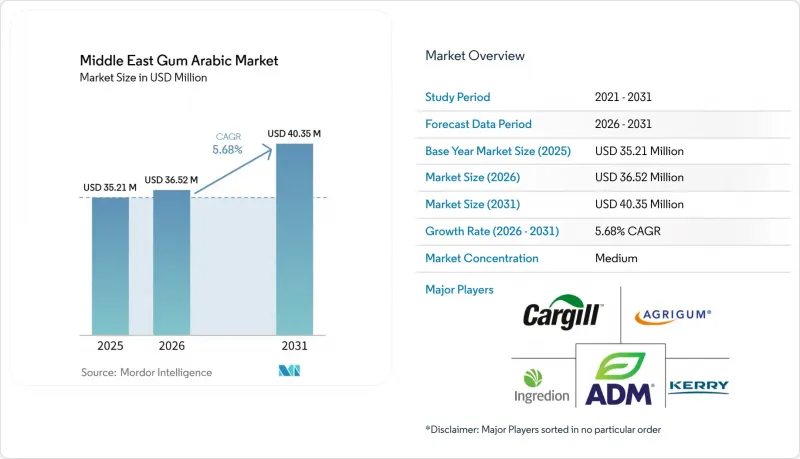
This report is Segmented by Product Type (Acacia Senegal Gum, Acacia Seyal Gum), Application (Food and Beverages, Animal Feed and Pet Food, Pharmaceuticals, Cosmetics and Personal Care, Others), and Geography (Saudi Arabia, United Arab Emirates, Iran, Qatar, Rest of Middle East). The Market Forecasts are Provided in Terms of Value (USD).
Middle East Gum Arabic Market Trends and Insights
Rising Demand for Natural, Clean-Label Stabilizers in Middle Eastern Food Processing
Food processors in Saudi Arabia and the United Arab Emirates are facing stronger pressure to simplify labels and reduce reliance on additives that appear more artificial to retailers and consumers. Gum arabic fits this requirement because it is recognized under the U.S. food additive framework and Codex standards, which gives manufacturers a clear regulatory reference when they sell into structured retail and export channels. The United Arab Emirates food processing sector is projected to generate USD 39.8 billion in 2025, and the country has more than 570 mainly small and mid-sized processors that rely heavily on imported ingredients, which creates a broad and recurring demand base for approved stabilizers. Because Dubai also works as a regional supply and redistribution point, ingredient preferences adopted there can move into neighboring GCC markets through established trade routes and distributor relationships. That pattern supports the Middle East gum arabic market because import demand at the hub level can convert into repeat downstream demand across several countries.
Expansion of Beverage, Confectionery, and Bakery Reformulation Programs
Beverage reformulation remains a core demand channel because gum arabic is widely used in flavor emulsions, spray-dried systems, and beverage bases where stable dispersion is essential. A 2025 peer-reviewed study noted that beverages accounted for 31.5% of global gum arabic usage, which supports the strong relevance of this application in the Middle East gum arabic market as local brands expand reduced-sugar and functional drink portfolios. Dubai International Chamber stated at Gulfood 2026 that retail soft drink sales in the United Arab Emirates are projected to reach USD 4.5 billion by 2030, while ready-to-drink tea is expected to grow at 9%, which points to a rising base for gum arabic use in reformulated drinks Ingredion has also introduced a pre-hydrated gum arabic spray dry powder that cuts mixing time from 4 to 16 hours down to 45 minutes, showing why processors view the ingredient as both a formulation and production tool. Similar logic applies in confectionery and bakery, where glazing, binding, and moisture-barrier roles allow manufacturers to replace some synthetic systems without giving up product handling or halal compatibility.
Heavy Dependence on Imported Raw Gum and Cross-Border Logistics Risk
The region remains dependent on imported raw or semi-processed gum arabic because there is no meaningful domestic acacia cultivation base. Supply risk has risen since the Sudan conflict disrupted flows from the world's most important producing area, and Reuters reported that uncertified material has moved through neighboring countries into informal channels that complicate origin checks. AIPG stated in March 2025 that Sudan still exported more than 70,000 tonnes in 2024 through Port Sudan, but it also noted that transport from inland producing zones had become more difficult and costly. This creates direct pressure in the Middle East gum arabic market because processors must manage higher freight, longer lead times, and tighter supplier screening before material enters food or pharmaceutical use. The result is a market where security of supply can influence purchasing decisions even when buyers remain resistant to broad price pass-throughs.
Other drivers and restraints analyzed in the detailed report include:
- Growth in Halal, Plant-Based, and Free-From Product Claims
- Higher Use of Gum Arabic in Nutraceutical Encapsulation and Fiber Fortification
- Price Sensitivity Versus Lower-Cost Hydrocolloid Substitutes
For complete list of drivers and restraints, kindly check the Table Of Contents.
Segment Analysis
Acacia senegal held 74.27% of the Middle East gum arabic market share in 2025, which kept it as the leading product type by a wide margin. Its position reflects stronger emulsification, film-forming behavior, and broader acceptance in beverage, confectionery, and pharmaceutical uses where performance consistency matters more than the lowest possible cost. The European Union's 2026 regulation on gum arabic also reinforces the central role of Acacia senegal by setting updated purity and compositional expectations that export-oriented GCC manufacturers will need to follow closely. This gives the dominant grade an added regulatory advantage in the Middle East gum arabic market because buyers serving formal retail and pharmaceutical channels tend to prefer the more established specification path. The segment therefore remains the reference grade for quality-sensitive demand across the region.
Acacia seyal is projected to record the fastest growth at a 6.78% CAGR through 2031, and that pace reflects a different value proposition centered on cost accessibility and broader use in beverage stabilization and industrial bakery applications. The Middle East gum arabic market is giving Seyal more room because some processors can accept a lower emulsification intensity when they gain savings and sourcing flexibility in return. Reuters also showed how the disruption around Sudanese Hashab-producing zones has pushed buyers to rethink grade and origin choices, which indirectly helps Seyal when Senegal-heavy sourcing becomes harder to secure on stable terms. Peer-reviewed analysis further noted innovation around blended and lower-carbon acacia formats, which suggests suppliers are trying to position Seyal-based solutions as more practical options rather than simple low-cost substitutes. Within the Middle East gum arabic industry, that gives Seyal a stronger role in value-engineered reformulation programs.
Complete Report Scope:
- By Product Type
- Acacia senegal Gum
- Acacia seyal Gum
- By Application
- Food and Beverages
- Bakery and Confectionery
- Dairy and Dairy Products
- Meat Industry
- Beverages
- Others
- Animal Feed and Pet Food
- Pharmaceuticals
- Cosmetics and Personal Care
- Others
- Food and Beverages
- By Geography
- Saudi Arabia
- United Arab Emirates
- Iran
- Qatar
- Rest of the Middle East
List of Companies Covered in this Report:
- Alland and Robert
- Ingredion Incorporated
- Kerry Group plc
- Archer Daniels Midland Company
- Cargill, Incorporated
- Agrigum International Limited
- Farbest Brands
- Hawkins Watts Limited
- AEP Colloids Inc.
- POLYGAL AG
- C.E. Roeper GmbH
- Norevo GmbH
- Gum Arabic Company
- Gum Sudan Company Ltd.
- AlfaFlax Gum Arabic
- Dar Savanna Ltd.
- SOMAR Corporation
- Morouj Commodities UK Ltd.
- Nagaad Gums and Resins LLC
Additional Benefits:
- The market estimate (ME) sheet in Excel format
- 3 months of analyst support
TABLE OF CONTENTS
1 INTRODUCTION
- 1.1 Study Assumptions and Market Definition
- 1.2 Scope of the Study
2 RESEARCH METHODOLOGY
3 EXECUTIVE SUMMARY
4 MARKET LANDSCAPE
- 4.1 Market Overview
- 4.2 Market Drivers
- 4.2.1 Rising Demand For Natural, Clean-Label Stabilizers In Middle Eastern Food Processing.
- 4.2.2 Expansion Of Beverage, Confectionery, And Bakery Reformulation Programs.
- 4.2.3 Growth In Halal, Plant-Based, And Free-From Product Claims.
- 4.2.4 Higher Use Of Gum Arabic In Nutraceutical Encapsulation And Fiber Fortification.
- 4.2.5 Sudan-Sahel Supply Diversification Into GCC Re-Export And Processing Hubs.
- 4.2.6 Traceability-Led Premiumization For Pharmaceutical And Export-Grade Material.
- 4.3 Market Restraints
- 4.3.1 Heavy Dependence On Imported Raw Gum And Cross-Border Logistics Risk.
- 4.3.2 Price Sensitivity Versus Lower-Cost Hydrocolloid Substitutes.
- 4.3.3 Batch Variability From Source Fragmentation And Adulteration Risk.
- 4.3.4 Conflict, Weather, And Harvest Volatility In The Wider Gum Belt.
- 4.4 Supply Chain Analysis
- 4.5 Regulatory Landscape
- 4.6 Technological Outlook
- 4.7 Porter's Five Forces
- 4.7.1 Threat of New Entrants
- 4.7.2 Bargaining Power of Buyers/Consumers
- 4.7.3 Bargaining Power of Suppliers
- 4.7.4 Threat of Substitute Products
- 4.7.5 Intensity of Competitive Rivalry
5 MARKET SIZE AND GROWTH FORECASTS (VALUE)
- 5.1 By Product Type
- 5.1.1 Acacia senegal Gum
- 5.1.2 Acacia seyal Gum
- 5.2 By Application
- 5.2.1 Food and Beverages
- 5.2.1.1 Bakery and Confectionery
- 5.2.1.2 Dairy and Dairy Products
- 5.2.1.3 Meat Industry
- 5.2.1.4 Beverages
- 5.2.1.5 Others
- 5.2.2 Animal Feed and Pet Food
- 5.2.3 Pharmaceuticals
- 5.2.4 Cosmetics and Personal Care
- 5.2.5 Others
- 5.2.1 Food and Beverages
- 5.3 By Geography
- 5.3.1 Saudi Arabia
- 5.3.2 United Arab Emirates
- 5.3.3 Iran
- 5.3.4 Qatar
- 5.3.5 Rest of the Middle East
6 COMPETITIVE LANDSCAPE
- 6.1 Market Concentration
- 6.2 Strategic Moves
- 6.3 Market Ranking Analysis
- 6.4 Company Profiles (includes Global level Overview, Market level overview, Core Segments, Financials as available, Strategic Information, Market Rank/Share for key companies, Products & Services, and Recent Developments)
- 6.4.1 Alland and Robert
- 6.4.2 Ingredion Incorporated
- 6.4.3 Kerry Group plc
- 6.4.4 Archer Daniels Midland Company
- 6.4.5 Cargill, Incorporated
- 6.4.6 Agrigum International Limited
- 6.4.7 Farbest Brands
- 6.4.8 Hawkins Watts Limited
- 6.4.9 AEP Colloids Inc.
- 6.4.10 POLYGAL AG
- 6.4.11 C.E. Roeper GmbH
- 6.4.12 Norevo GmbH
- 6.4.13 Gum Arabic Company
- 6.4.14 Gum Sudan Company Ltd.
- 6.4.15 AlfaFlax Gum Arabic
- 6.4.16 Dar Savanna Ltd.
- 6.4.17 SOMAR Corporation
- 6.4.18 Morouj Commodities UK Ltd.
- 6.4.19 Nagaad Gums and Resins LLC
7 MARKET OPPORTUNITIES AND FUTURE OUTLOOK

