PUBLISHER: Mordor Intelligence | PRODUCT CODE: 2099869

PUBLISHER: Mordor Intelligence | PRODUCT CODE: 2099869
Middle East and Africa AI Copilot - Market Share Analysis, Industry Trends & Statistics, Growth Forecasts (2026 - 2031)
According to Mordor Intelligence, the Middle East and Africa AI copilot market size is projected to expand from USD 1.01 billion in 2025 and USD 1.32 billion in 2026 to USD 5.26 billion by 2031, registering a CAGR of 31.85% between 2026 and 2031.
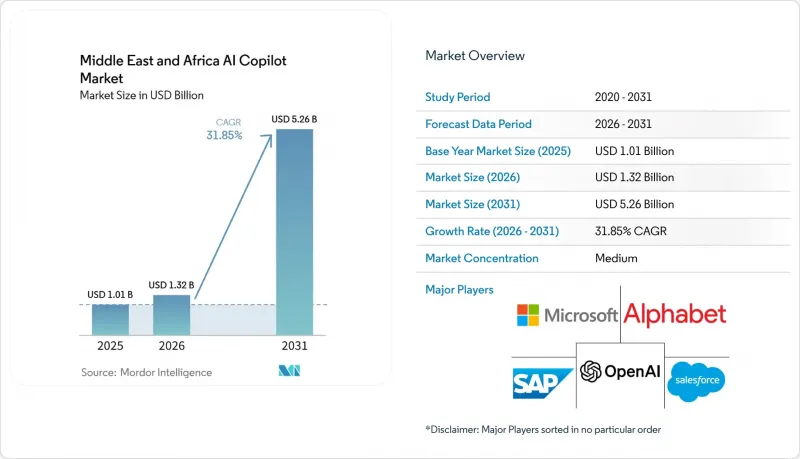
This report is Segmented by Copilot Type (Horizontal Productivity Copilots, and More), Deployment (Cloud-Based, Hybrid, and On-Premises), Organization Size (Large Enterprises, and Small and Medium Enterprises), Application (Knowledge Work and Productivity Assistance, and More), End-User Industry (BFSI, and More), and Geography. The Market Forecasts are Provided in Terms of Value (USD).
Middle East and Africa AI Copilot Market Trends and Insights
Rising Government-Led AI Sovereignty Programs in Saudi Arabia and the UAE
Government action is creating a direct demand base for the Middle East and Africa AI copilot market. The UAE approved a federal framework for the deployment of agentic AI in May 2026, and the program includes structured training for 80,000 federal employees while targeting agentic AI across 50% of government services by 2028. Abu Dhabi then moved from policy to scale deployment by extending Microsoft 365 Copilot to 35,000 civil servants across 27 government entities through the Frontier Employee Program. These moves show that public buyers in the region are treating copilots as part of administrative modernization rather than optional experimentation. That procurement stance spills over into the wider Middle East and Africa AI copilot market, as vendors now need stronger governance controls, local hosting options, and enterprise implementation capacity to compete for large institutional contracts.
Rapid Enterprise Shift From Chatbots to Context-Aware Copilot Workflows
The Middle East and Africa AI copilot market is also advancing as enterprises move beyond simple chat interfaces toward tools embedded in work systems. Dubai Holding announced an enterprise AI partnership with Microsoft in May 2026 to deploy Microsoft 365 Copilot across large employee populations in hospitality, real estate, telecom, investment, and entertainment operations. Abu Dhabi's program followed the same direction because the deployment was tied to a sovereign cloud environment that already supports more than 11 million daily digital interactions, which shows that the tool is being connected to real operating environments rather than isolated pilots. SAP's Joule rollout at Red Sea Global also supports this shift, as the product was deployed within human capital management functions across a large workforce rather than positioned as a stand-alone chatbot. This pattern matters for the Middle East and Africa AI copilot market because embedded workflow use raises switching costs and improves the case for larger seat expansions after early deployment.
Data Residency and Sovereignty Constraints Across Public and Regulated Sectors
Data residency remains a practical brake on the Middle East and Africa AI copilot market because many buyers cannot move sensitive workloads freely across borders or clouds. Abu Dhabi's Frontier Employee Program was built on a sovereign cloud environment supporting more than 11 million daily digital interactions, demonstrating that trusted deployment often depends on locally governed infrastructure before scale can occur. The UAE's federal framework for agentic AI also makes governance and controlled rollout central to implementation, which reinforces the need for compliance-ready operating models. These conditions add time to vendor qualification, architecture design, and rollout approval in public and regulated settings. As a result, the Middle East and Africa AI copilot market is growing quickly, but buyers still favor providers that can provide clear answers on hosting, access control, and operational accountability.
Other drivers and restraints analyzed in the detailed report include:
- Growth of Regulated Industry Use Cases in BFSI, Government, and Healthcare
- Demand for Arabic-First and Multilingual Copilot Interfaces
- Limited Availability of High-Quality Arabic Domain Data for Model Tuning
For complete list of drivers and restraints, kindly check the Table Of Contents.
Segment Analysis
Horizontal Productivity Copilots held 44.82% of the Middle East and Africa AI copilot market share in 2025, which made them the largest type in the region. Their position stems from existing workplace software deployments where AI can be activated as part of a familiar productivity stack rather than through a full platform replacement. This setup lowers change management friction and makes broad first-wave adoption easier across government entities and large enterprises. It also means that the early expansion of the Middle East and Africa AI copilot market has been shaped by installed software footprints as much as by pure model preference.
Industry-Specific Copilots are projected to grow at a CAGR of 34.24% during 2026-2031, making them the fastest-growing segment in the Middle East and Africa AI copilot market. Buyers are showing more interest in tools that can work with sector rules, formal document structures, approval paths, and domain language without heavy manual adjustment. SAP's July 2025 deployment of Joule at Red Sea Global across human capital management functions for 10,500 employees shows how a more specialized copilot can move into production once it fits a defined operating environment. Technical and engineering copilots remain smaller in current share, but their role is strengthening as enterprises look for tools that can support task-specific execution instead of only broad drafting and summarization. Over time, this should shift a larger part of the Middle East and Africa AI copilot market toward vertical workflows where accuracy, auditability, and contextual fit matter more than general productivity features alone.
Cloud-based deployment accounted for 75.16% of the Middle East and Africa AI copilot market in 2025, keeping it well ahead of other deployment modes. The reason is simple because most leading copilots are delivered through cloud software environments that enterprises already use for communication, storage, and workflow management. This makes the cloud the default entry point for many deployments, especially in non-regulated functions and among organizations seeking faster activation. It also explains why the Middle East and Africa AI copilot market has expanded rapidly, driven by use cases tied to standard office and business software.
Hybrid deployment is projected to expand at a CAGR of 33.91% during 2026-2031, which shows where buyer preference is moving as data controls become stricter. Abu Dhabi's sovereign cloud architecture and large public-sector copilot rollout illustrate why many institutions want a model that combines strong local governance with scalable access to AI. The UAE federal framework for agentic AI also supports this direction by placing governance and managed implementation at the center of deployment. On-Premises remains the smallest mode because it can be slower and more expensive to scale, but it still has a place in highly sensitive workloads. For that reason, the Middle East and Africa AI copilot market is likely to remain cloud-led in volume while hybrid becomes the preferred strategic model for controlled expansion in regulated environments.
Complete Report Scope:
- By Copilot Type
- Horizontal Productivity Copilots
- Functional Workflow Copilots
- Technical and Engineering Copilots
- Industry-Specific Copilots
- By Deployment
- Cloud-Based
- Hybrid
- On-Premises
- By Organization Size
- Large Enterprises
- Small and Medium Enterprises
- By Application
- Knowledge Work and Productivity Assistance
- Software Engineering and Technical Operations
- Customer and Employee Service Operations
- Sales, Marketing and Revenue Enablement
- Business Process and Enterprise Operations
- Regulated Industry Workflows
- By End-User Industry
- IT and Telecommunication
- BFSI
- Healthcare and Life Sciences
- Retail and E-Commerce
- Industrial Manufacturing
- Education and Research Institutions
- Media and Entertainment
- Government and administration
- Energy and Utilities
- Other End-User industries
- By Geography
- Middle East
- Saudi Arabia
- United Arab Emirates
- Turkey
- Qatar
- Rest of Middle East
- Africa
- South Africa
- Egypt
- Nigeria
- Rest of Africa
- Middle East
List of Companies Covered in this Report:
- Microsoft Corporation
- Alphabet Inc.
- Salesforce, Inc.
- ServiceNow, Inc.
- SAP SE
- Oracle Corporation
- Workday, Inc.
- Adobe Inc.
- IBM Corporation
- Amazon Web Services, Inc.
- Naver Corporation
- Samsung SDS Co., Ltd.
- HUMAIN
- e& UAE
- G42
- Core42
- NVIDIA Corporation
- OpenAI, L.L.C.
- Anthropic PBC
- Notion Labs, Inc.
Additional Benefits:
- The market estimate (ME) sheet in Excel format
- 3 months of analyst support
TABLE OF CONTENTS
1 INTRODUCTION
- 1.1 Study Assumptions and Market Definition
- 1.2 Scope of the Study
2 RESEARCH METHODOLOGY
3 EXECUTIVE SUMMARY
4 MARKET LANDSCAPE
- 4.1 Market Overview
- 4.2 Market Drivers
- 4.2.1 Rising Government-Led AI Sovereignty Programs in Saudi Arabia and the UAE
- 4.2.2 Rapid Enterprise Shift From Chatbots to Context-Aware Copilot Workflows
- 4.2.3 Demand for Arabic-First and Multilingual Copilot Interfaces
- 4.2.4 Copilot Adoption Inside Cloud-Based SaaS and CRM Suites
- 4.2.5 Use of Copilots for Internal Knowledge Retrieval and Employee Productivity
- 4.2.6 Growth of Regulated Industry Use Cases in BFSI, Government, and Healthcare
- 4.3 Market Restraints
- 4.3.1 Data Residency and Sovereignty Constraints Across Public and Regulated Sectors
- 4.3.2 Limited Availability of High-Quality Arabic Domain Data for Model Tuning
- 4.3.3 High Integration Effort With Legacy Enterprise Systems and Local Workflows
- 4.3.4 Talent Gaps in Prompt Engineering, AI Governance, and Copilot Administration
- 4.4 Impact of Macroeconomic Factors on the Market
- 4.5 Industry Value Chain Analysis
- 4.6 Technology Outlook
- 4.7 Regulatory Landscape
- 4.8 Porter's Five Forces Analysis
- 4.8.1 Threat of New Entrants
- 4.8.2 Bargaining Power of Suppliers
- 4.8.3 Bargaining Power of Buyers
- 4.8.4 Threat of Substitutes
- 4.8.5 Intensity of Competitive Rivalry
5 MARKET SIZE AND GROWTH FORECASTS (VALUE)
- 5.1 By Copilot Type
- 5.1.1 Horizontal Productivity Copilots
- 5.1.2 Functional Workflow Copilots
- 5.1.3 Technical and Engineering Copilots
- 5.1.4 Industry-Specific Copilots
- 5.2 By Deployment
- 5.2.1 Cloud-Based
- 5.2.2 Hybrid
- 5.2.3 On-Premises
- 5.3 By Organization Size
- 5.3.1 Large Enterprises
- 5.3.2 Small and Medium Enterprises
- 5.4 By Application
- 5.4.1 Knowledge Work and Productivity Assistance
- 5.4.2 Software Engineering and Technical Operations
- 5.4.3 Customer and Employee Service Operations
- 5.4.4 Sales, Marketing and Revenue Enablement
- 5.4.5 Business Process and Enterprise Operations
- 5.4.6 Regulated Industry Workflows
- 5.5 By End-User Industry
- 5.5.1 IT and Telecommunication
- 5.5.2 BFSI
- 5.5.3 Healthcare and Life Sciences
- 5.5.4 Retail and E-Commerce
- 5.5.5 Industrial Manufacturing
- 5.5.6 Education and Research Institutions
- 5.5.7 Media and Entertainment
- 5.5.8 Government and administration
- 5.5.9 Energy and Utilities
- 5.5.10 Other End-User industries
- 5.6 By Geography
- 5.6.1 Middle East
- 5.6.1.1 Saudi Arabia
- 5.6.1.2 United Arab Emirates
- 5.6.1.3 Turkey
- 5.6.1.4 Qatar
- 5.6.1.5 Rest of Middle East
- 5.6.2 Africa
- 5.6.2.1 South Africa
- 5.6.2.2 Egypt
- 5.6.2.3 Nigeria
- 5.6.2.4 Rest of Africa
- 5.6.1 Middle East
6 COMPETITIVE LANDSCAPE
- 6.1 Market Concentration
- 6.2 Strategic Moves
- 6.3 Market Share Analysis
- 6.4 Company Profiles (includes Global Level Overview, Market Level Overview, Core Segments, Financials as available, Strategic Information, Market Rank/Share, Products and Services, Recent Developments)
- 6.4.1 Microsoft Corporation
- 6.4.2 Alphabet Inc.
- 6.4.3 Salesforce, Inc.
- 6.4.4 ServiceNow, Inc.
- 6.4.5 SAP SE
- 6.4.6 Oracle Corporation
- 6.4.7 Workday, Inc.
- 6.4.8 Adobe Inc.
- 6.4.9 IBM Corporation
- 6.4.10 Amazon Web Services, Inc.
- 6.4.11 Naver Corporation
- 6.4.12 Samsung SDS Co., Ltd.
- 6.4.13 HUMAIN
- 6.4.14 e& UAE
- 6.4.15 G42
- 6.4.16 Core42
- 6.4.17 NVIDIA Corporation
- 6.4.18 OpenAI, L.L.C.
- 6.4.19 Anthropic PBC
- 6.4.20 Notion Labs, Inc.
7 MARKET OPPORTUNITIES AND FUTURE OUTLOOK
- 7.1 White-Space and Unmet-Need Assessment

