PUBLISHER: Mordor Intelligence | PRODUCT CODE: 2100614

PUBLISHER: Mordor Intelligence | PRODUCT CODE: 2100614
South America Waste Management - Market Share Analysis, Industry Trends & Statistics, Growth Forecasts (2026 - 2031)
According to Mordor Intelligence, the South America waste management market size was valued at USD 40.03 billion in 2025 and estimated to grow from USD 41.81 billion in 2026 to reach USD 51.97 billion by 2031, at a CAGR of 4.44% during the forecast period (2026-2031).
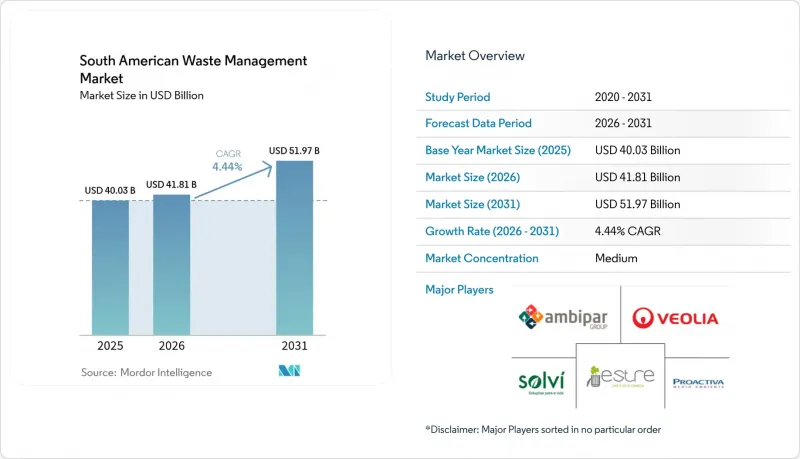
This report is Segmented by Source (Residential, Commercial, Industrial, and More), by Service Type (Collection, Transportation, Sorting & Segregation, and More), by Waste Type (Municipal Solid, Industrial Hazardous Waste, E-Waste, and More), and Geography (Brazil, Argentina, Chile, Colombia, Peru, and the Rest of South America). The Market Forecasts are Provided in Terms of Value (USD).
South America Waste Management Market Trends and Insights
Extended Producer Responsibility Rollout Across Brazil, Chile and Colombia
Brazil's Decree 12,688 obliges 32% recovery of plastic packaging by 2026 and requires 22% recycled content, compelling brand owners to fund reverse-logistics systems. Chile's Law 20.920 has been fully operational since 2023, while Colombia's Resolution 1407 is still building producer-responsibility organizations, leaving a two-year integration gap. Regional players that can navigate multiple compliance regimes enjoy early-mover advantages in sorting contracts. Brazil's public-investment program has allocated USD 126 million to formalize waste-picker cooperatives, reducing route-access conflicts. EPR's medium-term impact stems from the lag between fee collection and infrastructure rollout.
Post-COP30 Foreign Investment in Circular-Economy Infrastructure
Belem's role as COP30 host unlocked a USD 10 million Global Methane Hub grant for a municipal composting plant, illustrating how climate diplomacy reroutes finance toward waste assets. Eco Invest Brasil mobilized USD 13.5 billion for anaerobic digesters and material-recovery facilities, complemented by a USD 432 million commitment from BNDES for Sao Paulo projects. New investors favor biomethane, which also earns CBIO decarbonization certificates, although certificate price swings after 2023 defaults inject uncertainty. With a typical 2-4 year build cycle, these funds translate into mid-decade capacity growth across Brazil's Amazon states and adjoining Andean markets.
Entrenched Informal Collection Networks
Informal pickers manage 40% of Lima's waste, disrupting planned routes and reducing contracted haulers' payloads. Bogota's 15,000 pickers enjoy court-protected access rights, complicating tariff negotiations and quality-of-service metrics. Brazil earmarked USD 126 million to integrate cooperatives, yet uptake differs: Sao Paulo signed multi-year contracts, while Rio de Janeiro's favela-based groups remain outside EPR loops. The restraint weighs on the market until cooperative agreements, training and bin-standard upgrades mature, typically taking 30-36 months.
Other drivers and restraints analyzed in the detailed report include:
- Urban Organics-to-Landfill Bans Stimulating Composting and WtE
- Corporate Zero-Waste Targets in Mining & Agribusiness
- Fiscal Austerity Limiting Municipal CAPEX
For complete list of drivers and restraints, kindly check the Table Of Contents.
Segment Analysis
Residential generators delivered 55.39% of the South America Waste Management Market share in 2025 as densely populated metros such as Sao Paulo, Buenos Aires and Bogota filled curbside routes with municipal solid waste. Commercial streams, however, are on course for a 6.19% CAGR through 2031, the highest across sources, thanks to retail and office densification in Medellin, Curitiba and Guayaquil and to segregation mandates now embedded in storefront leases. EPR logistics hubs inside supermarkets and shopping malls are funneling cardboard and plastics directly to producer-responsibility organizations, trimming haul distances and boosting bale prices by up to 15%. Industrial players add volume more gradually as mining and agribusiness adopt closed-loop targets; Vale, for example, recaptured 12.7 million tonnes of waste-to-value material in 2024.
The commercial segment's swift climb recalibrates the South America Waste Management Market size calculus for haulers that long prioritized door-to-door residential density. Franchise contracts in second-tier cities are being rebid with higher scores for source-separated collection vehicles and point-of-sale take-back kiosks. Because informal pickers historically controlled cardboard around wet-markets, new concessionaires are paying cooperatives to supply bales to EPR sorters, an early sign of coexistence. Mining sites in the Chilean copper belt and Brazil's Minas Gerais increasingly tender specialty recyclers for scrap tires and reagent drums, reinforcing an industrial-grade revenue stream that carries above-average margins and hedges landfill-fee pressure.
Complete Report Scope:
- By Source
- Residential
- Commercial (retail, office, etc.)
- Industrial
- Medical (Health and Pharmaceutical)
- Construction & Demolition
- Others (institutional, agricultural, etc)
- By Service Type
- Collection, Transportation, Sorting & Segregation
- Disposal / Treatment
- Landfill
- Recycling & Resource Recovery
- Incineration & Waste-to-Energy
- Others (Chemical Treatment, Composting, etc.)
- Others (Consulting, Audit & Training, etc.)
- By Waste Type
- Municipal Solid Waste
- Industrial Hazardous Waste
- E-waste
- Plastic Waste
- Biomedical Waste
- Construction & Demolition Waste
- Agricultural Waste
- Other Specialized Waste (radio active, etc)
- By Geography
- Brazil
- Argentina
- Chile
- Colombia
- Peru
- Rest of South America
List of Companies Covered in this Report:
- Veolia Latin America
- Estre Ambiental
- Grupo Solvi
- Ambipar
- Proactiva Medio Ambiente
- Waste Management Inc.
- Republic Services Inc.
- Casella Waste Systems
- Covanta Holding Corporation
- Inciner8 Ltd
- SWM Colombia
- Capitao Ambiental
- Entorno Sustentable
- Syngas do Brasil
- Usina Verde
- Bioelektra
- Estaciones Ecologicas
- Solvi Essencis
- Reciclar S.A.
- TRASHCo Peru
Additional Benefits:
- The market estimate (ME) sheet in Excel format
- 3 months of analyst support
TABLE OF CONTENTS
1 Introduction
- 1.1 Study Assumptions
- 1.2 Scope of the Study
2 Research Methodology
3 Executive Summary
4 Market Landscape
- 4.1 Market Overview
- 4.2 Market Drivers
- 4.2.1 Extended Producer Responsibility rollout across Brazil, Chile, Colombia
- 4.2.2 Post-COP30 foreign investment in circular-economy infrastructure
- 4.2.3 Urban organics-to-landfill bans stimulating composting & WtE
- 4.2.4 Corporate zero-waste targets in mining & agribusiness
- 4.2.5 Lithium-ion battery recycling corridors in Lithium Triangle
- 4.2.6 AI/IoT route optimization reducing collection OPEX
- 4.3 Market Restraints
- 4.3.1 Entrenched informal collection networks
- 4.3.2 Fiscal austerity limiting municipal CAPEX
- 4.3.3 Cross-border e-waste dumping strains enforcement capacity
- 4.3.4 Volatile carbon-credit prices weaken WtE financing
- 4.4 Value / Supply-Chain Analysis
- 4.5 Regulatory Landscape
- 4.6 Technological Outlook
- 4.7 Industry Attractiveness - Porter's Five Force Analysis
- 4.7.1 Threat of New Entrants
- 4.7.2 Bargaining Power of Suppliers
- 4.7.3 Bargaining Power of Buyers
- 4.7.4 Threat of Substitutes
- 4.7.5 Intensity of Competitive Rivalry
- 4.8 Logistics Infrastructure Insights
- 4.9 Startup Strategies & Venture Funding
5 Market Size & Growth Forecasts (Values, In USD Billion)
- 5.1 By Source
- 5.1.1 Residential
- 5.1.2 Commercial (retail, office, etc.)
- 5.1.3 Industrial
- 5.1.4 Medical (Health and Pharmaceutical)
- 5.1.5 Construction & Demolition
- 5.1.6 Others (institutional, agricultural, etc)
- 5.2 By Service Type
- 5.2.1 Collection, Transportation, Sorting & Segregation
- 5.2.2 Disposal / Treatment
- 5.2.2.1 Landfill
- 5.2.2.2 Recycling & Resource Recovery
- 5.2.2.3 Incineration & Waste-to-Energy
- 5.2.2.4 Others (Chemical Treatment, Composting, etc.)
- 5.2.3 Others (Consulting, Audit & Training, etc.)
- 5.3 By Waste Type
- 5.3.1 Municipal Solid Waste
- 5.3.2 Industrial Hazardous Waste
- 5.3.3 E-waste
- 5.3.4 Plastic Waste
- 5.3.5 Biomedical Waste
- 5.3.6 Construction & Demolition Waste
- 5.3.7 Agricultural Waste
- 5.3.8 Other Specialized Waste (radio active, etc)
- 5.4 By Geography
- 5.4.1 Brazil
- 5.4.2 Argentina
- 5.4.3 Chile
- 5.4.4 Colombia
- 5.4.5 Peru
- 5.4.6 Rest of South America
6 Competitive Landscape
- 6.1 Market Concentration
- 6.2 Strategic Moves
- 6.3 Market Share Analysis
- 6.4 Company Profiles (includes Global level Overview, Market level overview, Core Segments, Financials as available, Strategic Information, Products & Services, Recent Developments)
- 6.4.1 Veolia Latin America
- 6.4.2 Estre Ambiental
- 6.4.3 Grupo Solvi
- 6.4.4 Ambipar
- 6.4.5 Proactiva Medio Ambiente
- 6.4.6 Waste Management Inc.
- 6.4.7 Republic Services Inc.
- 6.4.8 Casella Waste Systems
- 6.4.9 Covanta Holding Corporation
- 6.4.10 Inciner8 Ltd
- 6.4.11 SWM Colombia
- 6.4.12 Capitao Ambiental
- 6.4.13 Entorno Sustentable
- 6.4.14 Syngas do Brasil
- 6.4.15 Usina Verde
- 6.4.16 Bioelektra
- 6.4.17 Estaciones Ecologicas
- 6.4.18 Solvi Essencis
- 6.4.19 Reciclar S.A.
- 6.4.20 TRASHCo Peru
7 Market Opportunities & Future Outlook
- 7.1 White-space & Unmet-need Assessment

