PUBLISHER: Mordor Intelligence | PRODUCT CODE: 2113222

PUBLISHER: Mordor Intelligence | PRODUCT CODE: 2113222
Singapore Property and Casualty Insurance - Market Share Analysis, Industry Trends & Statistics, Growth Forecasts (2026 - 2031)
According to Mordor Intelligence, the Singapore property and casualty insurance market size stands at USD 1.87 billion in 2026 and is forecast to reach USD 2.47 billion by 2031 at a 5.78% CAGR.
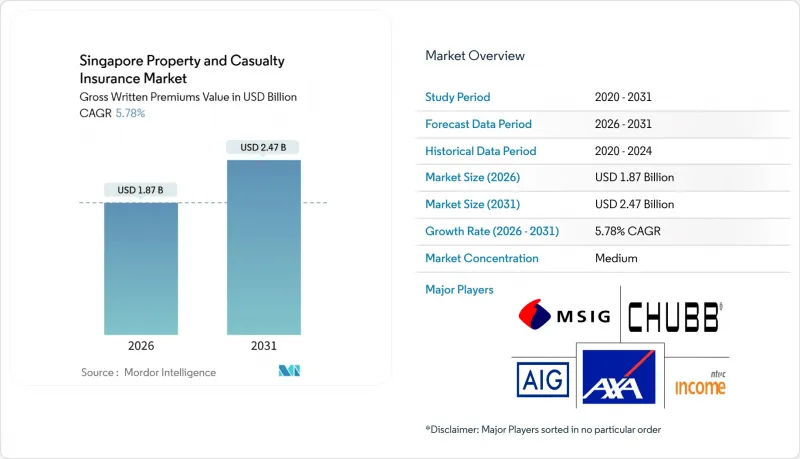
This report is Segmented by Line of Business (Motor Insurance, Health Insurance, Property Insurance, Liability Insurance, Other Insurance), Customer Type (Retail, Corporate), Distribution Channel (Brokers/Agents, Banks, Direct Sales, Other Channels), and Geography (Singapore). The Market Forecasts are Provided in Terms of Value (USD).
Singapore Property and Casualty Insurance Market Trends and Insights
Strengthening Market Confidence Through Robust Regulation
Risk-Based Capital 2 enhancements that took effect January 1, 2026, require that Additional Tier 1 and Tier 2 instruments be sold only to non-retail investors to qualify as regulatory capital, which lifts the quality of capital and shields retail investors from complex structures. These measures improve solvency resilience and indirectly strengthen confidence in the Singapore property and casualty insurance market as risk sensitivity rises in underwriting and investment policies.. The regulatory environment remains active, and supervisors continue to refine guidance and expectations on governance, distribution, and conduct, signaling a durable compliance baseline that supports premium sustainability. Legislative oversight is also more assertive, evidenced by the Insurance (Amendment) Act 2024, which set the stage for ministerial intervention in transactions where public interest factors are significant. Together, these shifts boost the credibility of prudential safeguards and foster long-term stability that is supportive of orderly growth in the Singapore property and casualty insurance market.
Leveraging Singapore's Role as a Regional Trade and Maritime Hub
Singapore's leading position as Asia's second-largest marine hull underwriter and fourth worldwide anchors a steady flow of specialty risk, reinsurance placements, and complex coverage requirements that spill over into related lines. Hosting of major international marine insurance events underscores the city-state's role in convening global markets, which benefits the Singapore property and casualty insurance market through knowledge transfer and deal origination. Regional risk pooling and parametric structures are also gaining traction, with the Southeast Asia Disaster Risk Insurance Facility operating from Singapore and delivering rapid post-disaster payouts in 2025 that demonstrate operational maturity. Singapore's regulatory clarity and concentration of insurers, reinsurers, and brokers create a natural hub for complex risk financing that benefits specialty segments within the Singapore property and casualty insurance market. This hub dynamic remains a long-term structural advantage, especially as Southeast Asia's infrastructure and logistics expansion continues to demand sophisticated coverage options.
Intensifying Competition and Compressing Underwriting Margins
Profitability came under pressure in 2024, as domestic underwriting profit fell 16.7% to USD 170.54 million (SGD 219.04 million) even though gross written premiums rose 8.3%, highlighting a more competitive rate environment. Motor insurance posted an underwriting loss in 2024, reflecting claims severity and cost inflation that outpaced rate actions and underscored sensitivity to repair and parts trends. The shift in Singapore's new-vehicle mix has implications for risk costs, with electric vehicles carrying higher repair complexity, which translates into higher premiums and tighter underwriting windows in motor insurance. Digitalization in claims and reporting curbs fraud and leakage, yet the same transparency heightens price comparisons and accelerates switching behavior in retail lines. These dynamics make measured growth and expense efficiency essential for sustainable returns in the Singapore property and casualty insurance market.
Other drivers and restraints analyzed in the detailed report include:
- Driving P&C Uptake via Government-Backed Insurance Schemes
- Expanding Specialty Lines Through Rising Risk Awareness
- Managing Heightened Catastrophe and Climate Risk Exposure
For complete list of drivers and restraints, kindly check the Table Of Contents.
Segment Analysis
Motor commanded 47.9% of the Singapore property and casualty insurance market share in 2025, preserving its position as the largest line even as underwriting results softened in 2024. The segment's profitability dipped due to higher claims severity, while the rate environment stayed competitive, which prompted underwriters to calibrate pricing and benefits more tightly. Health, property, and liability lines showed varied drivers, with property claims volatility in 2024 and liability steady demand from employers and commercial activity. Health-related cover continues to be shaped by system-wide cost management measures and household adoption of complementary protection, indicated by strong life-sector new business in 2025. Collectively, these patterns keep the Singapore property and casualty insurance market anchored by motor and supported by selective growth in other retail lines.
Other insurance, which includes cyber, engineering, surety, credit, and specialty liability, is projected to expand at an 8.95% CAGR within the Singapore property and casualty insurance market size between 2026 and 2031, setting the pace for the fastest growth across lines. Specialty momentum is supported by the city's risk hub role and access to reinsurance and alternative structures demonstrated through regional risk pooling activity. Travel insurance logged a 2024 upswing in gross premiums alongside higher claims, reflecting normalization of mobility and evolving consumer protections. Marine hull experienced a difficult 2024 with a swing into underwriting loss, reinforcing the need for disciplined capacity and better risk differentiation. Going forward, specialty lines are positioned to absorb a meaningful share of incremental premium as corporates recalibrate risk budgets and seek bespoke limits, which supports diversification in the Singapore property and casualty insurance market.
Complete Report Scope:
- By Line of Business
- Motor Insurance
- Health Insurance
- Property Insurance
- Liability Insurance
- Other Insurance
- By Customer Type
- Retail
- Corporate
- By Distribution Channel
- Brokers/Agents
- Banks
- Direct Sales
- Other Channels
List of Companies Covered in this Report:
- NTUC Income Insurance Ltd
- AXA Insurance Singapore Pte Ltd
- Chubb Insurance Singapore Limited
- MSIG Insurance (Singapore) Pte Ltd
- Liberty Insurance Pte Ltd
- Sompo Insurance Singapore Pte Ltd
- Tokio Marine Insurance Singapore Ltd
- AIG Asia Pacific Insurance Pte Ltd
- QBE Insurance (Singapore) Pte Ltd
- Allianz Insurance Singapore Pte Ltd
- Allied World Assurance Company Ltd (Singapore Branch)
- Auto & General Insurance (Singapore) Pte Ltd
- DirectAsia Insurance (Singapore) Pte Ltd
- ECICS Limited
- EQ Insurance Company Limited
- Etiqa Insurance Singapore
- HL Assurance Pte Ltd
- India International Insurance Pte Ltd
- Lonpac Insurance Bhd (Singapore Branch)
- United Overseas Insurance Limited
Additional Benefits:
- The market estimate (ME) sheet in Excel format
- 3 months of analyst support
TABLE OF CONTENTS
1 Introduction
- 1.1 Study Assumptions & Market Definition
- 1.2 Scope of the Study
2 Research Methodology
3 Executive Summary
4 Market Landscape
- 4.1 Market Overview
- 4.2 Market Drivers
- 4.2.1 Strengthening Market Confidence Through Robust Regulation
- 4.2.2 Leveraging Singapore's Role as a Regional Trade and Maritime Hub
- 4.2.3 Anchoring Insurance Demand in a Stable Macro-Political Environment
- 4.2.4 Driving P&C Uptake via Government-Backed Insurance Schemes
- 4.2.5 Expanding Specialty Lines Through Rising Risk Awareness
- 4.2.6 Supporting Sustainable Growth Through Strong Industry Infrastructure
- 4.3 Market Restraints
- 4.3.1 Intensifying Competition and Compressing Underwriting Margins
- 4.3.2 Managing Heightened Catastrophe and Climate Risk Exposure
- 4.3.3 Navigating Limited Domestic Scale and Market Saturation
- 4.3.4 Adapting to Rising Regulatory and Capital Requirements
- 4.4 Value / Supply-Chain Analysis
- 4.5 Regulatory Landscape
- 4.6 Technological Outlook
- 4.7 Porter's Five Forces
- 4.7.1 Bargaining Power of Suppliers
- 4.7.2 Bargaining Power of Buyers
- 4.7.3 Threat of New Entrants
- 4.7.4 Threat of Substitutes
- 4.7.5 Intensity of Competitive Rivalry
5 Market Size & Growth Forecasts (Value, USD)
- 5.1 By Line of Business
- 5.1.1 Motor Insurance
- 5.1.2 Health Insurance
- 5.1.3 Property Insurance
- 5.1.4 Liability Insurance
- 5.1.5 Other Insurance
- 5.2 By Customer Type
- 5.2.1 Retail
- 5.2.2 Corporate
- 5.3 By Distribution Channel
- 5.3.1 Brokers/Agents
- 5.3.2 Banks
- 5.3.3 Direct Sales
- 5.3.4 Other Channels
6 Competitive Landscape
- 6.1 Market Concentration
- 6.2 Strategic Moves
- 6.3 Market Share Analysis
- 6.4 Company Profiles (includes Global level Overview, Market level overview, Core Segments, Financials as available, Strategic Information, Market Rank/Share for key companies, Products & Services, and Recent Developments)
- 6.4.1 NTUC Income Insurance Ltd
- 6.4.2 AXA Insurance Singapore Pte Ltd
- 6.4.3 Chubb Insurance Singapore Limited
- 6.4.4 MSIG Insurance (Singapore) Pte Ltd
- 6.4.5 Liberty Insurance Pte Ltd
- 6.4.6 Sompo Insurance Singapore Pte Ltd
- 6.4.7 Tokio Marine Insurance Singapore Ltd
- 6.4.8 AIG Asia Pacific Insurance Pte Ltd
- 6.4.9 QBE Insurance (Singapore) Pte Ltd
- 6.4.10 Allianz Insurance Singapore Pte Ltd
- 6.4.11 Allied World Assurance Company Ltd (Singapore Branch)
- 6.4.12 Auto & General Insurance (Singapore) Pte Ltd
- 6.4.13 DirectAsia Insurance (Singapore) Pte Ltd
- 6.4.14 ECICS Limited
- 6.4.15 EQ Insurance Company Limited
- 6.4.16 Etiqa Insurance Singapore
- 6.4.17 HL Assurance Pte Ltd
- 6.4.18 India International Insurance Pte Ltd
- 6.4.19 Lonpac Insurance Bhd (Singapore Branch)
- 6.4.20 United Overseas Insurance Limited
7 Market Opportunities & Future Outlook
- 7.1 Digital & Embedded Insurance Expansion
- 7.2 Specialty & Complex Commercial Risk Growth

