PUBLISHER: Mordor Intelligence | PRODUCT CODE: 2113349

PUBLISHER: Mordor Intelligence | PRODUCT CODE: 2113349
North America Automotive Parts Die Casting - Market Share Analysis, Industry Trends & Statistics, Growth Forecasts (2026 - 2031)
According to Mordor Intelligence, the North american automotive parts die casting market size was valued at USD 12.68 billion in 2025 and estimated to grow from USD 13.37 billion in 2026 to reach USD 17.90 billion by 2031, at a CAGR of 6.01% during the forecast period (2026-2031).
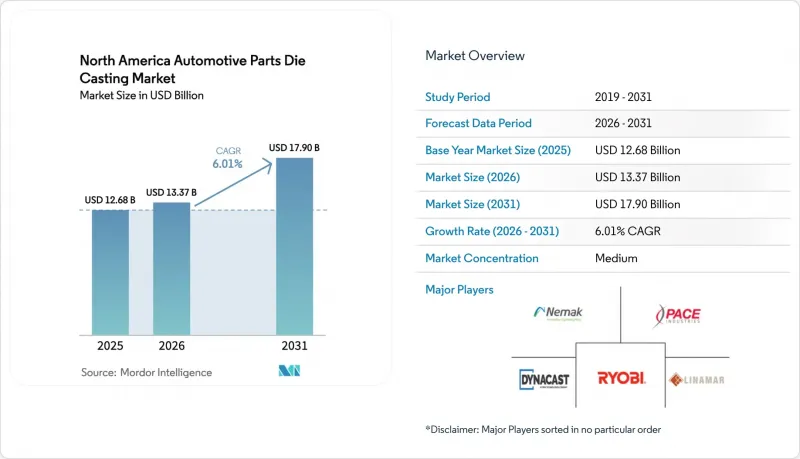
This report is Segmented by Raw Material (Aluminum, Magnesium, and Others), Process (Pressure Die Casting, Gravity Die Casting, and More), Application (Engine Components, and More), Vehicle Type (Passenger Cars, and More), End-Use Industry (Original Equipment Manufacturers, and Aftermarket), and Country. The Market Forecasts are Provided in Terms of Value (USD).
North America Automotive Parts Die Casting Market Trends and Insights
Exploding EV Battery-Housing Demand
As electric vehicles (EVs) continue to gain traction in the automotive market, battery trays have become a key driver in the growth of the die-casting segment. Tesla's innovative gigacasting for its rear underbody streamlines production by consolidating numerous parts and eliminating welds, resulting in cost savings and improved manufacturing efficiency. General Motors is advancing its electric vehicle (EV) production capabilities by installing high-capacity presses to support the manufacturing of components for its electric pickups. Meanwhile, Linamar's advanced press technology is contributing to Tesla's production efforts, highlighting Canada's growing prominence as a hub for gigacasting. These one-piece castings not only optimize production processes but also enhance battery safety by significantly reducing water-leak risks for vehicles operating within high-voltage ranges.
HPDC Gigacasting Adoption by NA OEMs
In 2025, General Motors, Ford, and Tesla secured significant multi-year contracts for structural gigacastings. Ford's Ontario facility, operational since late 2025, is set to deliver aluminum front and rear subframes for multiple electric vehicle (EV) platforms, streamlining production by significantly reducing the number of components and welds per vehicle. Linamar's Welland line highlights the substantial investments required in gigacasting technology . Gigacast front modules have transformed body-shop efficiency, drastically reducing production time while also improving crash absorption performance.
Aluminum/Magnesium Price Volatility
In 2025, aluminum prices experienced significant fluctuations, leading to margin compression due to delays in cost pass-through. Chinese export restrictions caused a sharp increase in magnesium prices, necessitating expensive alloy redesigns. This shift negatively impacted Linamar's casting margins. While rising aluminum prices can substantially increase the cost of producing a mid-size sedan, only a small proportion of die casters take the precaution of hedging prices.
Other drivers and restraints analyzed in the detailed report include:
- Light-Weighting Regulations and CAFE Tightening
- OEM Near-Shoring Under USMCA Rules Boosts Regional Die-Casting Volumes
- Capex Intensity of 4,000-ton Press Lines
For complete list of drivers and restraints, kindly check the Table Of Contents.
Segment Analysis
Aluminum alloys held 57.12% of the North American automotive parts die casting market share in 2025, riding on their balance of strength, thermal conductivity, and corrosion resistance. Magnesium is projected to outpace all materials at an 8.25% CAGR through 2031 thanks to its density advantage, despite a notable cost premium. Zinc claims a significant portion of output for door handles, buckles, and electronics, benefiting from die life that runs 10 times longer than aluminum. At Honda's Anna plant, aluminum boasts a high recycled content. This not only reduces lifecycle CO2 emissions but also bolsters compliance with United States-Mexico-Canada Agreement (USMCA) sourcing regulations. Meanwhile, at Meridian's Strathroy site, magnesium recycling has made significant progress, marking a stride in overcoming oxidation challenges.
Demand trends are influenced by both thermal and electromagnetic requirements. Aluminum, with its superior conductivity, is essential for battery trays that manage heat effectively. On the other hand, magnesium's properties make it ideal for shielding inverters in advanced systems. Research funded by the Department of Energy (DOE) is pushing towards a future where scrap-fed alloys dominate, aiming for recycled aluminum that matches the properties of primary alloys. These developments not only solidify aluminum's leading position but also carve out a substantial niche for magnesium in ultra-light EV modules.
High-pressure die casting accounted for 79.25% of volume in 2025, driven by 60-90 second cycles and thin-wall repeatability for housings and brackets. Vacuum die casting is projected to log a 7.86% CAGR through 2031, fueled by suspension knuckles and control arms that demand porosity below 0.5% for T6 heat treatment. Gravity die casting holds a significant position for low-volume prototype blocks, while squeeze casting is increasingly being used for steering knuckles, replacing heavier iron components.
Choosing a process involves balancing cost, volume, and mechanical objectives. Ryobi's innovative vacuum-valve system significantly reduces porosity, enabling welded A-pillars with impressive yield strength. Squeeze-cast engine mounts have demonstrated exceptional performance under heavy loads, proving their suitability for heavy-duty trucks. While High-Pressure Die Casting (HPDC) remains the preferred choice for thin-wall parts, both vacuum and squeeze methods are increasingly taking on structural roles, previously dominated by stampings, highlighting a diverse technological evolution in North America's automotive parts die casting landscape.
Complete Report Scope:
- By Raw Material
- Aluminum
- Magnesium
- Zinc
- Others
- By Process
- Pressure Die Casting
- High-Pressure
- Low-Pressure
- Gravity Die Casting
- Vacuum Die Casting
- Squeeze Die Casting
- Pressure Die Casting
- By Application
- Engine Components
- Blocks
- Cylinder Heads
- Transmission Components
- Housings
- Gear Cases
- Body Parts
- Structural Frames
- Brackets
- Electric Vehicle (EV) Components
- Battery Housings
- Motor Casings
- Others
- Engine Components
- By Vehicle Type
- Passenger Cars
- Light Commercial Vehicles
- Medium and Heavy Commercial Vehicles
- By End-Use Industry
- OEMs
- Aftermarket
- By Country
- United States
- Canada
- Rest of North America
List of Companies Covered in this Report:
- Nemak, S.A.B. de C.V.
- Pace Industries, Inc.
- Form Technologies (Dynacast)
- Ryobi Die Casting
- Linamar Corporation
- Martinrea International Inc.
- Dura | Shiloh
- Meridian Lightweight Technologies
- Gibbs Die Casting Corporation
- Alcast Technologies Ltd.
- Empire Casting Co
- KSM Castings Group
- Rheinmetall AG
- Cosma International
- Chicago White Metal Casting, Inc.
Additional Benefits:
- The market estimate (ME) sheet in Excel format
- 3 months of analyst support
TABLE OF CONTENTS
1 Introduction
- 1.1 Study Assumptions and Market Definition
- 1.2 Scope of the Study
2 Research Methodology
3 Executive Summary
4 Market Landscape
- 4.1 Market Overview
- 4.2 Market Drivers
- 4.2.1 Exploding Electric Vehicle (EV) Battery-Housing Demand
- 4.2.2 High-Pressure Die Casting (HPDC) Gigacasting Adoption by North America (NA) Original Equipment Manufacturers (OEMs)
- 4.2.3 Light-Weighting Regulations and Corporate Average Fuel Economy (CAFE) Tightening
- 4.2.4 Original Equipment Manufacturer (OEM) Near-Shoring Under United States-Mexico-Canada Agreement (USMCA) Rules Boosts Regional Die-Casting Volumes
- 4.2.5 Automation and Industry 4.0 Foundry Retrofits
- 4.2.6 Alloy Recipes Using Greater than/Equals 70 % Recycled Al/Mg Feedstock
- 4.3 Market Restraints
- 4.3.1 Aluminum/Magnesium Price Volatility
- 4.3.2 Capex Intensity of 4,000-ton Press Lines
- 4.3.3 Concentrated Magnesium (Mg) Supply Chain Risk
- 4.3.4 Environmental Protection Agency (EPA) and Occupational Safety and Health Administration (OSHA) Emissions / Waste-Slag Limits
- 4.4 Value / Supply-Chain Analysis
- 4.5 Regulatory Landscape
- 4.6 Technological Outlook
- 4.7 Porter's Five Forces
- 4.7.1 Threat of New Entrants
- 4.7.2 Bargaining Power of Suppliers
- 4.7.3 Bargaining Power of Buyers
- 4.7.4 Threat of Substitutes
- 4.7.5 Competitive Rivalry
5 Market Size and Growth Forecasts (Value in USD)
- 5.1 By Raw Material
- 5.1.1 Aluminum
- 5.1.2 Magnesium
- 5.1.3 Zinc
- 5.1.4 Others
- 5.2 By Process
- 5.2.1 Pressure Die Casting
- 5.2.1.1 High-Pressure
- 5.2.1.2 Low-Pressure
- 5.2.2 Gravity Die Casting
- 5.2.3 Vacuum Die Casting
- 5.2.4 Squeeze Die Casting
- 5.2.1 Pressure Die Casting
- 5.3 By Application
- 5.3.1 Engine Components
- 5.3.1.1 Blocks
- 5.3.1.2 Cylinder Heads
- 5.3.2 Transmission Components
- 5.3.2.1 Housings
- 5.3.2.2 Gear Cases
- 5.3.3 Body Parts
- 5.3.3.1 Structural Frames
- 5.3.3.2 Brackets
- 5.3.4 Electric Vehicle (EV) Components
- 5.3.4.1 Battery Housings
- 5.3.4.2 Motor Casings
- 5.3.5 Others
- 5.3.1 Engine Components
- 5.4 By Vehicle Type
- 5.4.1 Passenger Cars
- 5.4.2 Light Commercial Vehicles
- 5.4.3 Medium and Heavy Commercial Vehicles
- 5.5 By End-Use Industry
- 5.5.1 OEMs
- 5.5.2 Aftermarket
- 5.6 By Country
- 5.6.1 United States
- 5.6.2 Canada
- 5.6.3 Rest of North America
6 Competitive Landscape
- 6.1 Market Concentration
- 6.2 Strategic Moves
- 6.3 Market Share Analysis
- 6.4 Company Profiles (Includes Global Level Overview, Market Level Overview, Core Segments, Financials as Available, Strategic Information, Market Rank/Share for Key Companies, Products and Services, SWOT Analysis, and Recent Developments)
- 6.4.1 Nemak, S.A.B. de C.V.
- 6.4.2 Pace Industries, Inc.
- 6.4.3 Form Technologies (Dynacast)
- 6.4.4 Ryobi Die Casting
- 6.4.5 Linamar Corporation
- 6.4.6 Martinrea International Inc.
- 6.4.7 Dura | Shiloh
- 6.4.8 Meridian Lightweight Technologies
- 6.4.9 Gibbs Die Casting Corporation
- 6.4.10 Alcast Technologies Ltd.
- 6.4.11 Empire Casting Co
- 6.4.12 KSM Castings Group
- 6.4.13 Rheinmetall AG
- 6.4.14 Cosma International
- 6.4.15 Chicago White Metal Casting, Inc.
7 Market Opportunities & Future Outlook
- 7.1 White-space & Unmet-need Assessment

