PUBLISHER: Mordor Intelligence | PRODUCT CODE: 2113357

PUBLISHER: Mordor Intelligence | PRODUCT CODE: 2113357
United States Oil And Gas Midstream - Market Share Analysis, Industry Trends & Statistics, Growth Forecasts (2026 - 2031)
According to Mordor Intelligence, the United States oil and gas midstream market size was valued at USD 17.10 billion in 2025 and estimated to grow from USD 17.71 billion in 2026 to reach USD 21.08 billion by 2031, at a CAGR of 3.55% during the forecast period (2026-2031).
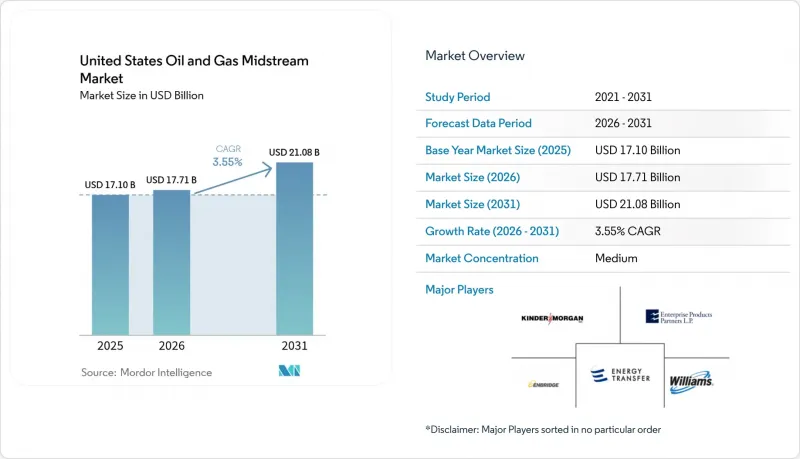
This report is Segmented by Infrastructure (Pipelines, Terminals, and Storage Facilities), Product Type (Crude Oil, Natural Gas, Refined Products, and LNG), and Service Type (Pipeline Construction, Pipeline Maintenance and Repair, Storage and Handling Services, and Transportation and Logistics). The Market Sizes and Forecasts are Provided in Terms of Value (USD).
United States Oil And Gas Midstream Market Trends and Insights
LNG-led Surge in Gulf Coast Export Capacity
Operational LNG capability is expected to increase to 21.2 Bcf/d by 2028, creating the single largest draw on pipeline throughput in the US oil and gas midstream market. Venture Global's USD 28 billion Calcasieu Pass 2, featuring a 91-mile feeder line, demonstrates how each terminal triggers interstate pipeline builds and compression upgrades. Cheniere's Corpus Christi Trains 8 & 9 add more than 3 Mtpa and require USD 50-100 million per interconnection for high-pressure tie-ins. Bidirectional design becomes standard, allowing lines to reverse during maintenance or hurricane disruptions, which adds cost but boosts resiliency. Concentrated Gulf activity tightens labor and specialty steel supply, elevating capital expenditures for smaller entrants.
Permian Crude & Associated-gas Production Growth
Permian output continues to outstrip takeaway, driving the need for new gathering, processing, and long-haul capacity across crude, gas, and NGL streams. Phillips 66's USD 300 million Iron Mesa plant, starting in 2027, captures gas once flared, while Tallgrass's 2.4 Bcf/d connector to Rockies Express unlocks western markets. Integrated operators switch volumes among crude, gas, and NGL pipelines based on hub spreads, maximizing system cash flow in the US oil and gas midstream market. Flow-optimization software defers the installation of new trunklines until volumes prove to be durable. Producers favor shippers that can offer multi-commodity take-or-pay contracts, tilting negotiation leverage toward large incumbents.
Federal Permitting Bottlenecks (NEPA, Sec 401)
One-year EIS targets set by Interior reduce paperwork, but lawsuits still stall rights-of-way, resulting in delay costs of up to USD 2 million per mile. Section 401 water reviews allow states to halt projects even when federal agencies approve, thereby prolonging the queue. Energy Transfer's Lake Charles LNG extension shows how serial FERC filings become routine in the US oil and gas midstream market. Developers front-load baseline studies and community outreach, inflating pre-FID spend but safeguarding schedules. Only the largest balance sheets can absorb multi-year delays without jeopardizing credit metrics.
Other drivers and restraints analyzed in the detailed report include:
- AI-Driven Data-Center Power Demand Boosting Gas Throughput
- Rising Ethane Recovery for Petrochemical Feedstock
- Activist Opposition / ESG Capital Constraints
For complete list of drivers and restraints, kindly check the Table Of Contents.
Segment Analysis
Pipelines supplied 44.25% of 2025 revenue for the US oil and gas midstream market and form the connective backbone among basins, processors, and docks. Capital cost averages USD 4 million per mile onshore, making trunkline investments sizable yet defensible when underpinned by 20-year take-or-pay contracts. Kinder Morgan's USD 9.3 billion backlog, two-thirds of which is dedicated to gas transmission, signals continued faith in continental grid expansion.
New builds emphasize bidirectional flow, sectionalized valves, and high-horsepower compression to swing gas between export and power-market pulls, features that older pipe lacks. Terminal infrastructure, although accounting for only 17.85% of 2025 revenue, is expected to advance at a 4.95% CAGR through 2031 as LNG and LPG docks proliferate. Calcasieu Pass 2 alone drives nearly 100 miles of new lateral pipe and twin loading berths, underscoring how each dock multiplies system spend. Storage caverns and tanks, often overlooked, yield optionality to capture shoulder-season arbitrage and to buffer ethane exports during license upheavals.
Complete Report Scope:
- By Infrastructure
- Pipelines
- Terminals
- Storage Facilities (Underground and Above-ground)
- By Product Type
- Crude Oil
- Natural Gas
- Refined Products
- LNG
- By Service Type
- Pipeline Construction
- Pipeline Maintenance and Repair
- Storage and Handling Services
- Transportation and Logistics
List of Companies Covered in this Report:
- Kinder Morgan Inc.
- Energy Transfer LP
- Enterprise Products Partners LP
- Enbridge Inc. (U.S. assets)
- Williams Companies Inc.
- MPLX LP
- ONEOK Inc.
- Plains All American Pipeline LP
- Targa Resources Corp.
- DT Midstream Inc.
- Cheniere Energy Inc.
- TC Energy Corp. (Columbia Gas)
- Magellan Midstream (ONEOK)
- WhiteWater Midstream LLC
- Atlantic Coast Pipeline LLC
- Maritimes & Northeast Pipeline LLC
- Tallgrass Energy LP
- Genesis Energy LP
- Shell Pipeline Company LP
- Freeport LNG Development LP
Additional Benefits:
- The market estimate (ME) sheet in Excel format
- 3 months of analyst support
TABLE OF CONTENTS
1 Introduction
- 1.1 Study Assumptions & Market Definition
- 1.2 Scope of the Study
2 Research Methodology
3 Executive Summary
4 Market Landscape
- 4.1 Market Overview
- 4.2 Market Drivers
- 4.2.1 LNG-led surge in Gulf Coast export capacity
- 4.2.2 Permian crude & associated-gas production growth
- 4.2.3 AI-driven data-center power demand boosting gas throughput
- 4.2.4 Rising ethane recovery for petrochemical feedstock
- 4.2.5 Digitization & predictive-maintenance adoption by operators
- 4.2.6 CCUS pipeline build-out incentives (IRA 45Q)
- 4.3 Market Restraints
- 4.3.1 Federal permitting bottlenecks (NEPA, Sec. 401)
- 4.3.2 Activist opposition / ESG capital constraints
- 4.3.3 Long-haul oil pipeline over-capacity in legacy corridors
- 4.3.4 China-focused ethane export license uncertainty
- 4.4 Supply-Chain Analysis
- 4.5 Regulatory Landscape
- 4.6 Technological Outlook
- 4.7 Installed Pipeline Capacity Analysis
- 4.8 Porter's Five Forces
- 4.8.1 Threat of New Entrants
- 4.8.2 Bargaining Power of Suppliers
- 4.8.3 Bargaining Power of Buyers
- 4.8.4 Threat of Substitutes
- 4.8.5 Industry Rivalry
- 4.9 PESTLE Analysis
5 Market Size & Growth Forecasts
- 5.1 By Infrastructure
- 5.1.1 Pipelines
- 5.1.2 Terminals
- 5.1.3 Storage Facilities (Underground and Above-ground)
- 5.2 By Product Type
- 5.2.1 Crude Oil
- 5.2.2 Natural Gas
- 5.2.3 Refined Products
- 5.2.4 LNG
- 5.3 By Service Type
- 5.3.1 Pipeline Construction
- 5.3.2 Pipeline Maintenance and Repair
- 5.3.3 Storage and Handling Services
- 5.3.4 Transportation and Logistics
6 Competitive Landscape
- 6.1 Market Concentration
- 6.2 Strategic Moves (M&A, Partnerships, PPAs)
- 6.3 Market Share Analysis (Market Rank/Share for key companies)
- 6.4 Company Profiles (includes Global level Overview, Market level overview, Core Segments, Financials as available, Strategic Information, Products & Services, and Recent Developments)
- 6.4.1 Kinder Morgan Inc.
- 6.4.2 Energy Transfer LP
- 6.4.3 Enterprise Products Partners LP
- 6.4.4 Enbridge Inc. (U.S. assets)
- 6.4.5 Williams Companies Inc.
- 6.4.6 MPLX LP
- 6.4.7 ONEOK Inc.
- 6.4.8 Plains All American Pipeline LP
- 6.4.9 Targa Resources Corp.
- 6.4.10 DT Midstream Inc.
- 6.4.11 Cheniere Energy Inc.
- 6.4.12 TC Energy Corp. (Columbia Gas)
- 6.4.13 Magellan Midstream (ONEOK)
- 6.4.14 WhiteWater Midstream LLC
- 6.4.15 Atlantic Coast Pipeline LLC
- 6.4.16 Maritimes & Northeast Pipeline LLC
- 6.4.17 Tallgrass Energy LP
- 6.4.18 Genesis Energy LP
- 6.4.19 Shell Pipeline Company LP
- 6.4.20 Freeport LNG Development LP
7 Market Opportunities & Future Outlook
- 7.1 White-space & Unmet-Need Assessment

