PUBLISHER: Mordor Intelligence | PRODUCT CODE: 2113801

PUBLISHER: Mordor Intelligence | PRODUCT CODE: 2113801
India Automotive Parts Aluminum Die Casting - Market Share Analysis, Industry Trends & Statistics, Growth Forecasts (2026 - 2031)
According to Mordor Intelligence, the India automotive parts aluminum die casting market size was valued at USD 1.71 billion in 2025 and estimated to grow from USD 1.83 billion in 2026 to reach USD 2.61 billion by 2031, at a CAGR of 7.29% during the forecast period (2026-2031).
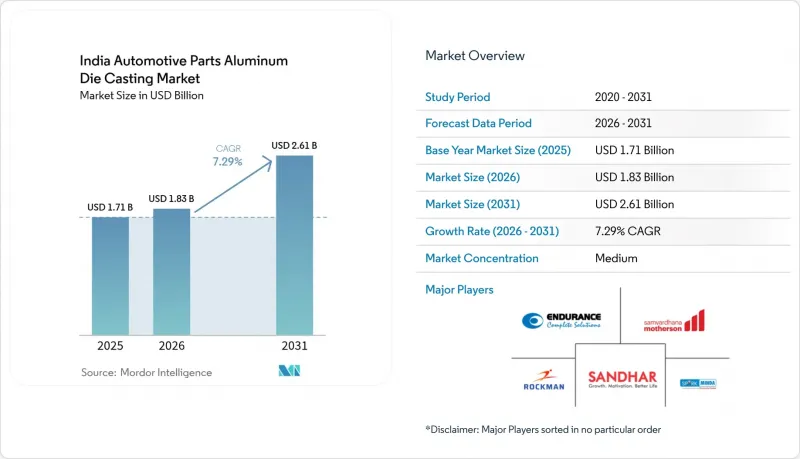
This report is Segmented by Production Process (Pressure Die Casting, Gravity Die Casting, and More), Application Type (Engine Parts, Body and Structural Parts, and More), Vehicle Type (Passenger Cars, Two-Wheelers, and More), Casting Alloy Family (Al-Si Alloys, and More), End-User, and Region. The Market Forecasts are Provided in Terms of Value (USD) and Volume (Tons).
India Automotive Parts Aluminum Die Casting Market Trends and Insights
Rising EV Production and Demand for Battery Housings
Electric-vehicle output surged at a 76% CAGR between 2020-2024, lifting EV components to 6% of total automotive part value. Battery enclosures demand Al-Mg alloys that provide electromagnetic shielding and crash energy absorption, spurring alloy innovation. A USD 2 billion annual sourcing agreement between Tesla and Tata Group suppliers underscores export potential. Thermal-management castings with intricate cooling channels emerge via low-pressure sand casting. ASK Automotive recorded 133% EV revenue growth after capacity expansion in Rajasthan and Karnataka plants. Production-Linked Incentives under FAME-II channel USD 1.1 billion toward advanced component facilities.
Vehicle Lightweighting and Fuel-Efficiency Norms
Corporate Average Fuel Economy rules and Bharat Stage VI standards accelerated aluminum substitution, pushing average content from 29 kg in 2024 toward 160 kg per vehicle by 2030. The shift cascades across casting supply chains, replacing ferrous parts with aluminum alternatives that trim mass by 40% without compromising stiffness. ICRA projects 9% annual domestic aluminum demand growth through 2025, with automotive uses dominant . High-pressure die casting now produces single-piece transmission housings, lowering manufacturing costs by up to 30%. Bureau of Indian Standards specifications harmonize alloy quality, ensuring mechanical properties remain within safety thresholds. Simulation-led design shortens development cycles and lowers defect rates as OEMs seek faster homologation.
Raw-Material Price Volatility and Power-Coal Shortages
Primary aluminum cash prices oscillated between USD 2,160 and USD 2,480 per tonne in 2024, while the Central Electricity Authority reported a 6% year-on-year rise in India's average industrial power tariff, squeezing die casters' operating margins. Coal supply issues forced smelters to import power-grade coal, raising costs. Hindalco committed USD 10 billion to expand capacity and transition toward renewables, hoping to stabilize input costs. Quarterly price-adjustment clauses now dominate OEM contracts, complicating forecast planning. Currency swings add risk for imported alloys and tool steel. To buffer volatility, leading die casters install scrap-melting lines, pushing recycled content toward 80% and lowering virgin-metal exposure.
Other drivers and restraints analyzed in the detailed report include:
- Growth in Domestic Passenger-Vehicle Production
- Export Demand Surge from ASEAN "China-De-Risking"
- High Capex for High-Tonnage HPDC Machines
For complete list of drivers and restraints, kindly check the Table Of Contents.
Segment Analysis
Pressure die casting captured 68.74% of the India automotive parts aluminum die casting market in 2025. Stronghold applications include engine blocks, gear housings, and integrated suspension arms, where tolerance windows below 50 microns are mandatory. Industry 4.0 dashboards track injection pressure, melt temperature, and cycle time, trimming rejection rates below 5%. The India automotive parts aluminum die casting market size generated by semi-solid rheocasting is small today, yet shows the highest 9.32% CAGR, thanks to lower porosity, making it ideal for EV battery cases exposed to thermal cycling. Gravity die casting persists in truck components with lower surface-finish needs, though share erodes as cost per part falls for high-pressure equipment.
Advanced simulation packs such as ProCAST and MAGMASOFT enable virtual gating trials, saving USD 0.5 million per tool set and accelerating PPAP sign-off. Automated die-spray robots and vacuum-assisted filling strengthen mechanical properties, crucial for safety-critical chassis parts. ISO 9001 and IATF 16949 certification levels now exceed 85% of installed capacity nationwide, raising baseline quality and attracting export orders from ASEAN assemblers seeking predictable dimensional profiles.
Engine parts held a 45.98% share in 2025, benefiting from aluminum's superior heat transfer that cools down-sized turbocharged engines more efficiently. The India automotive parts aluminum die casting market share for engine components will taper as EV penetration rises, yet absolute volume remains resilient due to hybrid powertrain complexity. Body and structural components grow fastest at 8.61% CAGR thanks to giga-casting adoption that consolidates rear under-bodies into single 60-kg castings. The India automotive parts aluminum die casting market size generated by battery housing castings may surpass engine blocks by the late 2020s as OEMs reorient platforms around skateboard architectures.
OEM validation protocols for structural castings now mirror BIW steel weld audits, demanding CT-scan inspections to verify internal integrity. End-users pay 15-20% price premiums for the elimination of 100-plus stamped parts and weld fixtures. Transmission and driveline castings remain steady as hybrids add planetary gearboxes. HVAC, steering, and brake parts embrace aluminum for corrosion resistance, especially in coastal cities where salt exposure accelerates oxidation on conventional ferrous alloys.
Complete Report Scope:
- By Production Process
- Pressure Die Casting
- Gravity Die Casting
- Semi-solid/Rheocasting
- By Application Type
- Engine Parts
- Body and Structural Parts
- Transmission and Driveline Parts
- E-mobility Battery Housings and Thermal Systems
- Other Applications (HVAC, Steering, Braking)
- By Vehicle Type
- Passenger Cars
- Two-Wheelers
- Three-Wheelers
- Light Commercial Vehicles
- Heavy Commercial Vehicles and Buses
- By Casting Alloy Family
- Al-Si Alloys (ADC12, LM-6 etc.)
- Al-Mg Alloys
- Al-Cu and Others
- By End-User
- OEM/Tier-1 Suppliers
- Independent Aftermarket
- By Region (India)
- West India
- South India
- North India
- East and North-East India
List of Companies Covered in this Report:
- Endurance Technologies
- Samvardhana Motherson Group
- Rockman Industries
- Sandhar Technologies
- Spark Minda (Minda Corp)
- Rico Auto Industries
- Jaya Hind Industries
- Sipra Quality Die Casting
- Form Technologies Inc. (Dynacast)
- Nemak India
- DR Axion India
- Indian Diecasting Industries
- Bhanderi Aluminium Casting
- Auto Die-Cast (New Delhi)
- Rane (Madras) Limited
Additional Benefits:
- The market estimate (ME) sheet in Excel format
- 3 months of analyst support
TABLE OF CONTENTS
1 Introduction
- 1.1 Study Assumptions & Market Definition
- 1.2 Scope of the Study
2 Research Methodology
3 Executive Summary
4 Market Landscape
- 4.1 Market Overview
- 4.2 Market Drivers
- 4.2.1 Rising EV Production and Demand for Battery Housings
- 4.2.2 Vehicle Lightweighting and Fuel-Efficiency Norms
- 4.2.3 Growth in Domestic Passenger-Vehicle Production
- 4.2.4 Export Demand Surge from ASEAN "China-De-Risking"
- 4.2.5 OEM Adoption of Giga/Mega-Casting Platforms
- 4.2.6 End-of-Life-Vehicle Rules Boosting Scrap Aluminum
- 4.3 Market Restraints
- 4.3.1 Raw-Material Price Volatility and Power-Coal Shortages
- 4.3.2 High Capex for High-Tonnage HPDC Machines
- 4.3.3 Skilled-Workforce Deficit in Simulation-Led Design
- 4.3.4 Competition from Hydroforming and Sheet-Metal Routes
- 4.4 Value / Supply-Chain Analysis
- 4.5 Regulatory Landscape
- 4.6 Technological Outlook
- 4.7 Porter's Five Forces
- 4.7.1 Bargaining Power of Buyers
- 4.7.2 Bargaining Power of Suppliers
- 4.7.3 Threat of New Entrants
- 4.7.4 Threat of Substitutes
- 4.7.5 Intensity of Competitive Rivalry
5 Market Size & Growth Forecasts (Value and Volume)
- 5.1 By Production Process
- 5.1.1 Pressure Die Casting
- 5.1.2 Gravity Die Casting
- 5.1.3 Semi-solid/Rheocasting
- 5.2 By Application Type
- 5.2.1 Engine Parts
- 5.2.2 Body and Structural Parts
- 5.2.3 Transmission and Driveline Parts
- 5.2.4 E-mobility Battery Housings and Thermal Systems
- 5.2.5 Other Applications (HVAC, Steering, Braking)
- 5.3 By Vehicle Type
- 5.3.1 Passenger Cars
- 5.3.2 Two-Wheelers
- 5.3.3 Three-Wheelers
- 5.3.4 Light Commercial Vehicles
- 5.3.5 Heavy Commercial Vehicles and Buses
- 5.4 By Casting Alloy Family
- 5.4.1 Al-Si Alloys (ADC12, LM-6 etc.)
- 5.4.2 Al-Mg Alloys
- 5.4.3 Al-Cu and Others
- 5.5 By End-User
- 5.5.1 OEM/Tier-1 Suppliers
- 5.5.2 Independent Aftermarket
- 5.6 By Region (India)
- 5.6.1 West India
- 5.6.2 South India
- 5.6.3 North India
- 5.6.4 East and North-East India
6 Competitive Landscape
- 6.1 Market Concentration
- 6.2 Strategic Moves
- 6.3 Market Share Analysis
- 6.4 Company Profiles (Includes Global Level Overview, Market Level Overview, Core Segments, Financials as Available, Strategic Information, Market Rank/Share for Key Companies, Products and Services, SWOT Analysis, and Recent Developments)
- 6.4.1 Endurance Technologies
- 6.4.2 Samvardhana Motherson Group
- 6.4.3 Rockman Industries
- 6.4.4 Sandhar Technologies
- 6.4.5 Spark Minda (Minda Corp)
- 6.4.6 Rico Auto Industries
- 6.4.7 Jaya Hind Industries
- 6.4.8 Sipra Quality Die Casting
- 6.4.9 Form Technologies Inc. (Dynacast)
- 6.4.10 Nemak India
- 6.4.11 DR Axion India
- 6.4.12 Indian Diecasting Industries
- 6.4.13 Bhanderi Aluminium Casting
- 6.4.14 Auto Die-Cast (New Delhi)
- 6.4.15 Rane (Madras) Limited
7 Market Opportunities & Future Outlook
- 7.1 White-space & Unmet-Need Assessment

