PUBLISHER: Mordor Intelligence | PRODUCT CODE: 2113866

PUBLISHER: Mordor Intelligence | PRODUCT CODE: 2113866
China Automotive Electric Power Steering (EPS) - Market Share Analysis, Industry Trends & Statistics, Growth Forecasts (2026 - 2031)
According to Mordor Intelligence, the chinese automotive electric power steering market size was valued at USD 17.91 billion in 2025 and is estimated to grow from USD 20.59 billion in 2026 to reach USD 41.39 billion by 2031, at a CAGR of 14.99% during the forecast period (2026-2031).
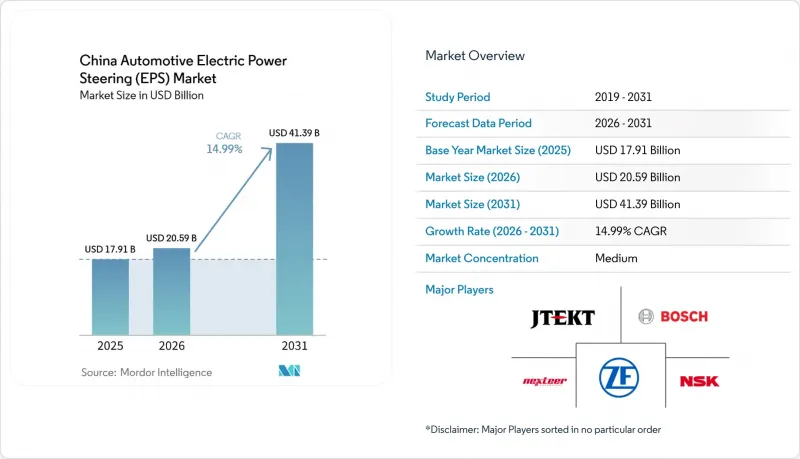
This report is Segmented by Type (Column Type, Pinion Type, and More), Component Type (Steering Column, Steering Rack and Mechanical Assembly, and More), Vehicle Type (Passenger Cars, Light Commercial Vehicles, and More), and Propulsion Type (Internal Combustion Engine Vehicles, Hybrid Electric Vehicles, and More). The Market Forecasts are Provided in Terms of Value (USD).
China Automotive Electric Power Steering (EPS) Market Trends and Insights
Vehicle Electrification and Hybridization
China's new energy vehicle penetration exceeded a major share of new passenger vehicle sales in 2025, while domestic new energy vehicle sales reached 16.49 million units. EPS is necessary on battery-electric vehicle platforms because the conventional engine-driven hydraulic pump is not available. This moves EPS from an optional equipment choice to a basic platform requirement for many new vehicle programs. Larger battery packs also increase steering-assist demands, especially in longer-range electric vehicles and sport utility vehicles. Those requirements support the use of dual-pinion and rack-assist designs when column systems cannot provide the required continuous torque. The China automotive electric power steering market benefits from this shift because each new electrified platform creates a defined requirement for electrically controlled steering, across mass-market cars, premium vehicles, sport utility vehicles, delivery fleets, and other models that are moving away from hydraulic arrangements, while these programs also require suppliers to coordinate steering specifications early with battery placement, vehicle weight, chassis geometry, motor capacity, electronic controls, production timing, and their customers' planned model ranges.
ADAS-Enabled Steering Functions
L2+ assisted-driving systems reached an 87.4% installation rate in domestic new energy passenger cars during January through April 2026 . The Ministry of Industry and Information Technology also reported that L2 driver-assist penetration reached 69% across new passenger car sales in early 2026. Lane keeping, automated parking, and lane-change functions require accurate electronic steering control. This gives EPS a central role in assisted-driving vehicle architecture rather than treating it as an isolated mechanical subsystem. Higher-function systems use additional sensors, control units, and software components compared with baseline column configurations. The Chinese automotive electric power steering market is therefore moving toward systems that can support vehicle automation requirements and stricter functional control needs, with steering response, sensor accuracy, software calibration, and control-unit capability becoming connected purchasing considerations for OEM engineering teams. The Chinese automotive electric power steering market also requires a reliable link between steering inputs, vehicle control functions, safety monitoring, vehicle testing, and routine operation across different road and weather conditions.
High Development and Validation Costs
Dual-pinion, rack-assist, and steer-by-wire systems require longer engineering and validation work than basic EPS products. The supplied research identifies certification cycles of 18-36 months under ISO 26262 for these systems. Suppliers must fund redundant hardware, diagnostic software, test processes, and external safety assessment before volume production. China Automotive Systems reported USD 365.3 million in Henglong passenger-vehicle steering revenue for 2025, illustrating the scale of the steering operations supporting these programs. Smaller domestic suppliers can find it difficult to match these multi-year investment commitments. The China automotive electric power steering market consequently gives scaled suppliers a stronger position in advanced systems, even as demand expands, because their earlier investments can be spread across more programs, larger production volumes, wider customer relationships, and several generations of steering technology. The Chinese automotive electric power steering market may therefore see smaller suppliers focus on selected components or established EPS products where technical entry requirements and engineering costs are more manageable.
Other drivers and restraints analyzed in the detailed report include:
- Fuel-Efficiency and Emission-Reduction Requirements
- Rising Adoption of Steer-by-Wire Architectures
- Electronic-System Reliability Under Harsh Operating Conditions
For complete list of drivers and restraints, kindly check the Table Of Contents.
Segment Analysis
Column EPS held 50.14% of the Chinese automotive electric power steering market size in 2025, supported by its fit with high-volume passenger cars. These vehicles commonly require a cost-conscious steering package with sufficient assist for normal urban driving. Column designs remain relevant in lower-priced vehicle programs where compact packaging and lower system cost are important. Their limits become clearer when heavier electric vehicles require higher continuous steering torque. The Chinese automotive electric power steering industry continues to depend on column EPS for volume, even as vehicle specifications become more demanding, because the design remains familiar to manufacturers, practical for compact vehicles, and suitable for many high-volume passenger-car applications where torque needs remain moderate.
Dual-pinion EPS is the fastest-growing type, with a forecast CAGR of 16.22% through 2031. Its motor position allows assist force to act closer to the rack, improving its suitability for higher-load applications. This configuration can also reduce the transfer of motor vibration through the steering column. Premium and mid-range new energy vehicle programs increasingly require these performance characteristics. Rack-assist EPS serves a related role in performance electric vehicles and electrified light commercial vehicles, where weight distribution and response requirements are more demanding and vehicle engineers place greater value on high-assist capability, stable response, direct rack support, and predictable steering feel.
The steering column accounted for 49.11% of component revenue in 2025, reflecting the extensive installed base of column EPS in mass-market passenger vehicles. The component remains a core physical part of an EPS system and continues to benefit from vehicle production volumes. Its leading position also reflects the long presence of column-based designs in China's passenger vehicle fleet. These established applications still support the Chinese automotive electric power steering market size for conventional components. However, vehicle electrification and assisted-driving functions are changing the relative value of electronic components within each system, because sensors, control units, motors, power electronics, diagnostics, and calibration software must work together to deliver the precise response required by modern vehicle platforms.
Torque and position sensors are forecast to grow at a 15.84% CAGR through 2031, making them the fastest-growing component group. Their role expands when assisted-driving functions need more precise steering-angle and torque information. Electronic control units, motors, and power electronics are also being adapted to meet changing insulation, heat management, and control requirements. Software calibration has become more important as suppliers seek to tailor steering response and support new vehicle functions, allowing individual vehicle programs to set different steering characteristics while meeting the control, safety, comfort, and assisted-driving requirements defined by each OEM.
Complete Report Scope:
- By Type
- Column Type
- Pinion Type
- Dual-Pinion Type
- Rack-Assist Type
- By Component Type
- Steering Column
- Steering Rack and Mechanical Assembly
- Torque and Position Sensors
- Steering Motor
- Electronic Control Unit
- Power Electronics
- Software and Calibration
- Other Component Types
- By Vehicle Type
- Passenger Cars
- Hatchbacks
- Sedans
- Sport Utility Vehicles
- Coupes
- Light Commercial Vehicles
- Medium and Heavy Commercial Vehicles
- Buses and Coaches
- Passenger Cars
- By Propulsion Type
- Internal Combustion Engine Vehicles
- Hybrid Electric Vehicles
- Plug-in Hybrid Electric Vehicles
- Battery Electric Vehicles
List of Companies Covered in this Report:
- JTEKT Corporation
- Robert Bosch GmbH
- Nexteer Automotive
- ZF Friedrichshafen AG
- NSK Ltd.
- Hyundai Mobis Co., Ltd.
- DENSO Corporation
- Astemo, Ltd.
- Mitsubishi Electric Corporation
- thyssenkrupp AG
- HL Mando Corporation
- Schaeffler AG
- KYB Corporation
- China Automotive Systems, Inc.
- Zhejiang Shibao Company Limited
- Global Steering Systems LLC
Additional Benefits:
- The market estimate (ME) sheet in Excel format
- 3 months of analyst support
TABLE OF CONTENTS
1 Introduction
- 1.1 Study Assumptions and Market Definition
- 1.2 Scope of the Study
2 Research Methodology
3 Executive Summary
4 Market Landscape
- 4.1 Market Overview
- 4.2 Market Drivers
- 4.2.1 Vehicle Electrification and Hybridization
- 4.2.2 ADAS-Enabled Steering Functions
- 4.2.3 Fuel-Efficiency and Emission-Reduction Requirements
- 4.2.4 Rising Adoption of Steer-by-Wire Architectures
- 4.2.5 High-Torque Steering Demand in SUVs and Electric Commercial Vehicles
- 4.2.6 Software-Defined Steering Calibration and Feature Personalization
- 4.3 Market Restraints
- 4.3.1 High Development and Validation Costs
- 4.3.2 Electronic-System Reliability Under Harsh Operating Conditions
- 4.3.3 Semiconductor and Motor-Controller Supply Volatility
- 4.3.4 Limited Retrofitting Options in Existing Vehicles
- 4.4 Supply-Chain Analysis
- 4.5 Regulatory Landscape
- 4.6 Technological Outlook
- 4.7 Porter's Five Forces
- 4.7.1 Threat of New Entrants
- 4.7.2 Bargaining Power of Buyers/Consumers
- 4.7.3 Bargaining Power of Suppliers
- 4.7.4 Threat of Substitute Products
- 4.7.5 Intensity of Competitive Rivalry
5 Market Size and Growth Forecasts (Value (USD))
- 5.1 By Type
- 5.1.1 Column Type
- 5.1.2 Pinion Type
- 5.1.3 Dual-Pinion Type
- 5.1.4 Rack-Assist Type
- 5.2 By Component Type
- 5.2.1 Steering Column
- 5.2.2 Steering Rack and Mechanical Assembly
- 5.2.3 Torque and Position Sensors
- 5.2.4 Steering Motor
- 5.2.5 Electronic Control Unit
- 5.2.6 Power Electronics
- 5.2.7 Software and Calibration
- 5.2.8 Other Component Types
- 5.3 By Vehicle Type
- 5.3.1 Passenger Cars
- 5.3.1.1 Hatchbacks
- 5.3.1.2 Sedans
- 5.3.1.3 Sport Utility Vehicles
- 5.3.1.4 Coupes
- 5.3.2 Light Commercial Vehicles
- 5.3.3 Medium and Heavy Commercial Vehicles
- 5.3.4 Buses and Coaches
- 5.3.1 Passenger Cars
- 5.4 By Propulsion Type
- 5.4.1 Internal Combustion Engine Vehicles
- 5.4.2 Hybrid Electric Vehicles
- 5.4.3 Plug-in Hybrid Electric Vehicles
- 5.4.4 Battery Electric Vehicles
6 Competitive Landscape
- 6.1 Market Concentration
- 6.2 Strategic Moves
- 6.3 Market Share Analysis
- 6.4 Company Profiles (includes Global Level Overview, Market Level Overview, Core Segments, Financials as Available, Strategic Information, Market Rank/Share for Key Companies, Products and Services, SWOT Analysis, and Recent Developments)
- 6.4.1 JTEKT Corporation
- 6.4.2 Robert Bosch GmbH
- 6.4.3 Nexteer Automotive
- 6.4.4 ZF Friedrichshafen AG
- 6.4.5 NSK Ltd.
- 6.4.6 Hyundai Mobis Co., Ltd.
- 6.4.7 DENSO Corporation
- 6.4.8 Astemo, Ltd.
- 6.4.9 Mitsubishi Electric Corporation
- 6.4.10 thyssenkrupp AG
- 6.4.11 HL Mando Corporation
- 6.4.12 Schaeffler AG
- 6.4.13 KYB Corporation
- 6.4.14 China Automotive Systems, Inc.
- 6.4.15 Zhejiang Shibao Company Limited
- 6.4.16 Global Steering Systems LLC
7 Market Opportunities and Future Outlook
- 7.1 White-space and Unmet-Need Assessment

