PUBLISHER: Mordor Intelligence | PRODUCT CODE: 2113925

PUBLISHER: Mordor Intelligence | PRODUCT CODE: 2113925
Negative Pressure Wound Therapy - Market Share Analysis, Industry Trends & Statistics, Growth Forecasts (2026 - 2031)
According to Mordor Intelligence, the negative pressure wound therapy market size stands at USD 3.16 billion in 2026 and is projected to reach USD 4.26 billion by 2031, advancing at a 6.17% CAGR.
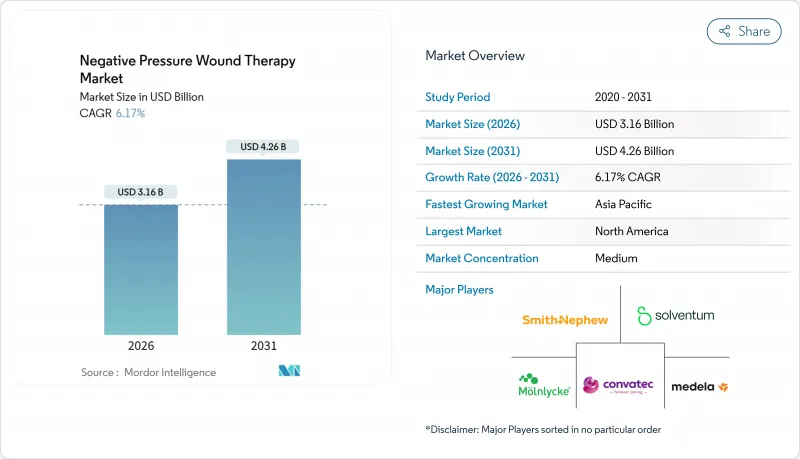
This report is Segmented by Product Type (Conventional/Re-usable Systems, Single-use/Disposable Systems, Accessories[canisters and More]), Mode of Delivery (Portable, Stand-alone/Stationary), Wound Type (Diabetic Foot Ulcer, Pressure Ulcer, and More), End User (Hospitals, and More), and Geography (North America, and More). Market Forecasts are Provided in Value (USD).
Global Negative Pressure Wound Therapy Market Trends and Insights
Increasing Incidence of Traumatic & Chronic Wounds
Road traffic injuries kill 1.35 million people every year, and survivors often present with complex soft-tissue trauma that heals faster under consistent negative pressure. Pressure ulcers affect up to 3 million U.S. residents yearly and create a USD 20 billion cost burden that payers aim to cut with early NPWT deployment. Populations over 65 now make up a growing share of OECD countries, and impaired healing in this cohort pushes clinicians toward therapies that accelerate granulation. Surgical site infections appear in 2%-5% of inpatient procedures, convincing surgeons to apply prophylactic negative pressure to clean, closed incisions after the FDA expanded labeling in 2024. Trauma centers in Ukraine and Gaza documented a 40% rise in complex extremity wounds during 2024, and field surgeons routinely requested portable NPWT units to avoid secondary amputations.
Growing Diabetic-Foot & Venous-Leg Ulcer Prevalence
The International Diabetes Federation counted 537 million adults living with diabetes in 2024, and an estimated 6.3% suffered at least one foot ulcer. Recurrence rates reach 40% within one year and 65% within five, turning each patient into a repeat consumer of dressings and pumps. Venous leg ulcers occur in 1% of adults in developed economies and respond well to NPWT when compression therapy alone fails. Amputations tied to diabetes rose 15% in the United States between 2020 and 2024, prompting wider Medicare coverage for home-care negative pressure applications. India's national non-communicable disease program earmarked USD 150 million in 2024 to subsidize NPWT consumables in public hospitals, signaling long-term demand growth.
High Device & Therapy Costs
Capital prices for reusable pumps range from USD 8,000 to USD 15,000, and four weeks of disposables can add USD 2,500, a sum that exceeds annual health spending per capita in many low-income countries. Leasing contracts ease capital outlay but lock hospitals into single-vendor ecosystems for up to five years. Single-use kits cost USD 400-800 each and remain unaffordable for self-pay patients in rural India even after subsidies. Cost-effectiveness studies show a 20% episode-of-care saving when NPWT replaces extended inpatient treatment, but hospitals rarely capture that benefit directly.
Other drivers and restraints analyzed in the detailed report include:
- Continuous Technological Innovation in NPWT Pumps
- Wider Reimbursement in the U.S. & EU-5
- Procedural Complications (Bleeding, Infection)
For complete list of drivers and restraints, kindly check the Table Of Contents.
Segment Analysis
Reusable pumps retained 66.56% share of the negative pressure wound therapy market in 2025, favored by hospitals that amortize capital over seven years and value adjustable pressure settings. Single-use disposables are on course for a 9.62% CAGR to 2031 as ambulatory surgical centers elevate infection-control protocols. These facilities like the fact that every kit arrives sterile and leaves with the patient, eliminating re-processing. Accessories such as dressings, drapes, and canisters form a steady consumable stream that shields revenue when capital budgets tighten. Proprietary connectors ensure brand loyalty because rival dressings will not fit the pump head. Disposables flourish where payers cover the higher per-episode cost to avoid cross-contamination claims, a trend most apparent in the United States.
Reusable platforms stay relevant in trauma centers that cycle one pump across multiple high-exudate wounds each day, keeping per-patient costs low. Competition intensifies as smaller firms leverage the FDA's 510(k) route to launch niche devices within nine months, undercutting multinationals on price without sacrificing core functionality. The negative pressure wound therapy industry now watches whether European payers will follow U.S. malpractice trends that favor disposables despite the waste burden.
Portable devices captured 58.63% of delivery-mode revenue in 2025 and aim for a 9.13% CAGR through 2031 as payers shift costs from hospital beds to home settings. Weighing under 500 grams and running silently at 45 decibels, modern pumps permit patients to sleep comfortably and walk freely, which improves compliance. Battery endurance of up to ten days reduces caregiver visits for recharging.
Stationary pumps remain indispensable in intensive care units where wound exudate can exceed 200 mL per hour and instillation cycles demand precise fluid management. Medicare reimburses both modes equally, but commercial insurers often require portable systems for post-discharge coverage. Manufacturers differentiate on alarm logic and cloud connectivity rather than suction power, signaling that software now drives procurement. Portable pumps therefore set the tone for home-care business models, while stationary units find a stable niche in high-acuity wards. The negative pressure wound therapy market now hinges on whether remote monitoring can convince lagging payers that home care delivers outcomes equal to inpatient treatment.
Complete Report Scope:
- By Product Type
- Conventional / Re-usable NPWT Systems
- Single-use / Disposable NPWT Systems
- NPWT Accessories
- Canisters
- Dressings & Drapes
- Tubing & Connectors
- By Mode of Delivery
- Portable Systems
- Stand-alone / Stationary Systems
- By Wound Type
- Diabetic Foot Ulcer
- Pressure Ulcer
- Venous Leg Ulcer
- Burn Wounds
- Traumatic & Surgical Wounds
- Other Wound Types
- By End User
- Hospitals
- Ambulatory Surgical Centers
- Home-care Settings
- Other End Users
- By Geography
- North America
- United States
- Canada
- Mexico
- Europe
- Germany
- France
- United Kingdom
- Italy
- Spain
- Rest of Europe
- Asia-Pacific
- China
- Japan
- India
- South Korea
- Australia
- Rest of Asia-Pacific
- Middle East & Africa
- GCC
- South Africa
- Rest of Middle East & Africa
- South America
- Brazil
- Argentina
- Rest of South America
- North America
Geography Analysis
North America contributed 39.61% of global revenue in 2025, anchored by predictable Medicare rules and brisk FDA clearance cycles that encourage product refreshes every two years. The 2024 expansion of LCD L33821 to high-risk incisions swelled the eligible patient base overnight. Canada lags the United States because provincial funding differs; Ontario reimburses home-care NPWT, but Alberta confines coverage to inpatient use. Mexico's private hospitals attract medical tourists from the United States, boosting imports of portable pumps that meet Joint Commission standards. Rural North American regions still see patchy access, and the Indian Health Service only started funding NPWT units for tribal facilities in 2024, indicating room for growth.
Europe's uptake remains uneven. Germany reimburses home use provided weekly teleconsults document progress, driving the region's highest per-capita utilization. The UK's NHS lists NPWT on its formulary but restricts indications through local commissioning groups. France demands prior authorization, which delays therapy initiation by weeks. Italy and Spain face fiscal constraints and reserve NPWT for teaching hospitals. EU Regulation 2017/745 raised compliance costs, causing smaller domestic suppliers to exit and concentrate share with multinationals, which could reshape competitive dynamics if reimbursement harmonizes.
Asia-Pacific posts the swiftest 8.72% CAGR to 2031. China's Healthy China 2030 program funds county-level wound-care clinics, while India's National Health Mission subsidizes consumables in 150 district hospitals. Japan's elderly population would support demand, yet low reimbursement rates slow adoption outside university centers. South Korea broadened coverage to post-operative wounds in 2024 and saw device sales jump 35% year on year. Australia reimburses consumables but not pumps, leading hospitals to favor reusable models. Southeast Asian countries such as Indonesia rely on humanitarian donations, showing latent potential once payer frameworks mature.
South America's growth is led by Brazil, where private insurers reimburse NPWT, but SUS still excludes single-use kits, splitting the market. Argentina's inflation deters importers, limiting access to high-margin private clinics. Chile added NPWT for diabetic-foot ulcers under FONASA in 2024, but budget strain limits rollout. Currency stability and domestic production approvals, like ANVISA's 2024 nod for Brazilian-made consumables, will determine whether the region moves from niche to mainstream adoption.
- Atmos MedizinTechnik GmbH
- BSN Medical (Essity AB)
- Cardinal Health
- Carilex Medical GmbH
- ConvaTec Group plc
- Cork Medical LLC
- DeRoyal Industries
- Equinox Medical
- Genadyne Biotechnologies Inc.
- Lohmann & Rauscher GmbH
- Medela
- Molnlycke Health Care
- Hartmann Group
- Prospera Technologies
- Smiths Group
- Solventum
- Spiracur Inc.
- Talley Group
Additional Benefits:
- The market estimate (ME) sheet in Excel format
- 3 months of analyst support
TABLE OF CONTENTS
1 Introduction
- 1.1 Study Assumptions & Market Definition
- 1.2 Scope of the Study
2 Research Methodology
3 Executive Summary
4 Market Landscape
- 4.1 Market Drivers
- 4.1.1 Increasing Incidence of Traumatic & Chronic Wounds
- 4.1.2 Growing Diabetic-Foot & Venous-Leg Ulcer Prevalence
- 4.1.3 Continuous Technological Innovation In NPWT Pumps
- 4.1.4 Wider Reimbursement in The U.S. & EU-5
- 4.1.5 Integration With Digital Wound-Monitoring Platforms
- 4.1.6 Humanitarian & Military Field Adoption Surge
- 4.2 Market Restraints
- 4.2.1 High Device & Therapy Costs
- 4.2.2 Procedural Complications (Bleeding, Infection)
- 4.2.3 Uncertain Reimbursement for Single-Use Systems in Ems
- 4.2.4 Disposal Regulations for Single-Use NPWT Waste
- 4.3 Value / Supply-Chain Analysis
- 4.4 Regulatory Landscape
- 4.5 Technological Outlook
- 4.6 Porter's Five Forces Analysis
- 4.6.1 Bargaining Power of Suppliers
- 4.6.2 Bargaining Power of Buyers
- 4.6.3 Threat of New Entrants
- 4.6.4 Threat of Substitutes
- 4.6.5 Intensity of Competitive Rivalry
5 Market Size & Growth Forecasts ( Value in USD)
- 5.1 By Product Type
- 5.1.1 Conventional / Re-usable NPWT Systems
- 5.1.2 Single-use / Disposable NPWT Systems
- 5.1.3 NPWT Accessories
- 5.1.3.1 Canisters
- 5.1.3.2 Dressings & Drapes
- 5.1.3.3 Tubing & Connectors
- 5.2 By Mode of Delivery
- 5.2.1 Portable Systems
- 5.2.2 Stand-alone / Stationary Systems
- 5.3 By Wound Type
- 5.3.1 Diabetic Foot Ulcer
- 5.3.2 Pressure Ulcer
- 5.3.3 Venous Leg Ulcer
- 5.3.4 Burn Wounds
- 5.3.5 Traumatic & Surgical Wounds
- 5.3.6 Other Wound Types
- 5.4 By End User
- 5.4.1 Hospitals
- 5.4.2 Ambulatory Surgical Centers
- 5.4.3 Home-care Settings
- 5.4.4 Other End Users
- 5.5 By Geography
- 5.5.1 North America
- 5.5.1.1 United States
- 5.5.1.2 Canada
- 5.5.1.3 Mexico
- 5.5.2 Europe
- 5.5.2.1 Germany
- 5.5.2.2 France
- 5.5.2.3 United Kingdom
- 5.5.2.4 Italy
- 5.5.2.5 Spain
- 5.5.2.6 Rest of Europe
- 5.5.3 Asia-Pacific
- 5.5.3.1 China
- 5.5.3.2 Japan
- 5.5.3.3 India
- 5.5.3.4 South Korea
- 5.5.3.5 Australia
- 5.5.3.6 Rest of Asia-Pacific
- 5.5.4 Middle East & Africa
- 5.5.4.1 GCC
- 5.5.4.2 South Africa
- 5.5.4.3 Rest of Middle East & Africa
- 5.5.5 South America
- 5.5.5.1 Brazil
- 5.5.5.2 Argentina
- 5.5.5.3 Rest of South America
- 5.5.1 North America
6 Competitive Landscape
- 6.1 Market Concentration
- 6.2 Market Share Analysis
- 6.3 Company Profiles (includes Global level Overview, Market level overview, Core Segments, Financials as available, Strategic Information, Market Rank/Share for key companies, Products & Services, and Recent Developments)
- 6.3.1 Atmos MedizinTechnik GmbH
- 6.3.2 BSN Medical (Essity AB)
- 6.3.3 Cardinal Health Inc.
- 6.3.4 Carilex Medical GmbH
- 6.3.5 ConvaTec Group plc
- 6.3.6 Cork Medical LLC
- 6.3.7 DeRoyal Industries Inc.
- 6.3.8 Equinox Medical
- 6.3.9 Genadyne Biotechnologies Inc.
- 6.3.10 Lohmann & Rauscher GmbH
- 6.3.11 Medela AG
- 6.3.12 Molnlycke Health Care AB
- 6.3.13 Paul Hartmann AG
- 6.3.14 Prospera Technologies
- 6.3.15 Smith & Nephew plc
- 6.3.16 Solventum
- 6.3.17 Spiracur Inc.
- 6.3.18 Talley Group Ltd
7 Market Opportunities & Future Outlook
- 7.1 White-space & Unmet-need Assessment

