PUBLISHER: Mordor Intelligence | PRODUCT CODE: 2114731

PUBLISHER: Mordor Intelligence | PRODUCT CODE: 2114731
Hot And Cold Therapy Packs - Market Share Analysis, Industry Trends & Statistics, Growth Forecasts (2026 - 2031)
According to Mordor Intelligence, the hot and cold therapy packs market size is estimated at USD 1.68 billion in 2026, and is expected to reach USD 2.21 billion by 2031, at a CAGR of 5.64% during the forecast period (2026-2031).
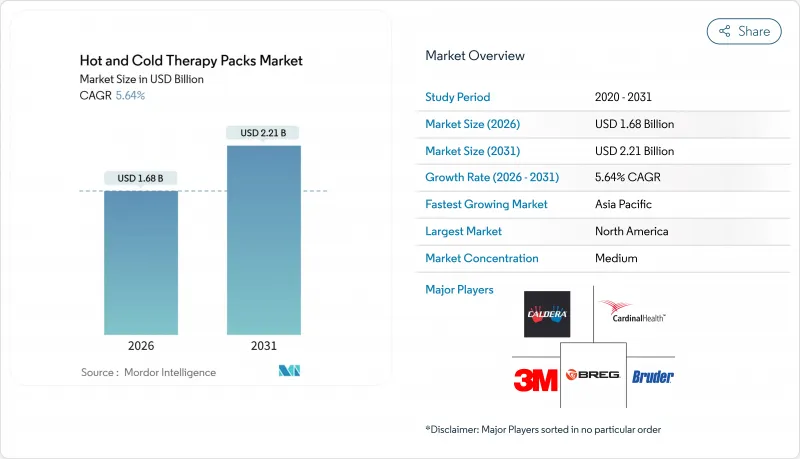
This report is Segmented by Product Type (Instant Electric Hot/Cold Packs, Dry & Moist Hot and Cold Packs, Gel Packs, Hybrid Compression Therapy Packs), Application (Sports Injury, Neuropathic Pain, Post-Surgical Recovery, and More), End User (Hospitals & Clinics, and More), and Geography (North America, Europe, and More). The Market Forecasts are Provided in Terms of Value (USD).
Global Hot And Cold Therapy Packs Market Trends and Insights
Rising Prevalence of Musculoskeletal Disorders & Chronic Pain
Musculoskeletal conditions affected 1.71 billion people, with low back pain alone responsible for 70.2 million years lived with disability. The Lancet projects osteoarthritis cases to more than double by 2050, a trend tied to obesity and longevity. Thermal packs provide vasodilation or vasoconstriction without systemic side effects, making them first-line adjuncts in rehabilitation. As payers shift to bundled payments, reusable devices that lower per-episode costs are favored. This structural demand underpins the steady expansion of the hot and cold therapy packs market.
Increasing Sports Injuries and Fitness Participation
The United States recorded 8.6 million sports injuries in 2023, including 3.5 million among youths under 14 years. Cold packs remain embedded in RICE protocols for acute trauma, while heat aids chronic overuse recovery. The sports medicine sector's trajectory bolsters the uptake of accessory products. Wearable technology encourages self-directed recovery, boosting sales of retail gel packs. Rising participation in organized athletics worldwide expands the addressable consumer pool, fueling the market for hot and cold therapy packs.
Competition From Low-Cost Analgesics & Alternative Therapies
Topical NSAID gels retail for USD 5-15, undercutting reusable packs priced at USD 20-50. TENS devices and ultrasound therapy offer additional alternatives. Price gaps are most damaging in regions where out-of-pocket spending is the primary concern. Manufacturers counter by emphasizing the importance of safety for patients with NSAID contraindications. Still, competitive pressure tempers the overall growth of the hot and cold therapy packs market.
Other drivers and restraints analyzed in the detailed report include:
- Growing Home-Based, Non-Pharmacological Pain Management Adoption
- Femtech-Oriented Packs for Menstrual Pain & Women's Wellness
- Limited Awareness & Correct Usage in Low-Income Regions
For complete list of drivers and restraints, kindly check the Table Of Contents.
Segment Analysis
Hybrid compression therapy packs are projected to lead segment growth at a 7.36% CAGR through 2031. These systems bundle cryotherapy with intermittent compression to curb post-operative edema, complementing enhanced recovery protocols in orthopedic surgery. Instant electric packs, despite a 47.11% share in 2025, face scrutiny after multiple recalls, prompting purchasers to diversify their suppliers. Gel packs utilize PCM upgrades that extend the effective temperature window to 60 minutes, enabling physiotherapy sessions without mid-treatment adjustments.
Electric packs still anchor the hot and cold therapy packs market because hospitals value on-demand heating. Yet rising utility costs and sustainability mandates favor passive alternatives. Moist heat variants, which enable deeper tissue penetration, are finding traction in chronic pain clinics. Collectively, the product landscape is diversifying, setting the stage for iterative innovation that will widen the hot and cold therapy packs market size over the forecast period.
Complete Report Scope:
- By Product Type
- Instant Electric Hot/Cold Packs
- Dry & Moist Hot and Cold Packs
- Gel Packs
- Hybrid Compression Therapy Packs
- By Application
- Sports Injury
- Neuropathic Pain
- Post-Surgical Recovery
- Chronic Musculoskeletal Disorders
- Other Applications
- By End User
- Hospitals & Clinics
- Physiotherapy & Rehabilitation Centers
- Home Healthcare
- Other End Users
- By Geography
- North America
- United States
- Canada
- Mexico
- Europe
- Germany
- United Kingdom
- France
- Italy
- Spain
- Rest of Europe
- Asia-Pacific
- China
- Japan
- India
- Australia
- South Korea
- Rest of Asia-Pacific
- Middle East & Africa
- GCC
- South Africa
- Rest of Middle East & Africa
- South America
- Brazil
- Argentina
- Rest of South America
- North America
Geography Analysis
North America accounted for 37.46% of the 2025 revenue, a position supported by Medicare coverage of durable medical equipment and the presence of over 6,100 ambulatory surgery centers that incorporate thermal therapy into standardized protocols. Canada's publicly funded system favors reusable gel packs to drive cost savings, while Mexico's expanding private insurance boosts interest in premium electric units.
Asia Pacific is projected to register an 8.22% CAGR through 2031, the fastest growth rate worldwide. China's Healthy China 2030 plan, India's Ayushman Bharat insurance expansion, and Japan's super-aged population collectively fuel volume growth. Connected packs gain early traction in South Korea and Singapore, where 5G infrastructure and tele-health reimbursement are mature. The hot and cold therapy packs market size in the region is therefore set to expand rapidly, especially in tier-2 cities that demand cost-effective gel solutions.
Europe's adoption trajectory is shaped by the Medical Device Regulation 2017/745, which is encouraging suppliers to adopt recyclable materials. Germany and the United Kingdom lead in per-capita consumption, while Southern Europe remains price-sensitive. Emerging markets in the Middle East, notably Saudi Arabia and the United Arab Emirates, mirror North American preferences. In contrast, much of sub-Saharan Africa contends with distribution gaps that slow uptake.
- 3M
- Beiersdorf
- Beurer
- Breg
- Bruder Healthcare Company
- Caldera International Inc.
- Cardinal Health
- Core Products International
- DJO LLC (Enovis)
- Halyard Worldwide Inc.
- Hisamitsu Pharmaceutical Co.
- Johnson & Johnson
- Medline Industries
- Ossur
- Performance Health (Biofreeze)
- Pfizer Inc. (ThermaCare)
- Polar Products Inc.
- Rapid Aid Corp.
- Sanofi (Icy Hot)
Additional Benefits:
- The market estimate (ME) sheet in Excel format
- 3 months of analyst support
TABLE OF CONTENTS
1 Introduction
- 1.1 Study Assumptions & Market Definition
- 1.2 Scope of the Study
2 Research Methodology
3 Executive Summary
4 Market Landscape
- 4.1 Market Overview
- 4.2 Market Drivers
- 4.2.1 Rising Prevalence of Musculoskeletal Disorders & Chronic Pain
- 4.2.2 Increasing Sports Injuries and Fitness Participation
- 4.2.3 Growing Home-Based, Non-Pharmacological Pain Management Adoption
- 4.2.4 Femtech-Oriented Packs for Menstrual Pain & Women's Wellness
- 4.2.5 Smart, Connected Packs Enabling Data-Driven Tele-Rehab
- 4.2.6 Technological Advances in Gels & PCM Materials
- 4.3 Market Restraints
- 4.3.1 Competition From Low-Cost Analgesics & Alternative Therapies
- 4.3.2 Limited Awareness & Correct Usage in Low-Income Regions
- 4.3.3 Regulatory Pressure on Pack Recyclability & Eco-Compliance
- 4.3.4 Regulatory Recalls of Faulty Electric Heating Pads
- 4.4 Value / Supply-Chain Analysis
- 4.5 Regulatory Landscape
- 4.6 Technological Outlook
- 4.7 Porter's Five Forces Analysis
- 4.7.1 Threat of New Entrants
- 4.7.2 Bargaining Power of Buyers
- 4.7.3 Bargaining Power of Suppliers
- 4.7.4 Threat of Substitutes
- 4.7.5 Competitive Rivalry
5 Market Size & Growth Forecasts
- 5.1 By Product Type
- 5.1.1 Instant Electric Hot/Cold Packs
- 5.1.2 Dry & Moist Hot and Cold Packs
- 5.1.3 Gel Packs
- 5.1.4 Hybrid Compression Therapy Packs
- 5.2 By Application
- 5.2.1 Sports Injury
- 5.2.2 Neuropathic Pain
- 5.2.3 Post-Surgical Recovery
- 5.2.4 Chronic Musculoskeletal Disorders
- 5.2.5 Other Applications
- 5.3 By End User
- 5.3.1 Hospitals & Clinics
- 5.3.2 Physiotherapy & Rehabilitation Centers
- 5.3.3 Home Healthcare
- 5.3.4 Other End Users
- 5.4 By Geography
- 5.4.1 North America
- 5.4.1.1 United States
- 5.4.1.2 Canada
- 5.4.1.3 Mexico
- 5.4.2 Europe
- 5.4.2.1 Germany
- 5.4.2.2 United Kingdom
- 5.4.2.3 France
- 5.4.2.4 Italy
- 5.4.2.5 Spain
- 5.4.2.6 Rest of Europe
- 5.4.3 Asia-Pacific
- 5.4.3.1 China
- 5.4.3.2 Japan
- 5.4.3.3 India
- 5.4.3.4 Australia
- 5.4.3.5 South Korea
- 5.4.3.6 Rest of Asia-Pacific
- 5.4.4 Middle East & Africa
- 5.4.4.1 GCC
- 5.4.4.2 South Africa
- 5.4.4.3 Rest of Middle East & Africa
- 5.4.5 South America
- 5.4.5.1 Brazil
- 5.4.5.2 Argentina
- 5.4.5.3 Rest of South America
- 5.4.1 North America
6 Competitive Landscape
- 6.1 Market Concentration
- 6.2 Market Share Analysis
- 6.3 Company Profiles (includes Global level Overview, Market-level Overview, Core Segments, Financials, Strategic Information, Market Rank/Share, Products & Services, Recent Developments)
- 6.3.1 3M
- 6.3.2 Beiersdorf AG
- 6.3.3 Beurer GmbH
- 6.3.4 Breg Inc.
- 6.3.5 Bruder Healthcare Company
- 6.3.6 Caldera International Inc.
- 6.3.7 Cardinal Health Inc.
- 6.3.8 Core Products International
- 6.3.9 DJO LLC (Enovis)
- 6.3.10 Halyard Worldwide Inc.
- 6.3.11 Hisamitsu Pharmaceutical Co.
- 6.3.12 Johnson & Johnson Services Inc.
- 6.3.13 Medline Industries LP
- 6.3.14 Ossur
- 6.3.15 Performance Health (Biofreeze)
- 6.3.16 Pfizer Inc. (ThermaCare)
- 6.3.17 Polar Products Inc.
- 6.3.18 Rapid Aid Corp.
- 6.3.19 Sanofi (Icy Hot)
7 Market Opportunities & Future Outlook
- 7.1 White-space & Unmet-need Assessment

