PUBLISHER: Mordor Intelligence | PRODUCT CODE: 2115041

PUBLISHER: Mordor Intelligence | PRODUCT CODE: 2115041
China Major Home Appliances - Market Share Analysis, Industry Trends & Statistics, Growth Forecasts (2026 - 2031)
According to Mordor Intelligence, China major home appliances market size in 2026 is estimated at USD 87.55 billion, growing from 2025 value of USD 84.55 billion with 2031 projections showing USD 104.23 billion, growing at 3.55% CAGR over 2026-2031.
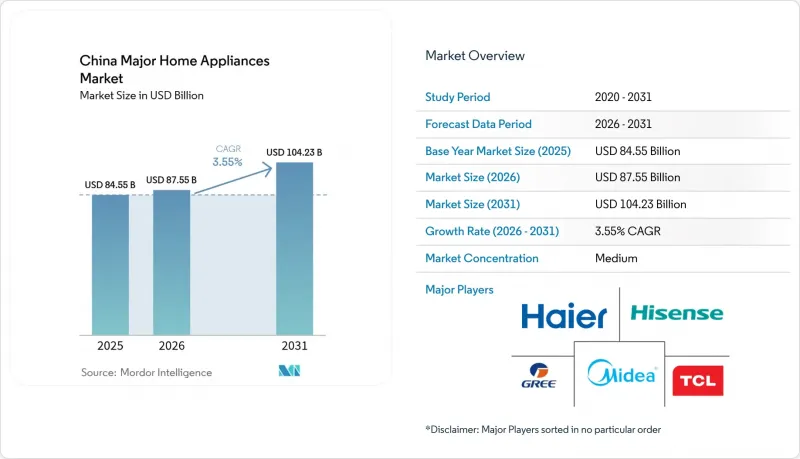
This report is Segmented by Product (Refrigerators, Freezers, Dishwashers, Washing Machines, and More), and by Distribution Channel (Multi-Brand Stores, Exclusive Brand Outlets, Online, and Other Distribution Channels), and by Geography (East China, Southwestern China, North China, South Central China, and More). The Market Forecasts are Provided in Terms of Value (USD).
China Major Home Appliances Market Trends and Insights
Rising Disposable Income and Urbanization
Per-capita disposable income climbed to CNY 41,314 (USD 5,700) in 2024, up 5.3% year on year, with rural growth outpacing urban for a second consecutive year. That convergence opens fresh pools of first-time buyers in lower-tier cities where appliance ownership trails metropolitan averages. Manufacturers respond by widening distribution footprints and tailoring entry-level smart models to local spending thresholds. Rising housing completions in emerging metropolitan clusters further stimulate purchases as new homeowners prioritize durable goods, especially air conditioners and refrigerators. The combination of income growth and accelerated urban migration, therefore, underpins structural demand across the China major home appliances market.
Rapid Adoption of Smart and IoT-Enabled Appliances
Smart functionality has shifted from novelty to a core purchase criterion. Haier's U+ Smart Life Platform connects refrigerators, washers, ovens, and air conditioners into scene-based routines and has recorded more than 20 million active users by 2023, with most adopters in Gen Z and millennial urban households . Generative AI now powers predictive maintenance, adaptive temperature zones, and personalised usage analytics that widen value beyond basic connectivity. Younger consumers view intelligent appliances as lifestyle infrastructure, which justifies premium pricing and raises average selling prices across categories. The AWE 2025 fair showcased over 1,000 brands focused on AI living concepts, proving industry-wide commitment to embedded intelligence. As software ecosystems mature, recurring service revenues will complement hardware margins and differentiate market leaders.
Raw-Material and Component Cost Fluctuation
Copper and aluminium price swings inflated production outlays during 2024, with Hisense flagging a material hit to margin due to metal cost spikes . Concurrent US tariffs on Chinese refrigerators, dishwashers, and related components amplify volatility for export-oriented firms. In June 2025, the US raised most tariffs on imported steel and aluminum to 50%, aiming to limit China's expanding influence in global trade. Manufacturers hedge risk through multi-region sourcing, forward contracts, and accelerated automation to trim labour content. Nonetheless, recurrent cost pass-through remains challenging in price-sensitive domestic tiers, dampening profit elasticity across the Chinese major home appliances market.
Other drivers and restraints analyzed in the detailed report include:
- Government Incentives for Green Appliances
- Strong E-Commerce and Omnichannel Distribution
- Urban Tier-1 & 2 Market Saturation Causing Price Wars
For complete list of drivers and restraints, kindly check the Table Of Contents.
Segment Analysis
Refrigerators retained a commanding 27.50% share of the China major home appliances market in 2025 owing to essential-use status, higher average ticket, and continuous energy-efficiency upgrades. Large-capacity multi-door models with AI freshness management and embedded cameras extend replacement rationale among affluent households. Manufacturers advertise nutrient-preserving zones, automated defrost cycles, and eco-friendly refrigerants to differentiate premium lines. Meanwhile, the segment benefits from government subsidies tied to energy ratings, which shorten payback periods for upgrades. Enhanced insulation materials and inverter compressors also reduce lifetime operating cost, adding to value perception.
Dishwashers record the fastest 4.05% CAGR through 2031 as societal norms around kitchen hygiene evolve. Penetration remains below 10% nationally, leaving significant headroom compared with developed economies. Rising single-patient and dual-income households in urban cores translate to limited time for manual dishwashing, elevating demand for compact built-ins and countertop models. The China major home appliances market size for dishwashers is expected to expand steadily as manufacturers localise spray-arm designs, mould-resistant interiors, and low-noise motors for apartment living. The Siemens Intelligent Clean Cube launch underlines ongoing innovation in water-efficiency and targeted grease removal, which strengthens consumer confidence in adoption. Export-oriented producers also favour the segment because dishwasher demand remains less cyclical than discretionary kitchen electronics internationally. Washing machines and air conditioners show flatter volume trajectories, but shift to heat-pump dryers and variable-frequency compressors supports margin protection. Ovens, steamers, and combination cookers benefit from the growing middle-class cooking culture and home-baking popularity ignited during pandemic restrictions. Freezers ride export momentum, particularly to Southeast Asian and African markets where cold-chain infrastructure upgrades increase commercial orders. Overall, a gradual mix move toward smart, integrated, and aesthetically aligned appliances elevates average selling price and cushions volume maturity pressures in legacy categories.
Complete Report Scope:
- By Product
- Refrigerators
- Freezers
- Washing Machines
- Dishwashers
- Ovens (Incl. Combi & Microwave)
- Air Conditioners
- Other Major Home Appliances (range hoods, cooktops, etc.)
- By Distribution Channel
- Multi-Brand Stores
- Exclusive Brand Outlets
- Online
- Other Distribution Channels
- By Geography
- East China
- Southwestern China
- North China
- South Central China
- Northeast China
- Northwestern China
List of Companies Covered in this Report:
- Haier
- Midea Group
- Gree Electric Appliances Inc.
- Changhong
- Hisense
- TCL Corporation
- Galanz
- Skyworth
- Aux Group
- Whirlpool Corporation
- Electrolux AB
- Panasonic Corp.
- Samsung Electronics
- LG Electronics
- BSH Home Appliances
- Sharp Corp.
- Xiaomi Corp.
- Hefei Meiling Company Ltd.
- Aucma Company Ltd
- Chunlan
Additional Benefits:
- The market estimate (ME) sheet in Excel format
- 3 months of analyst support
TABLE OF CONTENTS
1 Introduction
- 1.1 Study Assumptions & Market Definition
- 1.2 Scope of the Study
2 Research Methodology
3 Executive Summary
4 Market Landscape
- 4.1 Market Overview
- 4.2 Market Drivers
- 4.2.1 Rising Disposable Income & Urbanization
- 4.2.2 Rapid Adoption of Smart/IoT-Enabled Appliances
- 4.2.3 Government Incentives for Green Appliances
- 4.2.4 Rising Housing Completions and Renovations
- 4.2.5 Strong E-Commerce & Omnichannel Distribution
- 4.3 Market Restraints
- 4.3.1 Raw Material & Component Cost Fluctuation
- 4.3.2 Urban Tier-1/2 Market Saturation Causing Price Wars
- 4.3.3 Supply-Chain Decarbonisation Cost Inflation
- 4.3.4 Intensified Price Competition & Margin Pressure
- 4.4 Industry Value Chain Analysis
- 4.5 Porter's Five Forces Analysis
- 4.5.1 Threat of New Entrants
- 4.5.2 Bargaining Power of Suppliers
- 4.5.3 Bargaining Power of Buyers
- 4.5.4 Threat of Substitutes
- 4.5.5 Competitive Rivalry
- 4.6 Insights into the Latest Trends and Innovations in the Market
- 4.7 Insights on Recent Developments (New Product Launches, Strategic Initiatives, Investments, Partnerships, JVs, Expansion, M&As, etc.) in the Market
5 Market Size & Growth Forecasts (Value)
- 5.1 By Product
- 5.1.1 Refrigerators
- 5.1.2 Freezers
- 5.1.3 Washing Machines
- 5.1.4 Dishwashers
- 5.1.5 Ovens (Incl. Combi & Microwave)
- 5.1.6 Air Conditioners
- 5.1.7 Other Major Home Appliances (range hoods, cooktops, etc.)
- 5.2 By Distribution Channel
- 5.2.1 Multi-Brand Stores
- 5.2.2 Exclusive Brand Outlets
- 5.2.3 Online
- 5.2.4 Other Distribution Channels
- 5.3 By Geography
- 5.3.1 East China
- 5.3.2 Southwestern China
- 5.3.3 North China
- 5.3.4 South Central China
- 5.3.5 Northeast China
- 5.3.6 Northwestern China
6 Competitive Landscape
- 6.1 Market Concentration
- 6.2 Strategic Moves
- 6.3 Market Share Analysis
- 6.4 Company Profiles (includes Global level Overview, Market level overview, Core Segments, Financials as available, Strategic Information, Market Rank/Share for key companies, Products & Services, and Recent Developments)
- 6.4.1 Haier
- 6.4.2 Midea Group
- 6.4.3 Gree Electric Appliances Inc.
- 6.4.4 Changhong
- 6.4.5 Hisense
- 6.4.6 TCL Corporation
- 6.4.7 Galanz
- 6.4.8 Skyworth
- 6.4.9 Aux Group
- 6.4.10 Whirlpool Corporation
- 6.4.11 Electrolux AB
- 6.4.12 Panasonic Corp.
- 6.4.13 Samsung Electronics
- 6.4.14 LG Electronics
- 6.4.15 BSH Home Appliances
- 6.4.16 Sharp Corp.
- 6.4.17 Xiaomi Corp.
- 6.4.18 Hefei Meiling Company Ltd.
- 6.4.19 Aucma Company Ltd
- 6.4.20 Chunlan
7 Market Opportunities & Future Outlook
- 7.1 Growth of Built-In & Premium Appliances in Urban Areas

