PUBLISHER: Mordor Intelligence | PRODUCT CODE: 2115042

PUBLISHER: Mordor Intelligence | PRODUCT CODE: 2115042
Japan Major Home Appliances - Market Share Analysis, Industry Trends & Statistics, Growth Forecasts (2026 - 2031)
According to Mordor Intelligence, the Japan major home appliances market size is expected to grow from USD 27.34 billion in 2025 to USD 28.03 billion in 2026 and is forecast to reach USD 31.75 billion by 2031 at a 2.52% CAGR over 2026-2031.
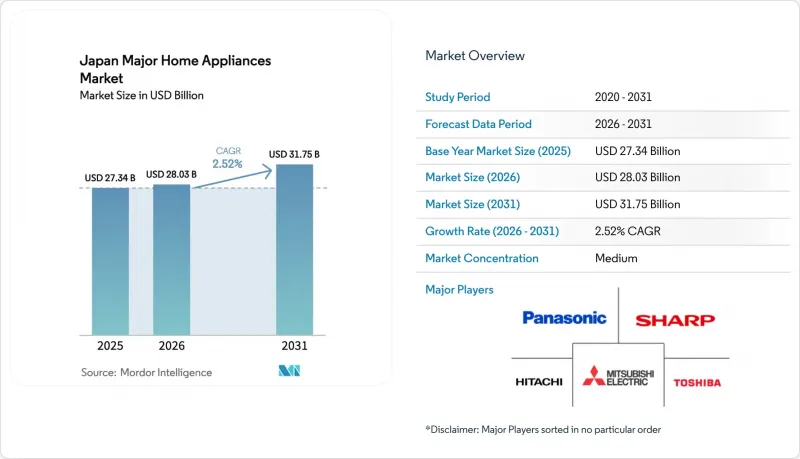
This report is Segmented by Product Type (Refrigerators, Freezers, Washing Machines, and More), Distribution Channel (Multi-Brand Stores, Exclusive Brand Outlets, Online, Other Distribution Channels), and Geography (Kanto, Kansai, Chubu, Rest of Japan). The Market Forecasts are Provided in Terms of Value (USD).
Japan Major Home Appliances Market Trends and Insights
Government "Top Runner" Energy-Efficiency Standards and Subsidy Schemes
The Top Runner Programme, Japan's mandatory energy-efficiency cornerstone since 1998, sets targets by benchmarking the most efficient model in each category, then enforcing a weighted-average compliance deadline for manufacturers. The program benchmarks performance to leading models and enforces weighted-average targets, which lifts the baseline for the entire category and keeps replacement cycles tied to compliance milestones. Local subsidies stack on national incentives and can reach JPY 300,000, which lowers the initial cost to consumers and supports faster adoption of efficient models in 2024 and 2025. This approach benefits brands that integrate efficiency enhancements into user-centric features such as better food preservation and quieter operation across constrained floor plans. The emphasis on secure connectivity stands out, with IoT security rules and labeling that favor players with compliance infrastructure and device lifecycle management. These policy frameworks sustain premium positioning for efficient and connected appliances within the Japan major home appliances market, which tightens the link between regulation and product roadmaps.
Urban Micro-Living Fueling Demand for Multi-Functional Appliances
Tokyo's micro-apartments, some as compact as 9 square meters, have ballooned as one-room rental rates spiked 29% year-over-year in 2025, prompting cost-conscious residents to trade square footage for location and savings. Over 11% of Tokyo's twenty-somethings now occupy units under 6 tatami mats (~10 sqm), and single-person households exceed 50% city-wide. Space scarcity elevates washer-dryer combos, slim-depth refrigerators, and one-burner induction cooktops from niche to necessity. Design ethos shifts to "form follows storage": appliances must either collapse, fold, or present aesthetically when left visible, aligning with the danshari decluttering philosophy. Japanese brands develop tall, narrow refrigerator formats and low-vibration stackable laundry sets that suit apartment codes and noise expectations. Visual simplicity and decluttering principles guide feature choices, as consumers seek convenience without visual clutter. This shift in living patterns aligns with growth in single-person households, which concentrates demand in smaller capacities and multi-function units that simplify daily tasks. The result is an enduring design and feature focus that benefits multi-functional appliances within the Japan major home appliances market across dense urban prefectures.
Stagnant Household Formation Curbing Unit Growth
Japan logged fewer than 670,000 births in 2025, the lowest since record-keeping began a century ago. Slower household formation reduces the number of first-time buyers for large white goods, which constrains organic unit growth. Fewer new households translate into lower demand for appliance bundles tied to new-home moves, so brands pivot to replacement-driven strategies. Housing starts fell 8.5% year-over-year in November 2025, marking the seventh decline of the year and reversing a brief October uptick. New-home appliance bundles, historically tied to household formation, face structural headwinds. The population shrank by 900,000 in 2024, and projections see further decay to 100 million by 2050. Premiumization remains a key lever to protect value even as unit volumes face demographic headwinds. This dynamic keeps the Japan major home appliances market concentrated on replacement and feature-led upgrades where households see clear value.
Other drivers and restraints analyzed in the detailed report include:
- Smart-Grid Roll-Out Boosting Demand for Connected White Goods
- Aging Population Accelerating Replacement of Legacy Appliances
- Culture of Repair and Second-Hand Use Limiting New Sales
For complete list of drivers and restraints, kindly check the Table Of Contents.
Segment Analysis
Refrigerators held the highest share in 2025 at 27.71%, which reflects steady replacement cycles and enduring demand for multi-door, large-capacity formats that support infrequent shopping and bulk-purchase habits. Panasonic's food-preservation feature set, including Prime Fresh cooling that maintains texture while extending shelf life, is a recognized differentiator that supports premium tiers. Sharp's Plasmacluster ion feature reduces odor and inhibits bacteria in refrigerators and other categories, which strengthens hygiene positioning where health preferences factor into purchase decisions. Smart refrigerators add internal cameras and inventory management features, and while they grow from a lower base, their value proposition improves as app experiences and interoperability mature. Feature upgrades that reduce energy use, improve food quality, and enhance convenience continue to sustain consumer interest in premium formats. These product characteristics reinforce the leadership of refrigerators within the Japan major home appliances market as brands balance efficiency with practical, space-aware designs.
Dishwashers extend the growth profile from a small installed base, with the category set to expand at a 3.35% CAGR to 2031. Built-in formats gain traction in new construction for seamless integration, and compact countertop models support retrofits in existing small kitchens. Hygiene features such as steam-assisted cleaning and self-sanitizing cycles remain points of differentiation as dual-income households trade time savings for convenience. Washing-machine demand is supported by front-load inverter models and washer-dryer combinations that optimize water and energy use while delivering deep-clean efficacy for urban homes. Feature sets like Hitachi's BeatWash agitation and Panasonic's ActiveFoam system elevate wash performance with lower resource use, and voice assistance aligns with ease-of-use preferences for aging users. The product mix continues to favor appliances that combine efficient performance with slim profiles suited to micro-living, which supports sustained interest across core categories in the Japan major home appliances market.
Complete Report Scope:
- By Product Type
- Refrigerators
- Freezers
- Washing Machines
- Dishwashers
- Cooktops & Ranges
- Microwave Ovens
- Air Conditioners
- Others (Electric Hobs etc)
- By Distribution Channel
- Multi-Brand Stores
- Exclusive Brand Outlets
- Online
- Other Distribution Channels
- By Region
- Kanto
- Kansai
- Chubu
- Rest of Japan
List of Companies Covered in this Report:
- Panasonic Corporation
- Sharp Corporation
- Toshiba Corporation
- Hitachi Global Life Solutions
- Mitsubishi Electric Corporation
- Haier Smart Home Co., Ltd. (AQUA)
- Midea Group Co., Ltd.
- LG Electronics Inc.
- Samsung Electronics Co., Ltd.
- Hisense Group
- BSH Home Appliances
- Electrolux AB
- Whirlpool Corporation
- Arcelik A.S. (Beko)
- Daikin Industries, Ltd.
- Fujitsu General Limited
- Dyson Ltd.
- Iris Ohyama Inc.
- Balmuda Inc.
Additional Benefits:
- The market estimate (ME) sheet in Excel format
- 3 months of analyst support
TABLE OF CONTENTS
1 Introduction
- 1.1 Study Assumptions & Market Definition
- 1.2 Scope of the Study
2 Research Methodology
3 Executive Summary
4 Market Landscape
- 4.1 Market Overview
- 4.2 Market Drivers
- 4.2.1 Inbound tourism & short-term rentals driving hospitality appliance demand
- 4.2.2 Government "Top Runner" energy-efficiency standards & subsidy schemes
- 4.2.3 Urban micro-living fueling demand for multi-functional appliances
- 4.2.4 Rise of appliance subscription/rental services among millennials
- 4.2.5 Smart-grid roll-out boosting demand for connected white goods
- 4.2.6 Aging population accelerating replacement of legacy appliances
- 4.3 Market Restraints
- 4.3.1 Stagnant household formation curbing unit growth
- 4.3.2 High electricity tariffs discouraging energy-intensive purchases
- 4.3.3 Price volatility in rare-earth & compressor supply chain
- 4.3.4 Culture of repair/second-hand use limiting new sales
- 4.4 Industry Value Chain Analysis
- 4.5 Porter's Five Forces
- 4.5.1 Bargaining Power of Suppliers
- 4.5.2 Bargaining Power of Buyers
- 4.5.3 Threat of New Entrants
- 4.5.4 Threat of Substitutes
- 4.5.5 Competitive Rivalry
- 4.6 Insights into Regulatory Framework and Energy-Efficiency Standards
- 4.7 Insights Into The Latest Trends And Innovations in the Market
- 4.8 Insights into Recent Developments (New Product Launches, Strategic Initiatives, Investments, Partnerships, JVs, Expansion, M&As, Etc.) In The Market
5 Market Size & Growth Forecasts
- 5.1 By Product Type
- 5.1.1 Refrigerators
- 5.1.2 Freezers
- 5.1.3 Washing Machines
- 5.1.4 Dishwashers
- 5.1.5 Cooktops & Ranges
- 5.1.6 Microwave Ovens
- 5.1.7 Air Conditioners
- 5.1.8 Others (Electric Hobs etc)
- 5.2 By Distribution Channel
- 5.2.1 Multi-Brand Stores
- 5.2.2 Exclusive Brand Outlets
- 5.2.3 Online
- 5.2.4 Other Distribution Channels
- 5.3 By Region
- 5.3.1 Kanto
- 5.3.2 Kansai
- 5.3.3 Chubu
- 5.3.4 Rest of Japan
6 Competitive Landscape
- 6.1 Market Concentration
- 6.2 Strategic Moves
- 6.3 Market Share Analysis
- 6.4 Company Profiles (includes Global level Overview, Market level overview, Core Segments, Financials as available, Strategic Information, Market Rank/Share for key companies, Products & Services, and Recent Developments)
- 6.4.1 Panasonic Corporation
- 6.4.2 Sharp Corporation
- 6.4.3 Toshiba Corporation
- 6.4.4 Hitachi Global Life Solutions
- 6.4.5 Mitsubishi Electric Corporation
- 6.4.6 Haier Smart Home Co., Ltd. (AQUA)
- 6.4.7 Midea Group Co., Ltd.
- 6.4.8 LG Electronics Inc.
- 6.4.9 Samsung Electronics Co., Ltd.
- 6.4.10 Hisense Group
- 6.4.11 BSH Home Appliances
- 6.4.12 Electrolux AB
- 6.4.13 Whirlpool Corporation
- 6.4.14 Arcelik A.S. (Beko)
- 6.4.15 Daikin Industries, Ltd.
- 6.4.16 Fujitsu General Limited
- 6.4.17 Dyson Ltd.
- 6.4.18 Iris Ohyama Inc.
- 6.4.19 Balmuda Inc.
7 Market Opportunities & Future Outlook
- 7.1 Growth of circular-economy certified refurbished appliance market
- 7.2 Integration of home energy-storage with smart HVAC & appliance ecosystems

