PUBLISHER: Mordor Intelligence | PRODUCT CODE: 2115221

PUBLISHER: Mordor Intelligence | PRODUCT CODE: 2115221
Asia-Pacific Major Home Appliance - Market Share Analysis, Industry Trends & Statistics, Growth Forecasts (2026 - 2031)
According to Mordor Intelligence, the Asia-Pacific major home appliance market size is expected to grow from USD 262.48 billion in 2025 to USD 268.21 billion in 2026 and is forecast to reach USD 298.62 billion by 2031 at 2.18% CAGR over 2026-2031.
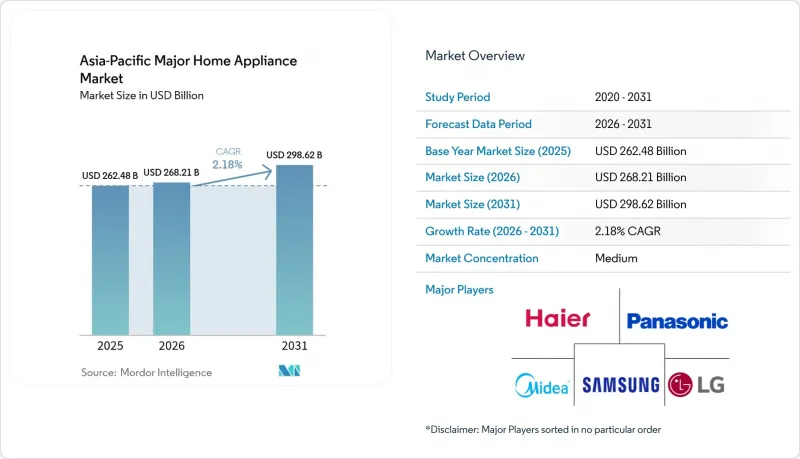
This report is Segmented by Product Type (Refrigerators, Freezers, Dishwashing Machines, Washing Machines, Ovens, Air Conditioners, Other Major Products), Distribution Channel (Multi-Brand Stores, and Other), Technology (Smart Connected Major Appliances, Conventional Major Appliances), and Geography (India, and Other). The Market Forecasts are Provided in Terms of Value (USD).
Asia-Pacific Major Home Appliance Market Trends and Insights
Rising Disposable Income & Rapid Urbanisation
Middle-income households across Indonesia and Vietnam grew sharply in 2024 and are projected to exceed 415 million by 2030, driving first-time appliance purchases and accelerating replacement cycles. Urban migration concentrates demand in tier-2 cities where real-estate developers bundle built-in kitchens with residential projects, spurring multi-appliance adoption. Retailers leverage BNPL platforms to convert latent demand into sales by lowering upfront price barriers. Correlation between urbanization velocity and appliance penetration remains strongest in cities where infrastructure outpaces income, creating near-term surges once credit access improves. For manufacturers, aligning product portfolios with aspirational yet affordable SKUs helps balance volume and margin goals.
Explosive Growth of E-Commerce & Last-Mile Logistics
Enhanced logistics networks and omnichannel strategies pushed digital transactions to a 19.84% CAGR for the Asia-Pacific major home appliance market. Regional platforms introduced augmented-reality showrooms that reduce the need for physical touchpoints in high-consideration categories like refrigerators and washers. Cross-border marketplaces allow Chinese brands to reach underserved rural customers, but aggressive discounting compresses margins. Partnerships with third-party logistics players shorten delivery windows to under 48 hours in key ASEAN metro areas, strengthening consumer confidence. Integrated after-sales services and instant refunds further narrow the experiential gap with brick-and-mortar outlets.
Volatile Raw-Material & Freight Costs
Steel and copper price volatility compressed manufacturer margins throughout 2024, with galvanized sheet demand from home appliances experiencing mixed performance despite overall production growth exceeding 10%. Raw material cost inflation forces manufacturers to implement dynamic pricing strategies, though consumer price sensitivity limits pass-through effectiveness in competitive segments. Supply chain disruptions from geopolitical tensions and port congestion create inventory management challenges, particularly for companies operating just-in-time production models across multiple geographic markets.
Other drivers and restraints analyzed in the detailed report include:
- Mandatory Energy-Efficiency Rebate & Trade-In Schemes
- BNPL & Embedded-Finance-Powered Affordability
- Margin Pressure from Low-Cost Regional OEMs
For complete list of drivers and restraints, kindly check the Table Of Contents.
Segment Analysis
Refrigerators captured 26.98 of % Asia-Pacific major home appliance market share in 2025 and continue to anchor connected-home ecosystems through embedded sensors, cameras, and AI-driven food management software. The premium smart-refrigerator segment is forecast to deliver a 14.75% CAGR, reinforcing the Asia-Pacific major home appliance market trajectory toward higher ASPs. Washing machines held an 17.82% stake as inverter motors and water-saving cycles resonate with urban dwellers. Air conditioners contributed 15.34%, benefiting from rising heat-wave frequency but tempered by energy-tariff sensitivities. Dishwashers and freezers remain niche yet are gaining acceptance in high-density urban apartments as lifestyles evolve.
The convergence of IoT with refrigeration repositions the appliance as a household command center capable of choreographing other devices via voice assistants or smartphone apps. Manufacturers deploy predictive maintenance analytics that flag compressor issues before failures, curbing service costs. Built-in French-door models integrated into modular kitchens enlarge design-driven appeal, while compact top-mount units meet small-space constraints. Competitive intensity is elevated, yet differentiated software ecosystems and proprietary AI algorithms help preserve margins for market leaders.
Complete Report Scope:
- By Product Type
- Refrigerators
- Freezers
- Dishwashing Machines
- Washing Machines
- Ovens
- Air Conditioners
- Other Major Products (Electric Hobs, Ranges, etc.)
- By Distribution Channel
- Multi-Brand Stores
- Exclusive Brand Outlets
- Online
- Other Distribution Channels
- By Technology
- Smart Connected Major Appliances
- Conventional Major Appliances
- By Geography
- India
- China
- Japan
- Australia
- South Korea
- South-East Asia (Singapore, Malaysia, Thailand, Indonesia, Vietnam, Philippines)
- Rest of Asia-Pacific
List of Companies Covered in this Report:
- Haier Smart Home
- Midea Group
- Samsung Electronics
- LG Electronics
- Panasonic Corp.
- Whirlpool Corp.
- BSH Hausgerate (Bosch/Siemens)
- Electrolux AB
- Hisense Home Appliances
- Sharp Corp.
- Hitachi Global Life Solutions
- Toshiba Lifestyle
- Gree Electric Appliances
- Godrej Appliances
- IFB Industries
- TCL Technology
- Arcelik (Beko)
- Fujitsu General
- Videocon Industries
- Skyworth
Additional Benefits:
- The market estimate (ME) sheet in Excel format
- 3 months of analyst support
TABLE OF CONTENTS
1 Introduction
- 1.1 Study Assumptions & Market Definition
- 1.2 Scope of the Study
2 Research Methodology
3 Executive Summary
4 Market Landscape
- 4.1 Market Overview
- 4.2 Market Drivers
- 4.2.1 Rising disposable income & rapid urbanisation
- 4.2.2 Explosive growth of e-commerce & last-mile logistics
- 4.2.3 Mandatory energy-efficiency rebate & trade-in schemes
- 4.2.4 Cross-border localisation of Chinese OEM manufacturing
- 4.2.5 BNPL & embedded-finance-powered affordability
- 4.2.6 Uptake of premium built-in / modular kitchen concepts
- 4.3 Market Restraints
- 4.3.1 Volatile raw-material & freight costs
- 4.3.2 Margin pressure from low-cost regional OEMs
- 4.3.3 Grid-instability & high tariffs curbing energy-hungry SKUs
- 4.3.4 Remote-area logistics & reverse-logistics costs
- 4.4 Value / Supply-Chain Analysis
- 4.5 Regulatory Landscape
- 4.6 Technological Outlook
- 4.7 Porter's Five Forces
- 4.7.1 Threat of New Entrants
- 4.7.2 Bargaining Power of Suppliers
- 4.7.3 Bargaining Power of Buyers
- 4.7.4 Threat of Substitutes
- 4.7.5 Competitive Rivalry
5 Market Size & Growth Forecasts
- 5.1 By Product Type
- 5.1.1 Refrigerators
- 5.1.2 Freezers
- 5.1.3 Dishwashing Machines
- 5.1.4 Washing Machines
- 5.1.5 Ovens
- 5.1.6 Air Conditioners
- 5.1.7 Other Major Products (Electric Hobs, Ranges, etc.)
- 5.2 By Distribution Channel
- 5.2.1 Multi-Brand Stores
- 5.2.2 Exclusive Brand Outlets
- 5.2.3 Online
- 5.2.4 Other Distribution Channels
- 5.3 By Technology
- 5.3.1 Smart Connected Major Appliances
- 5.3.2 Conventional Major Appliances
- 5.4 By Geography
- 5.4.1 India
- 5.4.2 China
- 5.4.3 Japan
- 5.4.4 Australia
- 5.4.5 South Korea
- 5.4.6 South-East Asia (Singapore, Malaysia, Thailand, Indonesia, Vietnam, Philippines)
- 5.4.7 Rest of Asia-Pacific
6 Competitive Landscape
- 6.1 Market Concentration
- 6.2 Strategic Moves
- 6.3 Market Share Analysis
- 6.4 Company Profiles (includes Global level Overview, Market level overview, Core Segments, Financials as available, Strategic Information, Market Rank/Share for key companies, Products & Services, and Recent Developments)
- 6.4.1 Haier Smart Home
- 6.4.2 Midea Group
- 6.4.3 Samsung Electronics
- 6.4.4 LG Electronics
- 6.4.5 Panasonic Corp.
- 6.4.6 Whirlpool Corp.
- 6.4.7 BSH Hausgerate (Bosch/Siemens)
- 6.4.8 Electrolux AB
- 6.4.9 Hisense Home Appliances
- 6.4.10 Sharp Corp.
- 6.4.11 Hitachi Global Life Solutions
- 6.4.12 Toshiba Lifestyle
- 6.4.13 Gree Electric Appliances
- 6.4.14 Godrej Appliances
- 6.4.15 IFB Industries
- 6.4.16 TCL Technology
- 6.4.17 Arcelik (Beko)
- 6.4.18 Fujitsu General
- 6.4.19 Videocon Industries
- 6.4.20 Skyworth
7 Market Opportunities & Future Outlook
- 7.1 Retrofit smart-module kits for legacy major appliances
- 7.2 Subscription-based "Appliance-as-a-Service" for premium SKUs

