PUBLISHER: Mordor Intelligence | PRODUCT CODE: 2115831

PUBLISHER: Mordor Intelligence | PRODUCT CODE: 2115831
Middle East And Africa ADAS - Market Share Analysis, Industry Trends & Statistics, Growth Forecasts (2026 - 2031)
According to Mordor Intelligence, the Middle East and Africa Advanced Driver Assistance Systems market size is expected to grow from USD 1.32 billion in 2025 to USD 1.52 billion in 2026 and is forecast to reach USD 3.06 billion by 2031 at 15.02% CAGR over 2026-2031.
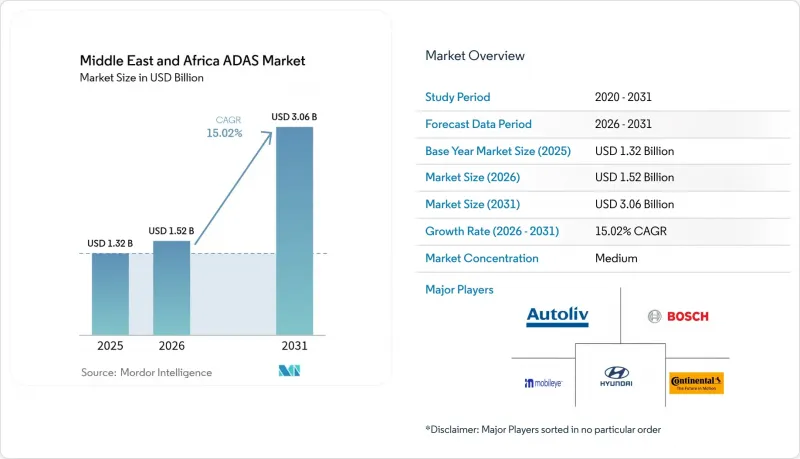
This report is Segmented by System Type (Parking Assist System, and More), Sensor Technology (Radar, Camera, Li-Dar, and More), Vehicle Type (Passenger Cars, Light Commercial Vehicles and More), Level of Autonomy (L1, L2 and L2+), Offering (Hardware, and More), Distribution Channel ( OEM-Fit and Aftermarket), and Country. The Market Forecasts are Provided in Terms of Value (USD) and Volume (Units).
Middle East And Africa ADAS Market Trends and Insights
Mandatory NCAP-style Safety Regulations & Fleet-fit Mandates
Regional transport ministries now embed Euro-NCAP-equivalent safety suites into type-approval frameworks. Dubai's Roads and Transport Authority began requiring telematics in heavy trucks, and UN ECE's Driver Control Assistance Systems regulation offers a harmonized technical rulebook . Because operating licences increasingly hinge on compliance, fleet operators accelerate ADAS installation schedules, creating a predictable revenue stream for Tier 1 suppliers.
Premium-vehicle Uptake Boosting L2+ Feature Penetration
Affluent Gulf consumers value collision-avoidance and highway-pilot functions as lifestyle statements. Hyundai's IONIQ range and Chinese brands like Changan now bundle Highway Driving Assist and automated lane-change features as standard on top trims. The demonstration effect shortens diffusion cycles, prompting mid-segment OEMs to offer stripped-down L2 packages at lower price points.
High System Cost Versus Disposable Income in Africa
In Sub-Saharan markets, the price uplift for ADAS can equal 5-10% of a new-vehicle invoice, a hurdle when average car-ownership costs already strain household budgets. Retrofit kits once addressed this gap, but Mobileye's 2024 exit from aftermarket programs removed a key low-cost channel. Without local credit subsidies or deeper duty breaks, mass adoption lags behind Gulf peers.
Other drivers and restraints analyzed in the detailed report include:
- Sensor Cost Declines & Local Assembly Incentives
- Smart-city Corridors Enabling ADAS-ready V2X Infrastructure
- Sparse Calibration and Servicing Networks
For complete list of drivers and restraints, kindly check the Table Of Contents.
Segment Analysis
Automatic emergency braking contributes the highest incremental value, expanding at 18.74% CAGR as regulators add forward-collision mitigation to inspection checklists. While already mainstream, parking-assist technology still holds a 29.12% share because dense urban cores in Dubai and Riyadh heighten low-speed collision anxiety. Tier 1 suppliers bundle these features to encourage higher take-rates, reinforcing the advanced driver assistance systems market's momentum.
Integrated safety suites increasingly combine blind-spot detection, adaptive front lighting, and driver-monitoring cameras. Tier 1s such as Bosch overlay AI perception algorithms on modular hardware, enabling OEMs to deploy tailored packages without costly redesigns.
Cameras remain the economic workhorse, controlling 42.75% of 2025 revenue. Yet Gulf operators contend with glare and dust, catalyzing LiDAR's 18.96% CAGR as solid-state units drop below USD 500 per channel. Radar upgrades to 4D-imaging configurations add weather-resilient object classification, while ultrasonic rings stay vital for low-speed urban maneuvers.
Software-defined architectures let OEMs refine algorithms over the air, optimizing sensor fusion for regional driving idiosyncrasies. This capability shifts differentiation from hardware cost curves toward update cadence and data-science expertise, a hallmark of the advanced driver assistance systems industry.
Complete Report Scope:
- By System Type
- Parking Assist Systems
- Adaptive Front-lighting
- Night Vision
- Blind-Spot Detection
- Lane Departure Warning
- Automatic Emergency Braking
- Driver Monitoring & Drowsiness Detection
- By Sensor Technology
- Radar (24 / 77 / 79 GHz)
- Camera (Mono, Stereo, Surround)
- LiDAR (Solid-state, Mechanical)
- Ultrasonic & Infra-red
- By Vehicle Type
- Passenger Cars
- Light Commercial Vehicles
- Medium & Heavy Commercial Vehicles & Buses
- By Level of Autonomy
- L1 (Driver Assistance)
- L2 (Partial Automation)
- L2+ (Enhanced Partial Automation)
- By Offering
- Hardware (ECU, Sensors)
- Software & Algorithms
- Integration & Calibration Services
- By Distribution Channel
- OEM-fit
- Aftermarket Retrofit
- By Country
- Saudi Arabia
- United Arab Emirates
- Qatar
- Kuwait
- South Africa
- Egypt
- Morocco
- Nigeria
- Rest of Middle East and Africa
List of Companies Covered in this Report:
- Autoliv AB
- Robert Bosch GmbH
- Continental AG
- Hyundai Mobis Co.
- Aptiv PLC
- Mobileye (Intel)
- ZF Friedrichshafen AG
- DENSO Corporation
- Valeo SA
- Magna International
- HELLA GmbH & Co. KGaA
- Veoneer
Additional Benefits:
- The market estimate (ME) sheet in Excel format
- 3 months of analyst support
TABLE OF CONTENTS
1 Introduction
- 1.1 Study Assumptions & Market Definition
- 1.2 Scope of the Study
2 Research Methodology
3 Executive Summary
4 Market Landscape
- 4.1 Market Overview
- 4.2 Market Drivers
- 4.2.1 Mandatory NCAP-style safety regulations & fleet-fit mandates
- 4.2.2 Premium-vehicle uptake boosting L2+ feature penetration
- 4.2.3 Sensor cost declines & local assembly incentives
- 4.2.4 Smart-city corridors enabling ADAS-ready V2X infrastructure
- 4.2.5 Ride-hailing & leasing fleets standardising safety packs
- 4.2.6 Vision-2030 diversification funds channelled into mobility tech
- 4.3 Market Restraints
- 4.3.1 High system cost vs disposable income in Africa
- 4.3.2 Sparse calibration & servicing networks
- 4.3.3 Harsh dust-heat environment degrading sensor uptime
- 4.3.4 Tariff swings & localisation rules disrupting supply chains
- 4.4 Value/Supply-Chain Analysis
- 4.5 Regulatory Landscape
- 4.6 Technological Outlook
- 4.7 Porter's Five Forces Analysis
- 4.7.1 Threat of New Entrants
- 4.7.2 Bargaining Power of Buyers
- 4.7.3 Bargaining Power of Suppliers
- 4.7.4 Threat of Substitutes
- 4.7.5 Intensity of Competitive Rivalry
5 Market Size & Growth Forecasts (Value (USD) and Volume (Units))
- 5.1 By System Type
- 5.1.1 Parking Assist Systems
- 5.1.2 Adaptive Front-lighting
- 5.1.3 Night Vision
- 5.1.4 Blind-Spot Detection
- 5.1.5 Lane Departure Warning
- 5.1.6 Automatic Emergency Braking
- 5.1.7 Driver Monitoring & Drowsiness Detection
- 5.2 By Sensor Technology
- 5.2.1 Radar (24 / 77 / 79 GHz)
- 5.2.2 Camera (Mono, Stereo, Surround)
- 5.2.3 LiDAR (Solid-state, Mechanical)
- 5.2.4 Ultrasonic & Infra-red
- 5.3 By Vehicle Type
- 5.3.1 Passenger Cars
- 5.3.2 Light Commercial Vehicles
- 5.3.3 Medium & Heavy Commercial Vehicles & Buses
- 5.4 By Level of Autonomy
- 5.4.1 L1 (Driver Assistance)
- 5.4.2 L2 (Partial Automation)
- 5.4.3 L2+ (Enhanced Partial Automation)
- 5.5 By Offering
- 5.5.1 Hardware (ECU, Sensors)
- 5.5.2 Software & Algorithms
- 5.5.3 Integration & Calibration Services
- 5.6 By Distribution Channel
- 5.6.1 OEM-fit
- 5.6.2 Aftermarket Retrofit
- 5.7 By Country
- 5.7.1 Saudi Arabia
- 5.7.2 United Arab Emirates
- 5.7.3 Qatar
- 5.7.4 Kuwait
- 5.7.5 South Africa
- 5.7.6 Egypt
- 5.7.7 Morocco
- 5.7.8 Nigeria
- 5.7.9 Rest of Middle East and Africa
6 Competitive Landscape
- 6.1 Market Concentration
- 6.2 Strategic Moves
- 6.3 Market Share Analysis
- 6.4 Company Profiles (Includes Global Level Overview, Market Level Overview, Core Segments, Financials as Available, Strategic Information, Market Rank/Share for Key Companies, Products and Services, and Recent Developments)
- 6.4.1 Autoliv AB
- 6.4.2 Robert Bosch GmbH
- 6.4.3 Continental AG
- 6.4.4 Hyundai Mobis Co.
- 6.4.5 Aptiv PLC
- 6.4.6 Mobileye (Intel)
- 6.4.7 ZF Friedrichshafen AG
- 6.4.8 DENSO Corporation
- 6.4.9 Valeo SA
- 6.4.10 Magna International
- 6.4.11 HELLA GmbH & Co. KGaA
- 6.4.12 Veoneer
7 Market Opportunities & Future Outlook
- 7.1 White-space & Unmet-Need Assessment

