PUBLISHER: Mordor Intelligence | PRODUCT CODE: 2115841

PUBLISHER: Mordor Intelligence | PRODUCT CODE: 2115841
Indian E-Bike Rental - Market Share Analysis, Industry Trends & Statistics, Growth Forecasts (2026 - 2031)
According to Mordor Intelligence, the indian e-Bike rental market size in 2026 is estimated at USD 8.13 million, growing from 2025 value of USD 7.26 million with 2031 projections showing USD 14.3 million, growing at 11.96% CAGR over 2026-2031.
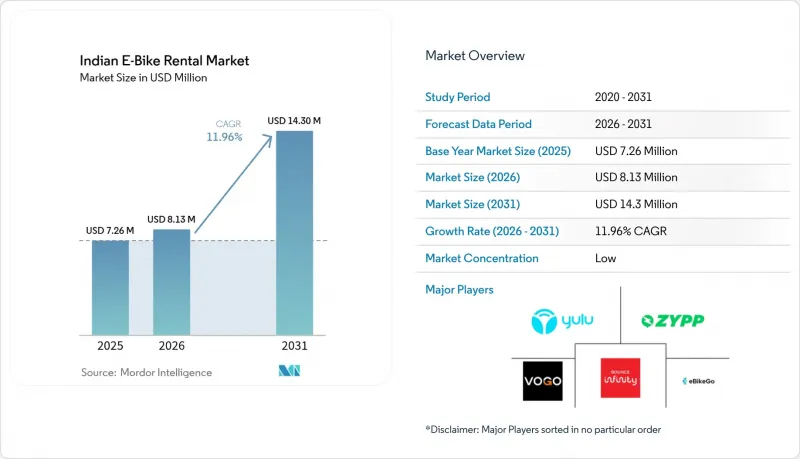
This report is Segmented by Application Type (Urban/City and Cargo & Logistics), Vehicle Type (Pedal-Assisted and Throttle-Assisted), End User (Consumers B2C and More), Subscription Model (Hourly, Daily, and More), Battery Type (Lithium-Ion, Lead-Acid, and Others), and Power Output (Less Than or Equal To 250 W and 251-500 W). The Market Forecasts are Provided in Terms of Value (USD).
Indian E-Bike Rental Market Trends and Insights
Government Incentives Under FAME-II & State EV Policies
Generous purchase subsidies, fee waivers, and clear battery-swap standards are tilting the total cost of ownership decisively toward rentals. The Ministry of Power's 2025 guidelines on swap-station interoperability cut vendor lock-in and simplify multi-brand fleet operations . Delhi's EV Policy 2.0 earmarks a dedicated fund, sourced from green taxes and aggregator license fees, to finance four-fifth of two-wheeler electrification by 2027. West Bengal is bolstering its electric mobility initiative by offering significant purchase incentives and complete road-tax waivers. As a result, operators can now set e-bike rental prices lower than those of traditional scooters. These initiatives are fostering consistent demand trends, drawing in fleet financing partners. Yet, lessons from previous subsidy programs underscore the importance of a coordinated infrastructure rollout to capitalize on this burgeoning demand.
Surge In VC Funding & Strategic Investments In Micromobility Start-Ups
Capital inflow reached record velocity in 2025, filling a historical funding gap that once throttled hardware scale-up. Yulu hit EBITDA breakeven while delivering annual recurring revenue, giving investors a rare proof point for positive unit economics . Greenerg Mobility, a new entrant, has garnered substantial investments, notably securing support from L.G. Balakrishnan & Bros to launch subscription-based hybrid models in Coimbatore. Ample liquidity shortens fleet payback cycles, subsidizes rider acquisition, and accelerates SaaS telematics rollouts. Partnerships with delivery giants convert capital into immediate utilization, protecting gross margins. Yet cash-burn tolerance varies; smaller operators without unique moats still face consolidation or acqui-hire prospects as the market matures.
Limited Public Charging & Swapping Infrastructure Density
India logged numerous public chargers by June 2024-roughly 1 unit for every 191 EVs-with three-fifths clustered inside five states. Such concentration compels operators to circle megacities, delaying entry into infrastructure-poor tier-2 catchments. Only a few swap stations operated nationally by March 2024, many OEM-exclusive, limiting cross-brand compatibility. The Ministry of Road Transport and Highways has issued model concession agreements for states, yet fragmented execution slows right-of-way approvals. Without dense grids, fleets over-invest in higher-capacity packs that impair capital efficiency. Resulting cost pass-through often erodes the consumer value proposition relative to ride-hailing or public transport.
Other drivers and restraints analyzed in the detailed report include:
- Corporate ESG Goals Accelerating Last-Mile E-Fleet Conversions
- Declining Lithium-Ion Battery Prices Lowering Operator Capex
- High Battery Replacement Costs Squeezing Operator Margins
For complete list of drivers and restraints, kindly check the Table Of Contents.
Segment Analysis
Urban/City trips account for a 83.12% of 2025 revenue for the Indian electric bike rental market, reaffirming the synergy between dense rider pools and short-trip range envelopes. Metropolitan catchments deliver network effects that push asset utilization above the 5-6 rides per day breakeven threshold. Although Cargo & Logistics has a far smaller 2025 base, it is accelerating at 12.09% CAGR to 2031 by piggybacking on e-commerce parcel volumes and corporates' net-zero roadmaps. Rental fleets deployed for Zomato in Delhi since June 2025, plus EVIFY's 1,000-unit Hero fleet, illustrate recipe-driven route economics that suit swappable batteries.
Urban prevalence also mirrors policy incentives and LEZ rules that penalize internal-combustion counterparts. Charge-point density allows operators to rebalance fleets throughout the day using telematics cues, minimizing deadheading. Conversely, cargo sub-verticals enjoy contractual locks and predictable shift patterns, supplying steady demand that dilutes the weekend slump typical in B2C rentals. As city master plans adopt congestion fees, rental bikes gain another cost uptick over taxis, cementing urban primacy even while parcel fleets seize incremental volume from heavyweight vans.
Throttle-assisted bikes accounts for a 60.74% of the 2025 spend within the Indian electric bike rental market share because friction-free acceleration and no-pedal convenience resonate with commuters juggling traffic bursts. They suit courier payloads yet require a license, registration, and third-party insurance, which inflates compliance costs per unit. Pedal-assisted alternatives, expanding at a 12.12% CAGR, slip under the 250 W ceiling and thus bypass licensing, letting casual users onboard instantly at tourist hotspots.
Operators stack fleets with a 70-30 throttle-pedal ratio in metros, but invert the mix in heritage districts where speed caps apply. Motor-efficiency gains now allow pedal-assist models to tackle minimal urban gradients without severe battery drain, shrinking performance gaps. Meanwhile, OEMs like Oben Electric publish simplified compliance matrices to demystify power-band thresholds, hoping to curb accidental regulatory breaches that once led to impounds.
Complete Report Scope:
- By Application Type
- Urban/City
- Cargo & Logistics
- By Vehicle Type
- Pedal-Assisted
- Throttle-Assisted
- By End User
- Consumers (B2C)
- Last-Mile Delivery & Couriers (B2B)
- Tourism & Leisure
- Corporate/Institutional Sharing
- By Subscription Model
- Hourly
- Daily
- Monthly
- Long-term Leasing
- By Battery Type
- Lithium-ion
- Lead-acid
- Others
- By Power Output
- Less than or equal to 250 W
- 251-500 W
List of Companies Covered in this Report:
- Yulu Bikes Pvt Ltd
- Zypp Electric
- Bounce Infinity
- Vogo Rental
- eBikeGo Pvt Ltd
- Rentrip Services Pvt Ltd
- ONN Bikes
- Royal Brothers
- Drivezy
- Rapido EV
- EXA RIDE (EXA Mobility)
- Wheelbros
- Voltium
- Green Drive Mobility (Lithium Urban-Spin)
- Quick Ride
- Chartered Bike
- PedL by Zoomcar
- MYBYK e-fleet
- Mobicy EV
- VahanPay Rentals
Additional Benefits:
- The market estimate (ME) sheet in Excel format
- 3 months of analyst support
TABLE OF CONTENTS
1 Introduction
- 1.1 Study Assumptions & Market Definition
- 1.2 Scope of the Study
2 Research Methodology
3 Executive Summary
4 Market Landscape
- 4.1 Market Overview
- 4.2 Market Drivers
- 4.2.1 Government Incentives Under Fame-LI & State EV Policies
- 4.2.2 Surge In VC Funding & Strategic Investments In Micromobility Start-Ups
- 4.2.3 Corporate ESG Goals Accelerating Last-Mile E-Fleet Conversions
- 4.2.4 Declining Lithium-Ion Battery Prices Lowering Operator Capex
- 4.2.5 Expansion Of Battery-Swapping Hubs Integrated With Rental Fleets
- 4.2.6 Urban Congestion Charges & LEZs Nudging Commuters To E-Bikes
- 4.3 Market Restraints
- 4.3.1 Limited Public Charging & Swapping Infrastructure Density
- 4.3.2 High Battery Replacement Costs Squeezing Operator Margins
- 4.3.3 Regulatory Ambiguity On E-Bike Lane & Helmet Compliance
- 4.3.4 Theft & Vandalism Risk Elevating Insurance Premiums
- 4.4 Value / Supply-Chain Analysis
- 4.5 Regulatory Landscape
- 4.6 Technological Outlook
- 4.7 Porter's Five Forces
- 4.7.1 Threat of New Entrants
- 4.7.2 Bargaining Power of Buyers/Consumers
- 4.7.3 Bargaining Power of Suppliers
- 4.7.4 Threat of Substitute Products
- 4.7.5 Intensity of Competitive Rivalry
5 Market Size & Growth Forecasts (Value (USD))
- 5.1 By Application Type
- 5.1.1 Urban/City
- 5.1.2 Cargo & Logistics
- 5.2 By Vehicle Type
- 5.2.1 Pedal-Assisted
- 5.2.2 Throttle-Assisted
- 5.3 By End User
- 5.3.1 Consumers (B2C)
- 5.3.2 Last-Mile Delivery & Couriers (B2B)
- 5.3.3 Tourism & Leisure
- 5.3.4 Corporate/Institutional Sharing
- 5.4 By Subscription Model
- 5.4.1 Hourly
- 5.4.2 Daily
- 5.4.3 Monthly
- 5.4.4 Long-term Leasing
- 5.5 By Battery Type
- 5.5.1 Lithium-ion
- 5.5.2 Lead-acid
- 5.5.3 Others
- 5.6 By Power Output
- 5.6.1 Less than or equal to 250 W
- 5.6.2 251-500 W
6 Competitive Landscape
- 6.1 Market Concentration
- 6.2 Strategic Moves
- 6.3 Market Share Analysis
- 6.4 Company Profiles (includes Global Level Overview, Market Level Overview, Core Segments, Financials as Available, Strategic Information, Market Rank/Share for Key Companies, Products and Services, SWOT Analysis, and Recent Developments)
- 6.4.1 Yulu Bikes Pvt Ltd
- 6.4.2 Zypp Electric
- 6.4.3 Bounce Infinity
- 6.4.4 Vogo Rental
- 6.4.5 eBikeGo Pvt Ltd
- 6.4.6 Rentrip Services Pvt Ltd
- 6.4.7 ONN Bikes
- 6.4.8 Royal Brothers
- 6.4.9 Drivezy
- 6.4.10 Rapido EV
- 6.4.11 EXA RIDE (EXA Mobility)
- 6.4.12 Wheelbros
- 6.4.13 Voltium
- 6.4.14 Green Drive Mobility (Lithium Urban-Spin)
- 6.4.15 Quick Ride
- 6.4.16 Chartered Bike
- 6.4.17 PedL by Zoomcar
- 6.4.18 MYBYK e-fleet
- 6.4.19 Mobicy EV
- 6.4.20 VahanPay Rentals
7 Market Opportunities & Future Outlook
- 7.1 White-space & Unmet-need Assessment

