PUBLISHER: Mordor Intelligence | PRODUCT CODE: 2115846

PUBLISHER: Mordor Intelligence | PRODUCT CODE: 2115846
GCC Car Rental - Market Share Analysis, Industry Trends & Statistics, Growth Forecasts (2026 - 2031)
According to Mordor Intelligence, the GCC car rental market size is expected to grow from USD 1.82 billion in 2025 to USD 1.94 billion in 2026 and is forecast to reach USD 2.71 billion by 2031 at 6.85% CAGR over 2026-2031.
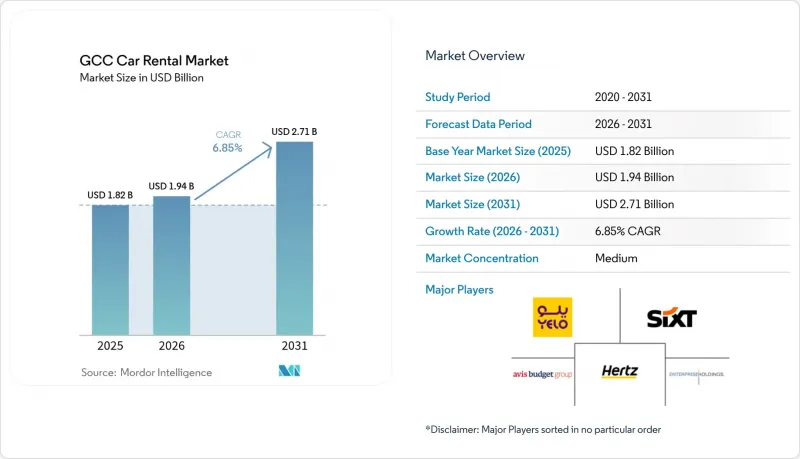
This report is Segmented by Booking Channel (Online and Offline), Rental Duration (Short-Term and Long-Term), Vehicle Type (Hatchback, Sedan, and More), Service Type (Self-Drive and Chauffeur-Drive), End-User (Individual, Corporate and SME, and More), and Country. The Market Forecasts are Provided in Terms of Value (USD).
GCC Car Rental Market Trends and Insights
Tourism rebound & mega-events pipeline
Gulf governments have synchronized a calendar of global spectacles ranging from Formula 1 races to World Cups, each generating predictable surges that rental companies meet through dynamic pricing and fleet redeployment. Saudi Arabia's target of 150 million annual visits by 2030 and the UAE's aim for 40 million overnight stays anchor long-range demand visibility. Dubai welcomed 9.3 million visitors in H1 2024, a 9% year-on-year lift, prompting Dubizzle to debut a dedicated aggregation service to capture the influx. Qatar's experience during the 2022 World Cup revealed both upside-Careem briefly scaled cross-border ride services-and downside risk once the event concluded. Continuous investments in airports and entertainment precincts entrench car rentals as indispensable infrastructure for the visitor economy.
Government Vision programs boosting inbound mobility
Policy frameworks embedded in Saudi Vision 2030 and the UAE Energy Strategy 2050 couple tourism and sustainability goals with regulatory clarity. Saudi Arabia's Ministry of Transport has codified rules for leasing brokers, enabling scale while Qatar and Bahrain publish visitor targets of 7.1 million and 14.1 million respectively. UAE authorities simplify cross-border mobility by recognizing GCC licenses, thereby enlarging the addressable tourist pool. Procurement guidelines that favor hybrid or electric fleets incentivize operators to green their inventories, a move that also appeals to corporate clients pursuing ESG metrics.
High insurance premiums on expatriate drivers
UAE motor premiums climbed 40% in 2024, with rental vehicle cover leaping from 2% to 8.5% of asset value. Expatriates pay additional surcharges due to limited local driving histories, compressing operator margins or inflating retail prices. The wider GCC insurance sector is propelled by IFRS 17 compliance costs and reinsurer hardening that flows through to end-customers. Extreme weather loss events amplify claims severity, and when combined with cross-border cover needs, insurers frequently attach bespoke riders that elevate premiums on multi-jurisdiction rentals.
Other drivers and restraints analyzed in the detailed report include:
- Rising digital aggregation platforms & super-apps
- Gig-economy demand for flexible wheels
- Fragmented regulatory rules across emirates/kingdoms
For complete list of drivers and restraints, kindly check the Table Of Contents.
Segment Analysis
The GCC car rental market retains a 63.52% offline share in 2025, underscoring the appeal of face-to-face interaction for first-time visitors and corporate bookers who favor in-person verification of vehicle condition and insurance coverage. Nevertheless, online channels are on course for a 7.18% CAGR, bolstered by super-apps that promise frictionless reservations in under 60 seconds. Young leisure travelers value transparent pricing and the ability to sync car pick-up with flight itineraries inside the same app, while corporate mobility managers begin to adopt dashboards that consolidate reservation data for expense control.
Dubizzle's entry in October 2024 immediately broadened digital supply, exploiting its marketplace traffic to funnel tourists-Dubai recorded 9.3 million arrivals in H1 2024-into rental bookings. Zero-commission innovators such as Drife illustrate how aggregator economics may compress commissions further, threatening traditional intermediaries. Still, offline counters continue to shine for premium bookings where renters demand bespoke packages, additional insurance clarifications, or luxury vehicle upgrades negotiated on the spot. The coexistence of channel models suggests that the GCC car rental market will evolve into a hybrid ecosystem rather than a pure-play digital environment.
Short-term contracts generated 70.74% of the GCC car rental market size in 2025, buoyed by holidaymakers, business travelers, and weekend shoppers crossing borders within the bloc. Yet long-term and operating leases outstrip in growth, advancing at 7.46% CAGR because corporates embrace asset-light approaches that free balance sheets from depreciation expenses. Regional corporations and project contractors now bundle maintenance, insurance, and telematics in twelve-month contracts that can be upsized or downsized as head-count fluctuates.
This structural pivot is mirrored in the subscription boom led by IndyGo, which raised USD 1.9 million to extend all-inclusive packages across Saudi Arabia and the UAE. Long-term clients prioritize total cost of mobility rather than day rates, rewarding operators who offer predictive maintenance and downtime guarantees. For short-term renters, fleet breadth and airport counter efficiency remain decisive. The coexistence of both duration types underlines how the GCC car rental market accommodates tourist spontaneity while simultaneously embedding itself into corporate supply chains.
Complete Report Scope:
- By Booking Channel
- Online
- Offline
- By Rental Duration
- Short-term
- Long-term / Operating Lease
- By Vehicle Type
- Hatchback
- Sedan
- Sport Utility Vehicle
- Multi-Purpose Vehicle
- By Service Type
- Self-drive
- Chauffeur-drive
- By End-User
- Individual
- Corporate & SME
- Government & NGO
- By Country
- United Arab Emirates
- Saudi Arabia
- Qatar
- Kuwait
- Oman
- Bahrain
List of Companies Covered in this Report:
- Hertz Corporation
- Sixt SE
- Avis Budget Group Inc.
- Enterprise Holdings Inc.
- Thrifty Car Rental (UAE)
- Europcar Mobility Group
- Budget Saudi Arabia
- Auto Rent (Oman)
- Key Car Rental (KSA)
- National Car Rental (Al Tayyar)
- Al-Futtaim Automall
- Danat Qatar
- Telgani
- ekar
- Udrive
- Moosa Rent-a-Car
- Dollar Rent-a-Car UAE
- Payless Car Rental
- Yelo (Al-Wefaq)
- Kayak
Additional Benefits:
- The market estimate (ME) sheet in Excel format
- 3 months of analyst support
TABLE OF CONTENTS
1 Introduction
- 1.1 Study Assumptions & Market Definition
- 1.2 Scope of the Study
2 Research Methodology
3 Executive Summary
4 Market Landscape
- 4.1 Market Overview
- 4.2 Market Drivers
- 4.2.1 Tourism rebound & mega-events pipeline
- 4.2.2 Government Vision programs boosting inbound mobility
- 4.2.3 Rising digital aggregation platforms & super-apps
- 4.2.4 Gig-economy demand for flexible wheels
- 4.2.5 EV adoption incentives lowering total-cost-of-ownership
- 4.2.6 Cross-border one-way rentals for weekend shopping
- 4.3 Market Restraints
- 4.3.1 High insurance premiums on expatriate drivers
- 4.3.2 Fragmented regulatory rules across emirates/kingdoms
- 4.3.3 Limited secondary market for ex-rental EVs
- 4.3.4 Shortage of Arabic UX in global OTAs
- 4.4 Value / Supply-Chain Analysis
- 4.5 Regulatory Landscape
- 4.6 Technological Outlook
- 4.7 Porter's Five Forces Analysis
- 4.7.1 Threat of New Entrants
- 4.7.2 Bargaining Power of Buyers/Consumers
- 4.7.3 Bargaining Power of Suppliers
- 4.7.4 Threat of Substitute Products
- 4.7.5 Intensity of Competitive Rivalry
5 Market Size & Growth Forecasts (Value (USD))
- 5.1 By Booking Channel
- 5.1.1 Online
- 5.1.2 Offline
- 5.2 By Rental Duration
- 5.2.1 Short-term
- 5.2.2 Long-term / Operating Lease
- 5.3 By Vehicle Type
- 5.3.1 Hatchback
- 5.3.2 Sedan
- 5.3.3 Sport Utility Vehicle
- 5.3.4 Multi-Purpose Vehicle
- 5.4 By Service Type
- 5.4.1 Self-drive
- 5.4.2 Chauffeur-drive
- 5.5 By End-User
- 5.5.1 Individual
- 5.5.2 Corporate & SME
- 5.5.3 Government & NGO
- 5.6 By Country
- 5.6.1 United Arab Emirates
- 5.6.2 Saudi Arabia
- 5.6.3 Qatar
- 5.6.4 Kuwait
- 5.6.5 Oman
- 5.6.6 Bahrain
6 Competitive Landscape
- 6.1 Market Concentration
- 6.2 Strategic Moves
- 6.3 Market Share Analysis
- 6.4 Company Profiles (includes Global Level Overview, Market Level Overview, Core Segments, Financials as Available, Strategic Information, Market Rank/Share for Key Companies, Products and Services, SWOT Analysis, and Recent Developments)
- 6.4.1 Hertz Corporation
- 6.4.2 Sixt SE
- 6.4.3 Avis Budget Group Inc.
- 6.4.4 Enterprise Holdings Inc.
- 6.4.5 Thrifty Car Rental (UAE)
- 6.4.6 Europcar Mobility Group
- 6.4.7 Budget Saudi Arabia
- 6.4.8 Auto Rent (Oman)
- 6.4.9 Key Car Rental (KSA)
- 6.4.10 National Car Rental (Al Tayyar)
- 6.4.11 Al-Futtaim Automall
- 6.4.12 Danat Qatar
- 6.4.13 Telgani
- 6.4.14 ekar
- 6.4.15 Udrive
- 6.4.16 Moosa Rent-a-Car
- 6.4.17 Dollar Rent-a-Car UAE
- 6.4.18 Payless Car Rental
- 6.4.19 Yelo (Al-Wefaq)
- 6.4.20 Kayak
7 Market Opportunities & Future Outlook
- 7.1 White-space & unmet-need assessment

