PUBLISHER: Mordor Intelligence | PRODUCT CODE: 2116310

PUBLISHER: Mordor Intelligence | PRODUCT CODE: 2116310
Middle East And Africa Venture Capital - Market Share Analysis, Industry Trends & Statistics, Growth Forecasts (2026 - 2031)
According to Mordor Intelligence, the Middle East and Africa venture capital market size is expected to grow from USD 3.69 billion in 2025 to USD 4.01 billion in 2026 and is forecast to reach USD 6.09 billion by 2031 at 8.70% CAGR over 2026-2031.
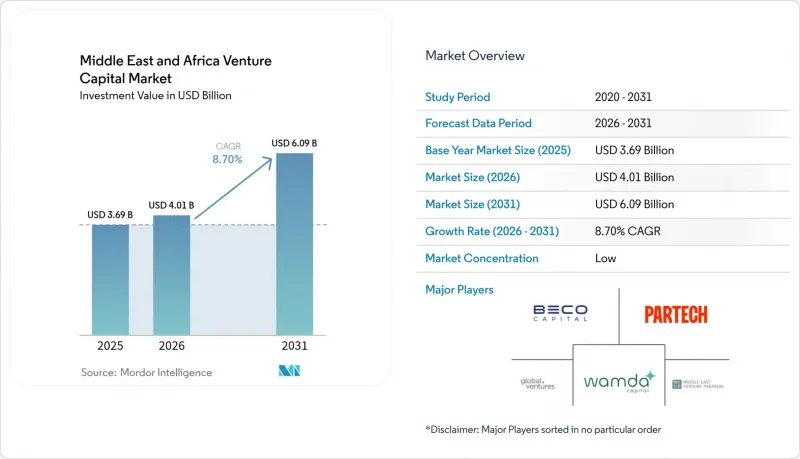
This report is Segmented by Investment Stage (Early Stage, Breakout Stage, Scale-Up), Industry (Health, Fintech, Enterprise Software, Energy, and More), Exit Type (Initial Public Offering (IPO), Strategic M&A, Secondary Sale / Buy-Out, and More), and Geography (United Arab Emirates, Saudi Arabia, South Africa, and More). The Market Forecasts are Provided in Value (USD).
Middle East And Africa Venture Capital Market Trends and Insights
Abundant Sovereign-Backed Startup Funds
Gulf sovereign funds collectively manage roughly USD 4 trillion and supply more than 54% of global sovereign deployment in 2024. Saudi Arabia's Public Investment Fund earmarks over 70% of its rising annual outlays for domestic assets, channeling long-dated capital into local venture vehicles. Mubadala's creation of MGX, with stakes in OpenAI and Databricks, exemplifies strategic technology investing that extends beyond traditional VC horizons. Sovereign participation stabilizes valuations and offers follow-on certainty, mitigating global risk-off episodes. Development-finance institutions have joined these funds in blended-finance structures worth USD 213 billion, widening pools available to startups tackling social and climate challenges.
Rapid Fintech Adoption Across MEA
Fintech dominated with a 34.6% share in 2024 as regional e-commerce is set to hit USD 50 billion in 2025, lifting demand for digital payments. African mobile-money accounts surpassed 2.1 billion, providing a distribution backbone that venture-funded wallets can monetize. Outbound remittances of AED 145.7 billion from the UAE and USD 38.56 billion from Saudi Arabia highlight cross-border payment opportunities. Real-time transaction values in the Middle East are forecast to quadruple to USD 2.6 billion by 2027, reinforcing revenue visibility for payment-rail startups. Regulatory sandboxes and open-banking mandates in Bahrain and Saudi Arabia accelerate licensing, shortening go-to-market periods and attracting patient capital.
Limited Exit Avenues & Shallow Capital Markets
Africa recorded only 26 venture-backed exits in 2024, returning just USD 0.13 per invested dollar, underscoring liquidity headwinds. MENA startups have raised USD 11 billion since 2021, yet fewer than 7.5% achieved exits, pointing to a growth-stage funding gap near USD 20 billion. UAE listing rules requiring two years of profitability curb IPO access for high-growth startups and skew exits toward strategic sales. Fragmented national exchanges raise cross-border compliance costs, discouraging dual listings that could broaden investor bases. Limited analyst coverage in post-IPO trading suppresses liquidity, dampening valuation multiples and recycle rates for venture funds.
Other drivers and restraints analyzed in the detailed report include:
- Business-Friendly Regulatory Reforms
- Surge in Sharia-Compliant Impact Investing
- Political-Economic Instability in Select Markets
For complete list of drivers and restraints, kindly check the Table Of Contents.
Segment Analysis
Early-stage funding held 47.55% of the Middle East and Africa venture capital market share in 2025, reflecting generous sovereign seed programs and sandbox initiatives that derisk product validation. Scale-up rounds, though smaller in count, are projected to post the ecosystem's fastest 9.21% CAGR to 2031 as breakout firms bridge the USD 10-15 million financing gap through rising venture-debt lines. Average initial checks of USD 500,000-1.5 million and reserve ratios near 45% position funds to support multiple follow-on cycles, sustaining portfolio momentum. Venture-debt deals jumped from USD 202 million in 2022 to USD 757 million in 2023, evidencing late-stage financing sophistication that nurtures scale-ups through capital-intensive growth phases. Strengthened valuation governance post-2022 ensures disciplined step-ups tied to institutional priced rounds, reinforcing market resilience.
Growth-stage scarcity has drawn global co-investors, with sovereign funds syndicating larger tickets alongside Silicon Valley and Asian firms, improving exit optionality. Early-stage abundance is enabled by angel collectives like COREangels MEA and fund-of-funds programs such as VC Grow that back first-time managers averaging USD 40 million vehicles. Breakout rounds benefit from enhanced third-party valuation services and updated governance codes introduced across DIFC and ADGM in 2024, lowering diligence friction for foreign limited partners. The Middle East and Africa venture capital market size devoted to scale-up deals is set to expand faster than any other stage as sovereign investors pursue domestic tech champions to advance industrial diversification agendas. Overall, stage distribution signals a maturing capital stack transitioning from pure company formation toward balanced growth-equity support.
Complete Report Scope:
- By Stage of Investment
- Early Stage
- Breakout Stage
- Scale-up
- By Industry
- Health
- Fintech
- Enterprise Software
- Energy
- Transportation
- Robotics
- Other Industries
- By Exit Type
- Initial Public Offering (IPO)
- Strategic M&A
- Secondary Sale / Buy-out
- Write-offs
- By Geography
- United Arab Emirates
- Saudi Arabia
- South Africa
- Nigeria
- Rest of Middle East & Africa
List of Companies Covered in this Report:
- Wamda Capital
- Middle East Venture Partners (MEVP)
- 500 Global
- Partech Partners
- Sequoia Capital India & SEA (Surge)
- Global Ventures
- Beco Capital
- Flat6Labs
- Algebra Ventures
- Future Africa
- Sawari Ventures
- Endure Capital
- Y Combinator
- Mubadala Capital Ventures
- Chimera Capital
- QED Investors
- Tiger Global Management
- SoftBank Vision Fund
- IFC (International Finance Corporation)
- KdV Capital
Additional Benefits:
- The market estimate (ME) sheet in Excel format
- 3 months of analyst support
TABLE OF CONTENTS
1 Introduction
- 1.1 Study Assumptions & Market Definition
- 1.2 Scope of the Study
2 Research Methodology
3 Executive Summary
4 Market Landscape
- 4.1 Market Overview
- 4.2 Market Drivers
- 4.2.1 Abundant sovereign-backed startup funds
- 4.2.2 Rapid fintech adoption across MEA
- 4.2.3 Business-friendly regulatory reforms
- 4.2.4 Surge in Sharia-compliant impact investing
- 4.2.5 Diaspora-led angel networks catalyzing later rounds
- 4.2.6 Cross-border CVC from telcos & energy majors
- 4.3 Market Restraints
- 4.3.1 Limited exit avenues & shallow capital markets
- 4.3.2 Political-economic instability in select markets
- 4.3.3 Talent drain via global remote-work migration
- 4.3.4 Currency volatility eroding exit returns
- 4.4 Value Chain Analysis
- 4.5 Regulatory Landscape
- 4.6 Technological Outlook
- 4.7 Porter's Five Forces
- 4.7.1 Threat of New Entrants
- 4.7.2 Bargaining Power of Suppliers
- 4.7.3 Bargaining Power of Buyers
- 4.7.4 Threat of Substitute Products
- 4.7.5 Competitive Rivalry
5 Market Size & Growth Forecasts (Value, USD Bn)
- 5.1 By Stage of Investment
- 5.1.1 Early Stage
- 5.1.2 Breakout Stage
- 5.1.3 Scale-up
- 5.2 By Industry
- 5.2.1 Health
- 5.2.2 Fintech
- 5.2.3 Enterprise Software
- 5.2.4 Energy
- 5.2.5 Transportation
- 5.2.6 Robotics
- 5.2.7 Other Industries
- 5.3 By Exit Type
- 5.3.1 Initial Public Offering (IPO)
- 5.3.2 Strategic M&A
- 5.3.3 Secondary Sale / Buy-out
- 5.3.4 Write-offs
- 5.4 By Geography
- 5.4.1 United Arab Emirates
- 5.4.2 Saudi Arabia
- 5.4.3 South Africa
- 5.4.4 Nigeria
- 5.4.5 Rest of Middle East & Africa
6 Competitive Landscape
- 6.1 Market Concentration
- 6.2 Strategic Moves
- 6.3 Market Share Analysis
- 6.4 Company Profiles (includes Global level Overview, Market level overview, Core Segments, Financials as available, Strategic Information, Market Rank/Share, Products & Services, Recent Developments)
- 6.4.1 Wamda Capital
- 6.4.2 Middle East Venture Partners (MEVP)
- 6.4.3 500 Global
- 6.4.4 Partech Partners
- 6.4.5 Sequoia Capital India & SEA (Surge)
- 6.4.6 Global Ventures
- 6.4.7 Beco Capital
- 6.4.8 Flat6Labs
- 6.4.9 Algebra Ventures
- 6.4.10 Future Africa
- 6.4.11 Sawari Ventures
- 6.4.12 Endure Capital
- 6.4.13 Y Combinator
- 6.4.14 Mubadala Capital Ventures
- 6.4.15 Chimera Capital
- 6.4.16 QED Investors
- 6.4.17 Tiger Global Management
- 6.4.18 SoftBank Vision Fund
- 6.4.19 IFC (International Finance Corporation)
- 6.4.20 KdV Capital
7 Market Opportunities & Future Outlook
- 7.1 White-space & Unmet-need Assessment

