PUBLISHER: Mordor Intelligence | PRODUCT CODE: 2116336

PUBLISHER: Mordor Intelligence | PRODUCT CODE: 2116336
MENA Health And Medical Insurance - Market Share Analysis, Industry Trends & Statistics, Growth Forecasts (2026 - 2031)
According to Mordor Intelligence, the MENA health & medical insurance market size is expected to grow from USD 18.93 billion in 2025 to USD 20.18 billion in 2026 and is forecast to reach USD 27.79 billion by 2031 at 6.61% CAGR over 2026-2031.
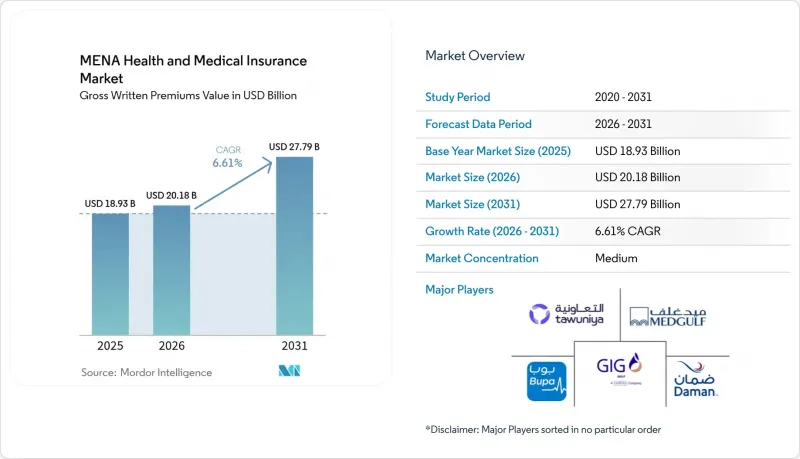
This report is Segmented by Insurance Product Type (Private Medical Insurance, Public/Social Security Schemes), Term of Coverage (Short-Term, Long-Term), Distribution Channel (Brokers/Agents, Banks Bancassurance, and More), End-User Segment (Individuals, Smes, and More), and Geography (Gulf Cooperation Council, North Africa, and More). The Market Forecasts are Provided in Terms of Value (USD).
MENA Health And Medical Insurance Market Trends and Insights
Expansion of Mandatory Health-Insurance Schemes
Federal and provincial mandates create the strongest tailwind for the MENA health & medical insurance market. The UAE's Federal Decree-Law No. 48/2023 requires every resident to carry out a health policy from January 2025, adding about 3.7 million new lives to insurer pools. Oman adopted a co-insurance framework in December 2024 that lets Category A and Category B carriers share risk, broadening capacity and lowering entry barriers. Saudi Arabia's rule extending coverage to 3.7 million domestic workers from July 2024 demonstrates how regulators target groups previously outside formal employment. Progressive solvency rules across GCC jurisdictions raise capital standards yet reassure providers, improving claim settlement reliability. Together, these measures stimulate premium inflow, cut hospital bad-debt exposure, and anchor long-run actuarial predictability.
Rising NCD-Linked Medical Inflation
Non-communicable diseases such as diabetes affect over 20% of GCC adults and drive utilization of high-cost interventions. New oncology biologics, continuous glucose monitors, and advanced cardiac procedures lift per-capita spending far above consumer price trends. Governments pilot value-based payment, Saudi Arabia's AR-DRG model, and Dubai's eClaimLink, yet specialty pharmaceutical outlays still increase at double-digit rates. Insurers counter through tiered formularies, prior authorization, and tighter preferred-provider agreements. Public-health campaigns under Vision 2030 pivot toward preventive care, but their fiscal savings materialize gradually, keeping margin pressure intense in the near term.
Double-Digit Medical-Cost Inflation
Escalating procedure and drug prices erode affordability, prompting carriers to lift premiums and trim benefits. Specialty medicines for oncology and immunology can surpass USD 100,000 per patient-year, straining reserves and raising reinsurance thresholds. Hospital consolidation across major metros concentrates bargaining power, discouraging aggressive tariff discounts. Imported equipment becomes pricier in markets coping with local-currency depreciation, intensifying cost pressures. Carriers pilot value-based contracts and bundled payments, but fragmented provider IT systems limit the rapid scalability of such models across the region.
Other drivers and restraints analyzed in the detailed report include:
- Privatization & PPPs in Regional Healthcare
- Cross-Border Insured Medical-Tourism Boom
- Regulatory Fragmentation Across MENA
For complete list of drivers and restraints, kindly check the Table Of Contents.
Segment Analysis
Private medical insurance retained a 65.64% leadership position in 2025, illustrating entrenched employer-sponsored benefits and individual demand among affluent expatriates. Public and social-security schemes, however, post the most rapid 7.53% trajectory, signaling government commitment to universal coverage. The UAE's AED 320 (USD 87.1) annual premium mandate expands pooled lives and bolsters underwriting depth. Saudi Arabia's planned National Health Insurance Centre will further tilt volumes toward public programs by 2026. Insurers pivot from premium-centric competition to administrative-service contracting, requiring advanced population-health analytics. Group coverage inside PMI leverages scale efficiencies, while retail PMI targets middle-class families seeking enhanced maternity and dental benefits. Yet as mandatory frameworks broaden, supplemental riders present lucrative cross-sell avenues for carriers.
Regulatory designs encourage duality: public baselines deliver essential benefits, and private top-ups fill gaps such as elective surgery or international treatment. Egypt's phased rollout brings 12.8 million more citizens under the umbrella, boosting risk diversification. Morocco's AMO extension to self-employed workers broadens contributory tax bases. This twin-track architecture supports actuarial stability, though it challenges legacy PMI players accustomed to high-margin expatriate products within the MENA health & medical insurance market.
Annual and multi-year contracts command 84.02% of premiums and log a 8.72% climb, showing participant preference for uninterrupted access and insurer appetite for predictable cash flow. Gulf expatriate visas typically span two to three years, dovetailing with policy durations and lowering churn. Short-term covers cater to medical tourists, seasonal labor, and humanitarian missions but remain a modest slice of overall volume. Oman's co-insurance scheme rewards carriers that keep clients enrolled across consecutive years, reinforcing long-term dominance.
Extended terms also dovetail with chronic-care management programs: continuous glucose monitoring, oncology case management, and wellness coaching demand year-round engagement to achieve cost savings. As wearable-driven data flows mature, insurers will refine renewal pricing based on longitudinal health metrics rather than broad socio-demographic proxies, sharpening risk segmentation within the MENA health & medical insurance market.
Complete Report Scope:
- By Insurance Product Type
- Private Medical Insurance (PMI)
- Individual Policy Coverage
- Group Policy Coverage
- Public / Social Security Schemes
- Private Medical Insurance (PMI)
- By Term of Coverage
- Short-term (< 12 months)
- Long-term (>= 12 months)
- By Distribution Channel
- Brokers / Agents
- Banks (Bancassurance)
- Direct-to-Consumer (Online / Phone)
- Employer-Sponsored (Companies)
- Other Channels (Affinity, Associations)
- By End-user Segment
- Individuals
- SMEs
- Large Corporates
- By Geography
- Gulf Cooperation Council (KSA, UAE, Qatar, Kuwait, Bahrain, Oman)
- North Africa (Egypt, Morocco, Algeria, Tunisia)
- Levant & Emerging (Jordan, Lebanon, Palestine, Iraq)
List of Companies Covered in this Report:
- Bupa Arabia
- Tawuniya
- Daman - National Health Insurance Co.
- MedGulf
- Orient Insurance (Sukoon)
- GIG Gulf
- Qatar Life & Medical (QLM)
- AXA Cooperative Egypt
- Allianz Saudi Fransi
- NAS Neuron Health Services (TPA)
- Nextcare (TPA)
- GlobeMed Saudi (TPA)
- Cigna Middle East
- MetLife Gulf
- Liva Insurance
- Wafa Assurance
- Al Rajhi Takaful
- Oman Insurance Company
- Doha Insurance Group
- Solidarity Bahrain
Additional Benefits:
- The market estimate (ME) sheet in Excel format
- 3 months of analyst support
TABLE OF CONTENTS
1 Introduction
- 1.1 Study Assumptions and Market Definition
- 1.2 Scope of the Study
2 Research Methodology
3 Executive Summary
4 Market Landscape
- 4.1 Market Overview
- 4.2 Market Drivers
- 4.2.1 Expansion of mandatory health-insurance schemes
- 4.2.2 Rising NCD-linked medical inflation
- 4.2.3 Privatization and PPPs in regional healthcare
- 4.2.4 Cross-border insured medical-tourism boom
- 4.2.5 Embedded coverage via super-apps and gig-platforms
- 4.2.6 AI-driven risk scoring unlocking new micro-plans
- 4.3 Market Restraints
- 4.3.1 Double-digit medical-cost inflation
- 4.3.2 Regulatory fragmentation across MENA
- 4.3.3 Chronic clinical-talent shortages
- 4.3.4 Geopolitical conflict-zone risk pools
- 4.4 Value / Supply-Chain Analysis
- 4.5 Regulatory Landscape
- 4.6 Technological Outlook
- 4.7 Porter's Five Forces
- 4.7.1 Competitive Rivalry
- 4.7.2 Threat of New Entrants
- 4.7.3 Bargaining Power of Suppliers
- 4.7.4 Bargaining Power of Buyers
- 4.7.5 Threat of Substitutes
5 Market Size and Growth Forecasts (Value, USD)
- 5.1 By Insurance Product Type
- 5.1.1 Private Medical Insurance (PMI)
- 5.1.1.1 Individual Policy Coverage
- 5.1.1.2 Group Policy Coverage
- 5.1.2 Public / Social Security Schemes
- 5.1.1 Private Medical Insurance (PMI)
- 5.2 By Term of Coverage
- 5.2.1 Short-term (< 12 months)
- 5.2.2 Long-term (>= 12 months)
- 5.3 By Distribution Channel
- 5.3.1 Brokers / Agents
- 5.3.2 Banks (Bancassurance)
- 5.3.3 Direct-to-Consumer (Online / Phone)
- 5.3.4 Employer-Sponsored (Companies)
- 5.3.5 Other Channels (Affinity, Associations)
- 5.4 By End-user Segment
- 5.4.1 Individuals
- 5.4.2 SMEs
- 5.4.3 Large Corporates
- 5.5 By Geography
- 5.5.1 Gulf Cooperation Council (KSA, UAE, Qatar, Kuwait, Bahrain, Oman)
- 5.5.2 North Africa (Egypt, Morocco, Algeria, Tunisia)
- 5.5.3 Levant & Emerging (Jordan, Lebanon, Palestine, Iraq)
6 Competitive Landscape
- 6.1 Market Concentration
- 6.2 Strategic Moves
- 6.3 Market Share Analysis
- 6.4 Company Profiles (includes Global level Overview, Market level overview, Core Segments, Financials as available, Strategic Information, Market Rank/Share, Products & Services, Recent Developments)
- 6.4.1 Bupa Arabia
- 6.4.2 Tawuniya
- 6.4.3 Daman - National Health Insurance Co.
- 6.4.4 MedGulf
- 6.4.5 Orient Insurance (Sukoon)
- 6.4.6 GIG Gulf
- 6.4.7 Qatar Life & Medical (QLM)
- 6.4.8 AXA Cooperative Egypt
- 6.4.9 Allianz Saudi Fransi
- 6.4.10 NAS Neuron Health Services (TPA)
- 6.4.11 Nextcare (TPA)
- 6.4.12 GlobeMed Saudi (TPA)
- 6.4.13 Cigna Middle East
- 6.4.14 MetLife Gulf
- 6.4.15 Liva Insurance
- 6.4.16 Wafa Assurance
- 6.4.17 Al Rajhi Takaful
- 6.4.18 Oman Insurance Company
- 6.4.19 Doha Insurance Group
- 6.4.20 Solidarity Bahrain
7 Market Opportunities & Future Outlook
- 7.1 White-space & Unmet-Need Assessment

