PUBLISHER: Mordor Intelligence | PRODUCT CODE: 2116361

PUBLISHER: Mordor Intelligence | PRODUCT CODE: 2116361
United States Private Equity - Market Share Analysis, Industry Trends & Statistics, Growth Forecasts (2026 - 2031)
According to Mordor Intelligence, the United States private equity market size is USD 900.16 billion in 2026 and is projected to reach USD 1,402.46 billion by 2031 at a 9.27% CAGR.
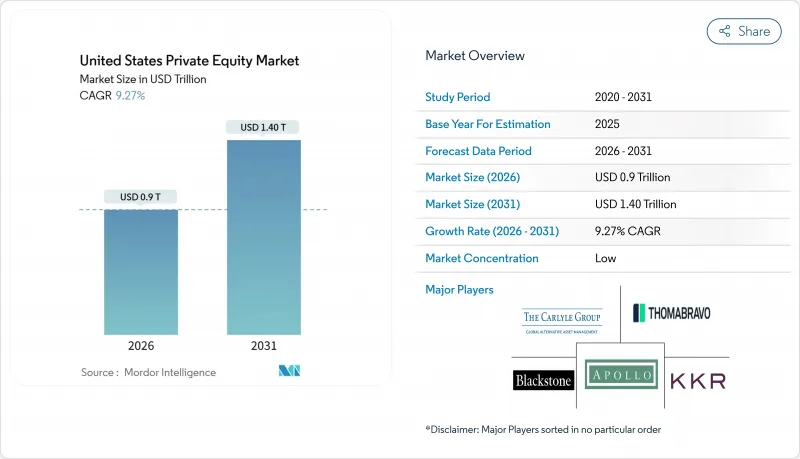
This report is Segmented by Fund Type (Buyout Funds, Growth Equity Funds, and More), Sector Focus (Technology & Software, Energy, and More), Deal Size (Mid-Cap USD 100 M - USD 1 B EV, Large-Cap USD 1 B - USD 5 B EV, and More), Investor Type (Pension Funds, Insurance Companies, and More), and Geography (Northeast, Midwest, South, West). The Market Forecasts are Provided in Terms of Value (USD).
United States Private Equity Market Trends and Insights
Rising Dry-Powder Levels from U.S. Institutional Allocations
Global private equity dry powder reached USD 2.51 trillion by mid-June 2025, with United States-based funds holding roughly USD 880 billion, which sustains a strong deployment agenda across the United States private equity market. Allocators continued to raise target weights in late 2024 and 2025, and a meaningful portion of investors signaled intention to raise commitments through 2026 despite slower distributions, which prolongs the reinvestment cycle within the United States private equity market. Time pressure has grown as more mature assets sit in portfolios awaiting exit windows, so managers prioritize platform strategies and roll-ups where operating levers can shape returns independent of broad market timing within the United States private equity market. Institutions have concentrated commitments in USD 1 billion to USD 5 billion funds that can execute repeatable exits, which reinforces the middle-market's appeal for proprietary sourcing and integration plays. This dynamic tilts activity toward founder succession, add-on programs, and disciplined bolt-ons, where execution steps can buffer elevated entry multiples and produce clearer value bridges in the United States private equity market.
Digitization-Led Deal Flow in Software & Tech-Enabled Services
Technology's share of deployment climbed through 2024 and into 2025 as sponsors favored software models with high recurring revenue and predictable retention, which remains a core allocation driver in the United States private equity market. Software deal values rose in 2024 and early 2025, and median revenue multiples moved higher as buyers priced durable growth into platforms positioned for AI and cloud infrastructure needs across the United States private equity market. Generative AI absorbed a large share of venture capital in 2025, which reinforced sponsor appetite for carve-outs of tech-enabled divisions where stand-alone governance can accelerate product roadmaps. Thoma Bravo's agreement to purchase Boeing's Digital Aviation Solutions business in April 2025 highlighted the carve-out pipeline from legacy industrials into sponsor ownership inside the United States private equity market. Adoption of AI tools across the investment lifecycle has broadened, as firms automate sourcing, diligence, and portfolio monitoring workflows to expand capacity and improve decision quality in the United States private equity market .
SEC Fee-Transparency Crackdown Raising Compliance Costs
SEC enforcement and examination priorities in 2025 sustained a focus on valuation, fees and expenses, custody, and marketing disclosures, which increased fixed overhead for mid-sized managers in the United States private equity market. Actions and penalties related to fee calculation and conflicts of interest required many advisers to invest in personnel, systems, and third-party valuation support. New and amended rules covering incident response, customer notification timelines, and AML program requirements that take effect in 2026 further raise the compliance bar in the United States private equity market. These obligations weigh more heavily on emerging managers that lack scale to amortize costs across larger asset bases, which can accelerate consolidation. Managers are responding with enhanced internal controls, audit readiness, and clearer client communications to reduce regulatory risk within the United States private equity market.
Other drivers and restraints analyzed in the detailed report include:
- SEC Marketing-Rule Relaxation Expanding Accredited-Investor Pool
- Energy-Transition Mandates Driving Infrastructure & Renewables PE Funds
- Heightened Competition from SPACs & Strategics Compressing Entry Multiples
For complete list of drivers and restraints, kindly check the Table Of Contents.
Segment Analysis
Buyout Funds commanded 48.39% of the United States private equity market share in 2025, reflecting sponsor preference for mature, cash-flow-generative platforms with reliable exit paths. Venture Capital Funds are projected to grow at a 12.37% CAGR through 2031, supported by the concentration of capital in AI and machine learning that captured a large portion of 2025 deal value in early-stage and growth rounds. Growth Equity Funds represented a notable share of deal flow by count in mid-2025, although large buyout add-ons skewed value toward control transactions across the United States private equity market. Mezzanine and preferred structures gained traction for bridging valuation gaps and managing downside in separation-heavy processes. Infrastructure and energy transition strategies attracted commitments consistent with long-duration needs and stable yield targets within the United States private equity market.
The United States private equity industry continues to diversify across fund types as allocators balance return targets against liquidity and risk preferences. Distressed and turnaround strategies remain a smaller slice but can expand if macro conditions tighten and over-levered assets need restructuring. Large, sector-focused managers with repeatable operating playbooks have broadened their capital menu to include structured equity and private credit, which widens their opportunity set in the United States private equity market. The performance wedge between top-quartile sector specialists and generalists emphasizes the benefit of scale and domain expertise. Managers who demonstrate disciplined underwriting, deep sourcing, and technology-enabled diligence continue to draw support in the United States private equity market.
Technology & Software captured a 33.24% share in 2025, driven by SaaS, cloud, and data platforms that align with mission-critical workflows in the United States private equity market. Healthcare & Life Sciences is forecasted to grow at a 14.39% CAGR through 2031 as AI-enabled diagnostics, specialty care, and medtech platforms draw sponsor interest. Medtech deal activity and exits picked up in 2025 versus 2024, creating scope for take-privates and carve-outs that can benefit from digital and AI-enabled operating upgrades. Energy, power, and utilities deal flow continued to tilt toward renewables, grid, and storage, reflecting policy support and project finance visibility in the United States private equity market.
The United States private equity industry also saw momentum across financial services and fintech, where payment processing, embedded finance, and wealth platforms attracted sponsor capital. Consumer and residential services platforms grew as managers used buy-and-build strategies to consolidate HVAC, plumbing, and specialty trades that exhibit recurring demand. Industrials and manufacturing benefited from supply chain realignment and domestic capacity additions, which supported roll-up playbooks that create procurement and operations efficiencies in the United States private equity market. Sponsors are allocating more operating resources to data, pricing analytics, and sales enablement within sector platforms to accelerate organic growth. Sector specialists maintain an edge in sourcing and integration, which supports premium underwriting assumptions in the United States private equity market.
Complete Report Scope:
- By Fund Type
- Buyout Funds
- Growth Equity Funds
- Venture Capital Funds
- Mezzanine & Preferred Equity Funds
- Distressed/Turnaround Funds
- Infrastructure & Energy Transition Funds
- By Sector Focus
- Technology & Software
- Healthcare & Life Sciences
- Consumer & Retail
- Industrial & Manufacturing
- Financial Services & FinTech
- Energy, Power & Utilities
- By Deal Size
- Small-Cap (Less than $100 M EV)
- Mid-Cap ($100 M - $1 B EV)
- Large-Cap ($1 B - $5 B EV)
- Mega-Deals (Greater than $5 B EV)
- By Investor Type
- Pension Funds
- Insurance Companies
- Endowments & Foundations
- Funds of Funds
- Family Offices & HNWIs
- Corporate/Strategic LPs
- By Geography (United States)
- Northeast
- Midwest
- South
- West
List of Companies Covered in this Report:
- Blackstone Inc.
- Kohlberg Kravis Roberts & Co. L.P. (KKR)
- Apollo Global Management, Inc.
- The Carlyle Group Inc.
- TPG Inc.
- Bain Capital LP
- Vista Equity Partners
- Thoma Bravo LP
- Silver Lake Partners
- Warburg Pincus LLC
- Advent International Corp.
- Clayton, Dubilier & Rice LLC
- Hellman & Friedman LLC
- Leonard Green & Partners, L.P.
- Oak Hill Capital Partners
- Ares Management Corporation
- Brookfield Asset Management Ltd.
- GTCR LLC
- Madison Dearborn Partners
- Providence Equity Partners
Additional Benefits:
- The market estimate (ME) sheet in Excel format
- 3 months of analyst support
TABLE OF CONTENTS
1 Introduction
- 1.1 Study Assumptions & Market Definition
- 1.2 Scope of the Study
2 Research Methodology
3 Executive Summary
4 Market Landscape
- 4.1 Market Overview
- 4.2 Market Drivers
- 4.2.1 Rising Dry-Powder Levels from U.S. Institutional Allocations
- 4.2.2 Digitization-Led Deal Flow in Software & Tech-Enabled Services
- 4.2.3 Generational Succession in U.S. Mid-Market Businesses Creating Buy-out Targets
- 4.2.4 SEC Marketing-Rule Relaxation Expanding Accredited-Investor Pool
- 4.2.5 Energy-Transition Mandates Driving Infrastructure & Renewables PE Funds
- 4.2.6 Corporate Carve-outs Accelerating as Conglomerates Refocus on Core
- 4.3 Market Restraints
- 4.3.1 SEC Fee-Transparency Crackdown Raising Compliance Costs
- 4.3.2 Sharp Rise in Interest Rates Inflating Leveraged-Buy-out Financing Costs
- 4.3.3 Heightened Competition from SPACs & Strategics Compressing Entry Multiples
- 4.3.4 Growing Political & ESG Scrutiny of PE Labor Practices
- 4.4 Value Chain Analysis
- 4.5 Regulatory Outlook (SEC, CFIUS, Dodd-Frank Amendments)
- 4.6 Technological Outlook (AI-Driven Sourcing & Diligence Tools)
- 4.7 Porter's Five Forces
- 4.7.1 Bargaining Power of Limited Partners
- 4.7.2 Bargaining Power of General Partners
- 4.7.3 Threat of New Entrants
- 4.7.4 Threat of Substitutes (Public Markets, SPACs, Direct Lending)
- 4.7.5 Competitive Rivalry Among PE Firms
5 Market Size & Growth Forecasts (Value)
- 5.1 By Fund Type
- 5.1.1 Buyout Funds
- 5.1.2 Growth Equity Funds
- 5.1.3 Venture Capital Funds
- 5.1.4 Mezzanine & Preferred Equity Funds
- 5.1.5 Distressed/Turnaround Funds
- 5.1.6 Infrastructure & Energy Transition Funds
- 5.2 By Sector Focus
- 5.2.1 Technology & Software
- 5.2.2 Healthcare & Life Sciences
- 5.2.3 Consumer & Retail
- 5.2.4 Industrial & Manufacturing
- 5.2.5 Financial Services & FinTech
- 5.2.6 Energy, Power & Utilities
- 5.3 By Deal Size
- 5.3.1 Small-Cap (Less than $100 M EV)
- 5.3.2 Mid-Cap ($100 M - $1 B EV)
- 5.3.3 Large-Cap ($1 B - $5 B EV)
- 5.3.4 Mega-Deals (Greater than $5 B EV)
- 5.4 By Investor Type
- 5.4.1 Pension Funds
- 5.4.2 Insurance Companies
- 5.4.3 Endowments & Foundations
- 5.4.4 Funds of Funds
- 5.4.5 Family Offices & HNWIs
- 5.4.6 Corporate/Strategic LPs
- 5.5 By Geography (United States)
- 5.5.1 Northeast
- 5.5.2 Midwest
- 5.5.3 South
- 5.5.4 West
6 Competitive Landscape
- 6.1 Market Concentration
- 6.2 Strategic Moves
- 6.3 Market Share Analysis
- 6.4 Company Profiles (includes Global level Overview, Market level overview, Core Segments, Financials as available, Strategic Information, Market Rank/Share for key companies, Products & Services, and Recent Developments)
- 6.4.1 Blackstone Inc.
- 6.4.2 Kohlberg Kravis Roberts & Co. L.P. (KKR)
- 6.4.3 Apollo Global Management, Inc.
- 6.4.4 The Carlyle Group Inc.
- 6.4.5 TPG Inc.
- 6.4.6 Bain Capital LP
- 6.4.7 Vista Equity Partners
- 6.4.8 Thoma Bravo LP
- 6.4.9 Silver Lake Partners
- 6.4.10 Warburg Pincus LLC
- 6.4.11 Advent International Corp.
- 6.4.12 Clayton, Dubilier & Rice LLC
- 6.4.13 Hellman & Friedman LLC
- 6.4.14 Leonard Green & Partners, L.P.
- 6.4.15 Oak Hill Capital Partners
- 6.4.16 Ares Management Corporation
- 6.4.17 Brookfield Asset Management Ltd.
- 6.4.18 GTCR LLC
- 6.4.19 Madison Dearborn Partners
- 6.4.20 Providence Equity Partners
7 Market Opportunities & Future Outlook
- 7.1 Strategic partnerships and co-investment structures unlock new capital flows.
- 7.2 Targeted large buyouts, carve-outs, and add-ons with operational transformation potential yield high returns.

