PUBLISHER: Mordor Intelligence | PRODUCT CODE: 2116416

PUBLISHER: Mordor Intelligence | PRODUCT CODE: 2116416
United Kingdom Lubricants - Market Share Analysis, Industry Trends & Statistics, Growth Forecasts (2026 - 2031)
According to Mordor Intelligence, the United Kingdom lubricants market size in 2026 is estimated at 433.01 Million Liters, growing from 2025 value of 422.78 Million Liters with 2031 projections showing 487.99 Million Liters, growing at 2.42% CAGR over 2026-2031.
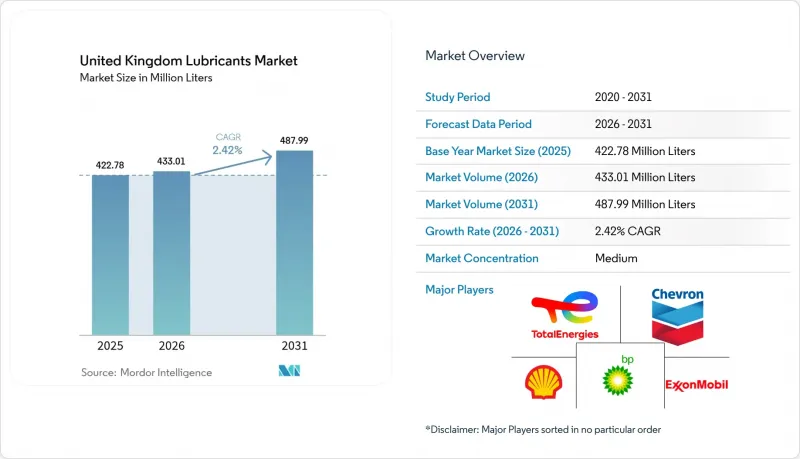
This report is Segmented by End-User Industry (Automotive, Heavy Equipment, Metalworking and Metallurgy, Power Generation, and Other End-User Industries) and Product Type (Engine Oils, Transmission and Gear Oils, Hydraulic Fluids, Metalworking Fluids, Greases, and Other Product Types). The Market Forecasts are Provided in Terms of Volume (Liters).
United Kingdom Lubricants Market Trends and Insights
Euro 7 Emissions Standards Drive Premium Synthetic Adoption
Euro 7 rules, effective in 2025, impose tighter particulate and NOx thresholds that mineral oils struggle to meet, steering fleets toward synthetics with higher oxidation resistance and better low-viscosity film strength. Field data show that synthetics deliver 15-20% longer service life, reducing downtime and total ownership costs despite higher list prices. UK commercial-vehicle registrations climbed 8.2% in 2024, multiplying demand for Euro 7-grade lubricants in logistics, construction, and municipal fleets. Suppliers with proprietary additive packages enjoy margin upside, while legacy mineral producers retreat to price-sensitive legacy niches.
Manufacturing Reshoring Programmes Boost Industrial Lubricant Demand
Domestic output rose 3.1% in 2024 as firms relocated production from Asia, lifting consumption of metalworking fluids, hydraulic oils, and NSF-approved food-grade lubricants. Government incentives worth GBP 4.5 billion through 2026 target aerospace, electronics, and renewable-energy equipment, each rich in lubrication points. Midlands and Northern clusters report 25-30% spikes in industrial-fluid orders as greenfield plants ramp up, favoring suppliers with technical service teams and rapid-response warehouses.
Electric Vehicle Adoption Erodes Traditional Engine-Oil Demand
EV registrations surged 38% in 2024 to reach 315,000 units, accounting for 18.1% of new-car sales and reducing engine oil demand per vehicle. Fleet data indicate that electric vans reduce lubricant use by 60-70% compared to diesel models, as drivetrains shift to sealed bearings and coolant-damped power electronics. With a ban on new internal-combustion engine sales from 2030, engine oil volumes are expected to face permanent contraction despite the emergence of EV thermal-management fluids.
Other drivers and restraints analyzed in the detailed report include:
- Offshore Wind Expansion Creates Specialized Grease Market
- IoT Integration Transforms Lubrication Service Models
- Volatile Feedstock Costs Pressure Margin Sustainability
For complete list of drivers and restraints, kindly check the Table Of Contents.
Segment Analysis
The automotive segment accounted for 56.12% of the UK lubricants market in 2025, reflecting the nation's 32 million-vehicle parc and dense commercial fleet activity. The UK lubricants market size tied to the automotive sector is forecast to decelerate as electrification advances; yet, premium synthetics for Euro 7 diesel vans and light trucks continue to support both volume and value. Large fleet operators now prioritize longer drain intervals and warranty-compliant low-SAP formulations to lower the total cost of ownership. Meanwhile, plant-based manufacturing reshoring reallocates lubricant demand toward heavy equipment in new gigafactories and food-processing lines, gradually trimming the automotive share.
Power generation currently holds only a single-digit percentage but is expected to register the fastest 2.85% CAGR as offshore wind capacity scales. Turbine OEMs mandate tailored ester-enhanced fluids and water-resistant greases that can run for seven-year intervals between servicing, driving high-unit-value sales. Construction equipment, marine, and aerospace collectively stabilize base-load volumes through mixed machinery parks that rely on hydraulic, gear, and compressor oils. Automotive suppliers reposition R&D budgets toward EV thermal-management fluids, while industrial specialists invest in field-service teams to support power-plant operators, indicating a gradual dilution of vehicle-centric revenue concentration.
Complete Report Scope:
- By End-user Industry
- Automotive
- Heavy Equipment
- Metalworking and Metallurgy
- Power Generation
- Other End-user Industries
- By Product Type
- Engine Oils
- Transmission and Gear Oils
- Hydraulic Fluids
- Metalworking Fluids
- Greases
- Other Product Types
List of Companies Covered in this Report:
- BP p.l.c.
- Chevron Corporation
- DriveTec
- Exol Lubricants Limited
- Exxon Mobil Corporation
- FUCHS
- Gazpromneft - Lubricants Ltd.
- Gulf Oil UK
- Kluber Lubrication
- Liqui Moly UK
- Metalube
- Millers Oils Ltd.
- Morris Lubricants
- Motul UK
- Shell plc
- TotalEnergies
- Valvoline Global Operations
Additional Benefits:
- The market estimate (ME) sheet in Excel format
- 3 months of analyst support
TABLE OF CONTENTS
1 Introduction
- 1.1 Study Assumptions and Market Definition
- 1.2 Scope of the Study
2 Research Methodology
3 Executive Summary
4 Market Landscape
- 4.1 Market Overview
- 4.2 Market Drivers
- 4.2.1 Euro 7 / UK CO2-fleet rules spur premium synthetics
- 4.2.2 Manufacturing reshoring programmes (e.g., automotive, food)
- 4.2.3 Offshore-wind build-out needs long-life turbine greases
- 4.2.4 IoT-enabled "lube-as-a-service" adoption in factories
- 4.2.5 Circular-economy mandates accelerate re-refined base-oil use
- 4.3 Market Restraints
- 4.3.1 Accelerating electric-vehicle parc lowers engine-oil volumes
- 4.3.2 Volatile crude and additive feedstock prices
- 4.3.3 Shrinking UK base-oil refining capacity heightens import risk
- 4.4 Value Chain Analysis
- 4.5 Porter's Five Forces
- 4.5.1 Threat of New Entrants
- 4.5.2 Bargaining Power of Suppliers
- 4.5.3 Bargaining Power of Buyers
- 4.5.4 Threat of Substitutes
- 4.5.5 Competitive Rivalry
- 4.6 Distribution-Channel Analysis
5 Market Size and Growth Forecasts (Value)
- 5.1 By End-user Industry
- 5.1.1 Automotive
- 5.1.2 Heavy Equipment
- 5.1.3 Metalworking and Metallurgy
- 5.1.4 Power Generation
- 5.1.5 Other End-user Industries
- 5.2 By Product Type
- 5.2.1 Engine Oils
- 5.2.2 Transmission and Gear Oils
- 5.2.3 Hydraulic Fluids
- 5.2.4 Metalworking Fluids
- 5.2.5 Greases
- 5.2.6 Other Product Types
6 Competitive Landscape
- 6.1 Market Concentration
- 6.2 Strategic Moves
- 6.3 Market Share (%)/Ranking Analysis
- 6.4 Company Profiles (includes Global level Overview, Market level overview, Core Segments, Financials as available, Strategic Information, Market Rank/Share, Products and Services, Recent Developments)
- 6.4.1 BP p.l.c.
- 6.4.2 Chevron Corporation
- 6.4.3 DriveTec
- 6.4.4 Exol Lubricants Limited
- 6.4.5 Exxon Mobil Corporation
- 6.4.6 FUCHS
- 6.4.7 Gazpromneft - Lubricants Ltd.
- 6.4.8 Gulf Oil UK
- 6.4.9 Kluber Lubrication
- 6.4.10 Liqui Moly UK
- 6.4.11 Metalube
- 6.4.12 Millers Oils Ltd.
- 6.4.13 Morris Lubricants
- 6.4.14 Motul UK
- 6.4.15 Shell plc
- 6.4.16 TotalEnergies
- 6.4.17 Valvoline Global Operations
7 Market Opportunities and Future Outlook
- 7.1 White-Space and Unmet-Need Assessment

