PUBLISHER: Mordor Intelligence | PRODUCT CODE: 2116682

PUBLISHER: Mordor Intelligence | PRODUCT CODE: 2116682
Protein Purification And Isolation - Market Share Analysis, Industry Trends & Statistics, Growth Forecasts (2026 - 2031)
According to Mordor Intelligence, protein purification and isolation market size in 2026 is estimated at USD 11.83 billion, growing from 2025 value of USD 10.76 billion with 2031 projections showing USD 18.97 billion, growing at 9.92% CAGR over 2026-2031.
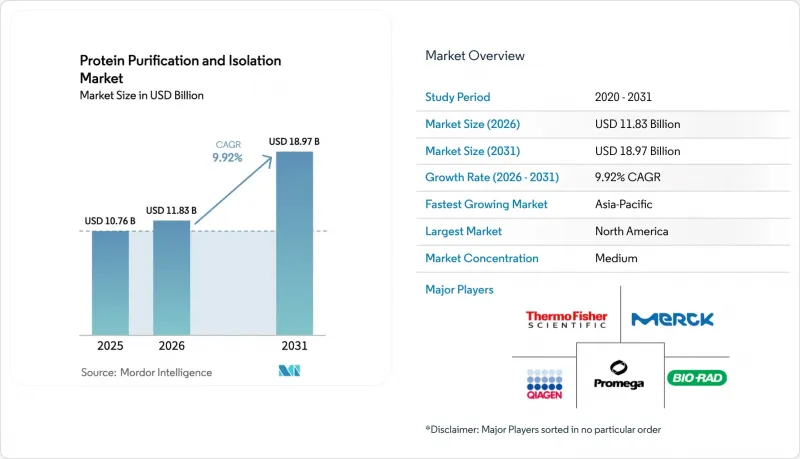
This report is Segmented by Product (Instruments, Consumables), Technology (Precipitation, Ultrafiltration and Diafiltration, Chromatography, Electrophoresis, and More), End-User (Academic and Research Institutes, Pharmaceutical and Biopharmaceutical Companies, and More), and Geography (North America, Europe, and More). The Market Forecasts are Provided in Terms of Value (USD).
Global Protein Purification And Isolation Market Trends and Insights
Expansion of Monoclonal Antibody and Recombinant Biologics Pipeline
Monoclonal antibody volumes continue to rise at roughly 8% annually, driving demand for Protein A affinity chromatography skids that dominate IgG capture workflows. Fujifilm's USD 1.2 billion facility in North Carolina adds 160,000 L of bioreactor capacity devoted to antibody production, a scale-up that necessitates proportional downstream investments. The pipeline now spans antibody-drug conjugates and bispecific formats, each introducing unique selectivity challenges that boost demand for high-capacity resins. Standardization of modular skids across sites helps global manufacturers accelerate validation and cut procurement cost. Consequently, suppliers with deep process-development expertise and global support teams capture larger slices of the protein purification and isolation market.
Surge in Cell- & Gene-Therapy Manufacturing Capacity Investments
Biopharma's pivot toward genetic medicines is reshaping purification needs because viral vectors and plasmid DNA have larger molecular footprints and stricter contamination limits than conventional proteins. Asahi Kasei's Bionova Scientific opened a Texas site to supply plasmid DNA solutions tailored for these modalities. Manufacturers often lock in three- to five-year capex plans that include chromatography columns designed for large-pore resins and membrane-based harvest technologies. Regulators impose heightened scrutiny on adventitious-agent control, accelerating uptake of sterile, single-use flow paths. As a result, the protein purification and isolation market gains durable revenue streams from both first-of-kind therapies and follow-on capacity expansions.
Capital-Intensive Downstream Hardware and Facility Retro-Fits
Modern chromatography skids often cost USD 0.5-2 million each, and converting a stainless-steel suite into a single-use environment adds incremental infrastructure bills. Small biotechnology firms and manufacturers in cost-sensitive regions frequently delay upgrades, risking capacity bottlenecks. Currency volatility elevates landed cost of imported equipment, while limited access to long-term financing prolongs payback horizons. Consequently, some companies outsource production to well-capitalized CDMOs, shifting equipment demand from buyers to service providers inside the protein purification and isolation market.
Other drivers and restraints analyzed in the detailed report include:
- Growing Demand for High-Throughput, Single-Use Purification Systems
- Government Funding for Structural Proteomics Consortia
- Scarcity of Advanced Purification Talent in Emerging Clusters
For complete list of drivers and restraints, kindly check the Table Of Contents.
Segment Analysis
Consumables captured 62.88% of the protein purification and isolation market in 2025 as disposable filters, membranes, ready-to-use columns, and buffer kits became standard for cGMP suites. Kits and reagents sit at the heart of this lead because standardized formulations simplify validation across multi-site networks. Demand is reinforced by global harmonization of microbial-residue limits that favor sterile, pre-gamma-irradiated flow paths. The recurring nature of consumable purchases translates into stable revenue that underwrites supplier R&D.
The instruments segment, though smaller, is set to log an 11.37% CAGR as manufacturers modernize with AI-enabled chromatography systems and inline formulation skids. Capital investment cycles mirror facility build-outs such as Samsung Biologics' multi-plant expansion in South Korea, which lifts baseline equipment shipments. Vendors linking hardware with digital twins and predictive-maintenance dashboards stand to enlarge their slice of the protein purification and isolation market size for instrumentation.
Complete Report Scope:
- By Product
- Instruments
- Consumables
- Kits
- Reagents and Buffers
- Columns and Cartridges
- Other Products
- By Technology
- Precipitation
- Ultrafiltration and Diafiltration
- Chromatography
- Ion-Exchange
- Size-Exclusion
- Reverse-Phase
- Others
- Electrophoresis
- Gel Electrophoresis
- Capillary Electrophoresis
- Isoelectric Focusing
- Western Blotting and Immunoprecipitation
- Other Technologies
- By End-User
- Academic and Research Institutes
- Pharmaceutical and Biopharmaceutical Companies
- Contract Research and Manufacturing Organizations (CROs/CMOs)
- Hospitals and Diagnostic Labs
- Other End Users
- By Geography
- North America
- United States
- Canada
- Mexico
- Europe
- Germany
- United Kingdom
- France
- Italy
- Spain
- Rest of Europe
- Asia-Pacific
- China
- Japan
- India
- Australia
- South Korea
- Rest of Asia-Pacific
- Middle East and Africa
- GCC
- South Africa
- Rest of Middle East and Africa
- South America
- Brazil
- Argentina
- Rest of South America
- North America
Geography Analysis
North America held 41.95% of global revenue in 2025, supported by seasoned regulators, deep capital markets, and marquee CDMOs. NSF's USD 40 million protein-design program amplifies academic orders for high-specification chromatographs, reinforcing regional dominance. Novo Nordisk's USD 4.1 billion expansion in North Carolina confirms the region's ability to attract mega-projects despite cost-of-labor premiums. Manufacturers operating under FDA oversight often set global purification benchmarks, giving North American suppliers export leverage.
Asia-Pacific is projected to clock an 11.66% CAGR, making it the quickest climber within the protein purification and isolation market. Samsung Biologics' 360,000 L of capacity across three plants, with a fourth underway, showcases regional scaling power. MilliporeSigma and Cytiva have mirrored customer moves by establishing local resin-packing and equipment-service footprints to curb supply-chain risk. Policy frameworks in China and India further catalyze domestic build-outs, although geopolitical tensions such as the prospective US BioSecure Act could reshape future supply routes.
Europe maintains mature clusters in Germany, Switzerland, and the United Kingdom, underpinned by harmonized regulatory statutes that simplify cross-border equipment validation. Environmental stewardship regulations motivate adoption of continuous processing and low-buffer technologies, opening opportunities for green-chemistry-oriented suppliers. Elsewhere, the Middle East, Africa, and South America register rising interest, particularly where governments fund vaccine sovereignty projects, but inadequate cold-chain and water infrastructure still impede wide-scale uptake.
- Thermo Fisher Scientific
- Merck KGaA (MilliporeSigma)
- Danaher Corporation (Cytiva & Pall)
- Sartorius
- Agilent Technologies
- Bio-Rad Laboratories
- QIAGEN
- Promega
- Norgen Biotek
- Abcam
- Purolite (Ecolab)
- Repligen
- 3M Purification Inc.
- Waters Corporation
- Shimadzu
- Revvity Inc. (formerly PerkinElmer)
- Tosoh
- GenScript Biotech
- Takara Bio
- Chromatrap (Porvair Sciences)
Additional Benefits:
- The market estimate (ME) sheet in Excel format
- 3 months of analyst support
TABLE OF CONTENTS
1 Introduction
- 1.1 Study Assumptions & Market Definition
- 1.2 Scope of the Study
2 Research Methodology
3 Executive Summary
4 Market Landscape
- 4.1 Market Overview
- 4.2 Market Drivers
- 4.2.1 Expansion of Monoclonal Antibody and Recombinant Biologics Pipeline
- 4.2.2 Surge In Cell- & Gene-Therapy Manufacturing Capacity Investments
- 4.2.3 Growing Demand for High-Throughput, Single-Use Purification Systems
- 4.2.4 Government Funding for Structural Proteomics Consortia
- 4.2.5 Adoption Of Continuous/Chromatographic Intensification Platforms
- 4.2.6 AI-Guided Resin and Buffer Selection Software Integration
- 4.3 Market Restraints
- 4.3.1 Capital-Intensive Downstream Hardware and Facility Retro-Fits
- 4.3.2 Scarcity of Advanced Purification Talent in Emerging Clusters
- 4.3.3 Batch-To-Batch Variability of Affinity Resins Limiting Re-Use
- 4.3.4 Environmental Burden of Single-Use Plastics in Bioprocessing
- 4.4 Regulatory Landscape
- 4.5 Technological Outlook
- 4.6 Porter's Five Forces Analysis
- 4.6.1 Bargaining Power of Buyers
- 4.6.2 Bargaining Power of Suppliers
- 4.6.3 Threat of New Entrants
- 4.6.4 Threat of Substitutes
- 4.6.5 Intensity of Competitive Rivalry
5 Market Size & Growth Forecasts (Value)
- 5.1 By Product
- 5.1.1 Instruments
- 5.1.2 Consumables
- 5.1.2.1 Kits
- 5.1.2.2 Reagents and Buffers
- 5.1.2.3 Columns and Cartridges
- 5.1.2.4 Other Products
- 5.2 By Technology
- 5.2.1 Precipitation
- 5.2.2 Ultrafiltration and Diafiltration
- 5.2.3 Chromatography
- 5.2.3.1 Ion-Exchange
- 5.2.3.2 Size-Exclusion
- 5.2.3.3 Reverse-Phase
- 5.2.3.4 Others
- 5.2.4 Electrophoresis
- 5.2.4.1 Gel Electrophoresis
- 5.2.4.2 Capillary Electrophoresis
- 5.2.4.3 Isoelectric Focusing
- 5.2.5 Western Blotting and Immunoprecipitation
- 5.2.6 Other Technologies
- 5.3 By End-User
- 5.3.1 Academic and Research Institutes
- 5.3.2 Pharmaceutical and Biopharmaceutical Companies
- 5.3.3 Contract Research and Manufacturing Organizations (CROs/CMOs)
- 5.3.4 Hospitals and Diagnostic Labs
- 5.3.5 Other End Users
- 5.4 By Geography
- 5.4.1 North America
- 5.4.1.1 United States
- 5.4.1.2 Canada
- 5.4.1.3 Mexico
- 5.4.2 Europe
- 5.4.2.1 Germany
- 5.4.2.2 United Kingdom
- 5.4.2.3 France
- 5.4.2.4 Italy
- 5.4.2.5 Spain
- 5.4.2.6 Rest of Europe
- 5.4.3 Asia-Pacific
- 5.4.3.1 China
- 5.4.3.2 Japan
- 5.4.3.3 India
- 5.4.3.4 Australia
- 5.4.3.5 South Korea
- 5.4.3.6 Rest of Asia-Pacific
- 5.4.4 Middle East and Africa
- 5.4.4.1 GCC
- 5.4.4.2 South Africa
- 5.4.4.3 Rest of Middle East and Africa
- 5.4.5 South America
- 5.4.5.1 Brazil
- 5.4.5.2 Argentina
- 5.4.5.3 Rest of South America
- 5.4.1 North America
6 Competitive Landscape
- 6.1 Market Concentration
- 6.2 Market Share Analysis
- 6.3 Company Profiles (includes Global level Overview, Market level overview, Core Segments, Financials as available, Strategic Information, Market Rank/Share for key companies, Products & Services, and Recent Developments)
- 6.3.1 Thermo Fisher Scientific Inc.
- 6.3.2 Merck KGaA (MilliporeSigma)
- 6.3.3 Danaher Corporation (Cytiva & Pall)
- 6.3.4 Sartorius AG
- 6.3.5 Agilent Technologies Inc.
- 6.3.6 Bio-Rad Laboratories Inc.
- 6.3.7 QIAGEN N.V.
- 6.3.8 Promega Corporation
- 6.3.9 Norgen Biotek Corp.
- 6.3.10 Abcam plc
- 6.3.11 Purolite (Ecolab)
- 6.3.12 Repligen Corporation
- 6.3.13 3M Purification Inc.
- 6.3.14 Waters Corporation
- 6.3.15 Shimadzu Corporation
- 6.3.16 Revvity Inc. (formerly PerkinElmer)
- 6.3.17 Tosoh Bioscience
- 6.3.18 GenScript Biotech
- 6.3.19 Takara Bio Inc.
- 6.3.20 Chromatrap (Porvair Sciences)
7 Market Opportunities & Future Outlook
- 7.1 White-space & Unmet-Need Assessment

