PUBLISHER: Mordor Intelligence | PRODUCT CODE: 2116888

PUBLISHER: Mordor Intelligence | PRODUCT CODE: 2116888
Asia-Pacific Digestive Health Supplements - Market Share Analysis, Industry Trends & Statistics, Growth Forecasts (2026 - 2031)
According to Mordor Intelligence, the Asia-Pacific digestive health supplements market size was valued at USD 3.01 billion in 2025 and estimated to grow from USD 3.22 billion in 2026 to reach USD 4.49 billion by 2031, at a CAGR of 6.91% during the forecast period (2026-2031).
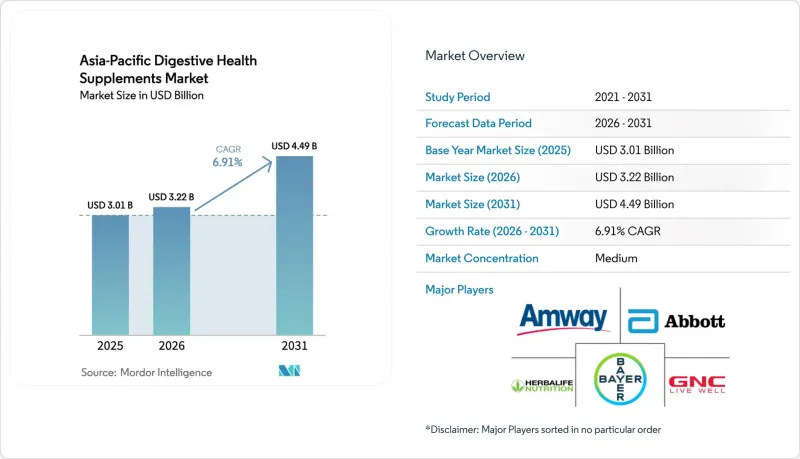
This report is Segmented by Type (Prebiotics, Probiotics, Enzymes, Botanicals, and Others), Form (Capsules and Softgels, Tablets, Gummies and Chewables, and More), Distribution Channel (Supermarkets/Hypermarkets, Specialty and Health Stores and More), and Geography (China, India, Japan, Australia, and More). The Market Forecasts are Provided in Terms of Value and Volume (USD/ Tonnes).
Asia-Pacific Digestive Health Supplements Market Trends and Insights
Rising Prevalence of Digestive Disorders Prompting Demand for Supplements
The rising prevalence of digestive diseases across Asia has generated sustained demand for therapeutic supplements, with the region experiencing a substantial burden from digestive conditions. This health trend stems from urbanization-related dietary changes, increased stress levels affecting gut function, and growing cases of inflammatory bowel conditions that traditional medications do not fully address. The aging populations in Japan, South Korea, and Singapore have increased the need for therapies that support digestive enzyme production and maintain microbiome balance. Research validating the effectiveness of specific probiotic strains like Bifidobacterium longum ES1 in treating irritable bowel syndrome has encouraged both medical professionals to recommend and patients to use these supplements. Healthcare systems, particularly in markets with developed infrastructure, are increasingly incorporating digestive health supplements into standard treatment protocols, shifting from treating symptoms to preventing digestive issues.
Increasing Focus on Preventive Healthcare and Natural Health Solutions
The increasing health consciousness among consumers has fundamentally shifted their preferences toward preventive supplementation, as evidenced by the substantial growth in online health supplement sales across China. This transformation extends beyond immediate immune support, with consumers adopting holistic wellness approaches and recognizing gut health as a cornerstone of overall well-being. In response to this trend, governments in China and India have implemented programs that effectively bridge traditional medicine with modern nutraceuticals while maintaining stringent safety regulations. The market has evolved to meet these changing consumer needs by introducing personalized nutrition offerings, as demonstrated by Calbee's innovative approach of providing microbiota-based granola recommendations. This shift in consumer behavior reflects a growing willingness to invest in preventive healthcare products, particularly when companies can validate health improvements through concrete measures such as biomarker measurements and systematic symptom tracking.
Regulatory Complexities and Inconsistent Policies
The regulatory landscape across Asia-Pacific presents significant barriers to market expansion, as each jurisdiction maintains distinct approval processes, health claim requirements, and quality standards. These variations increase compliance costs and cause market entry delays. For example, Indonesia's registration requirements demand detailed scientific evidence for each probiotic strain, creating challenges for smaller companies while established multinationals benefit from their regulatory expertise. The absence of mutual recognition agreements between major markets requires companies to duplicate clinical studies and regulatory submissions, which increases development costs and constrains innovation investment. Regulatory updates in 2025 across multiple APAC jurisdictions have introduced additional compliance requirements that existing market participants must address while maintaining product availability. This regulatory environment particularly affects novel probiotic strains and innovative delivery formats without established precedents, creating market entry challenges for new products.
Other drivers and restraints analyzed in the detailed report include:
- Fueling Fitness and Sports Nutrition Trends Promoting Digestive Health
- Growing Demand for Organic and Plant-Based Digestive Supplements
- Stability and Shelf-Life Issues Affecting Probiotic Product Viability
For complete list of drivers and restraints, kindly check the Table Of Contents.
Segment Analysis
The microbiome supplement market demonstrates clear consumer preferences, with probiotics maintaining a substantial 77.65% market share in 2025. This dominance reflects years of consumer familiarity and robust scientific validation. In contrast, prebiotics have emerged as the market's growth driver, achieving an 8.04% CAGR through 2031, as consumers develop a more sophisticated understanding of microbiome optimization strategies.
The probiotic segment's market leadership builds on decades of research that validates strain-specific benefits for digestive health, immunity, and metabolic function. Major industry players, such as Morinaga Milk, are capitalizing on this trend by developing proprietary strains like Bifidobacterium longum subsp. infantis M-63 for specialized infant nutrition products in China. Within the broader market, enzymes maintain consistent demand for targeted digestive support applications, while botanicals benefit from increasing integration with traditional medicine practices. The "Others" category encompasses innovative postbiotic formulations and synbiotic combinations, representing the latest developments in microbiome science and product development.
Complete Report Scope:
- By Type
- Prebiotics
- Probiotics
- Enzymes
- Botanicals
- Others
- By Form
- Capsules and Softgels
- Tablets
- Gummies and Chewables
- Powders and Granules
- Others
- By Distribution Channel
- Supermarkets/ Hypermarkets
- Pharmacies/ Drugstores
- Online Retailers
- Other Distribution Channels
- By Geography
- China
- India
- Japan
- Australia
- Indonesia
- South Korea
- Thailand
- Singapore
- Rest of Asia-Pacific
List of Companies Covered in this Report:
- Abbott Laboratories
- Amway
- Bayer AG
- Herbalife Nutrition Ltd.
- GNC Holdings LLC
- DuPont de Nemours, Inc.
- NOW Foods
- Nestle S.A.
- Nordic Naturals
- Organic India Pvt. Ltd.
- Yakult Honsha Co., Ltd.
- Danone S.A.
- Blackmores Limited
- By-Health Co., Ltd.
- Swisse Wellness Pty Ltd.
- Glanbia plc (Optimum Nutrition)
- Meiji Holdings Co., Ltd.
- Zhejiang Conba Pharmaceutical
- Otsuka Holdings Co., Ltd.
- Suntory Holdings Ltd.
Additional Benefits:
- The market estimate (ME) sheet in Excel format
- 3 months of analyst support
TABLE OF CONTENTS
1 INTRODUCTION
- 1.1 Study Assumptions and Market Definition
- 1.2 Scope of the Study
2 RESEARCH METHODOLOGY
3 EXECUTIVE SUMMARY
4 MARKET LANDSCAPE
- 4.1 Market Overview
- 4.2 Market Drivers
- 4.2.1 Rising prevalence of digestive disorders prompting demand for supplements
- 4.2.2 Incresing focus on preventive healthcare and natural health solutions
- 4.2.3 Fueling fitness and sports nutrition trends promoting digestive health
- 4.2.4 Growing demand for organic and plant-based digestive supplements
- 4.2.5 Expansion of dairy-free and allergen-free supplement options
- 4.2.6 Greater penetration of e-commerce and online distribution channels.
- 4.3 Market Restraints
- 4.3.1 Regulatory complexities and inconsistent policies
- 4.3.2 Stability and shelf-life issues affecting probiotic product viability
- 4.3.3 Taste and palatability challenges affecting consumer adherence
- 4.3.4 Storage and refrigeration requirements increasing limiting distribution
- 4.4 Supply Chain Analysis
- 4.5 Regulatory Outlook
- 4.6 Porter's Five Forces
- 4.6.1 Threat of New Entrants
- 4.6.2 Bargaining Power of Buyers/Consumers
- 4.6.3 Bargaining Power of Suppliers
- 4.6.4 Threat of Substitute Products
- 4.6.5 Intensity of Competitive Rivalry
- 4.6.5.1 ewe
5 MARKET SIZE and GROWTH FORECASTS (VALUE AND VOLUME)
- 5.1 By Type
- 5.1.1 Prebiotics
- 5.1.2 Probiotics
- 5.1.3 Enzymes
- 5.1.4 Botanicals
- 5.1.5 Others
- 5.2 By Form
- 5.2.1 Capsules and Softgels
- 5.2.2 Tablets
- 5.2.3 Gummies and Chewables
- 5.2.4 Powders and Granules
- 5.2.5 Others
- 5.3 By Distribution Channel
- 5.3.1 Supermarkets/ Hypermarkets
- 5.3.2 Pharmacies/ Drugstores
- 5.3.3 Online Retailers
- 5.3.4 Other Distribution Channels
- 5.4 By Geography
- 5.4.1 China
- 5.4.2 India
- 5.4.3 Japan
- 5.4.4 Australia
- 5.4.5 Indonesia
- 5.4.6 South Korea
- 5.4.7 Thailand
- 5.4.8 Singapore
- 5.4.9 Rest of Asia-Pacific
6 COMPETITIVE LANDSCAPE
- 6.1 Market Concentration
- 6.2 Strategic Moves
- 6.3 Market Share Analysis
- 6.4 Company Profiles (includes Global-level Overview, Market-level Overview, Core Segments, Financials (if available), Strategic Information, Market Rank/Share, Products and Services, Recent Developments)
- 6.4.1 Abbott Laboratories
- 6.4.2 Amway
- 6.4.3 Bayer AG
- 6.4.4 Herbalife Nutrition Ltd.
- 6.4.5 GNC Holdings LLC
- 6.4.6 DuPont de Nemours, Inc.
- 6.4.7 NOW Foods
- 6.4.8 Nestle S.A.
- 6.4.9 Nordic Naturals
- 6.4.10 Organic India Pvt. Ltd.
- 6.4.11 Yakult Honsha Co., Ltd.
- 6.4.12 Danone S.A.
- 6.4.13 Blackmores Limited
- 6.4.14 By-Health Co., Ltd.
- 6.4.15 Swisse Wellness Pty Ltd.
- 6.4.16 Glanbia plc (Optimum Nutrition)
- 6.4.17 Meiji Holdings Co., Ltd.
- 6.4.18 Zhejiang Conba Pharmaceutical
- 6.4.19 Otsuka Holdings Co., Ltd.
- 6.4.20 Suntory Holdings Ltd.
7 MARKET OPPORTUNITIES AND FUTURE OUTLOOK

