PUBLISHER: Mordor Intelligence | PRODUCT CODE: 2116962

PUBLISHER: Mordor Intelligence | PRODUCT CODE: 2116962
United States Floor Coatings - Market Share Analysis, Industry Trends & Statistics, Growth Forecasts (2026 - 2031)
According to Mordor Intelligence, united states floor coatings market size in 2026 is estimated at USD 1.99 billion, growing from 2025 value of USD 1.91 billion with 2031 projections showing USD 2.43 billion, growing at 4.12% CAGR over 2026-2031.
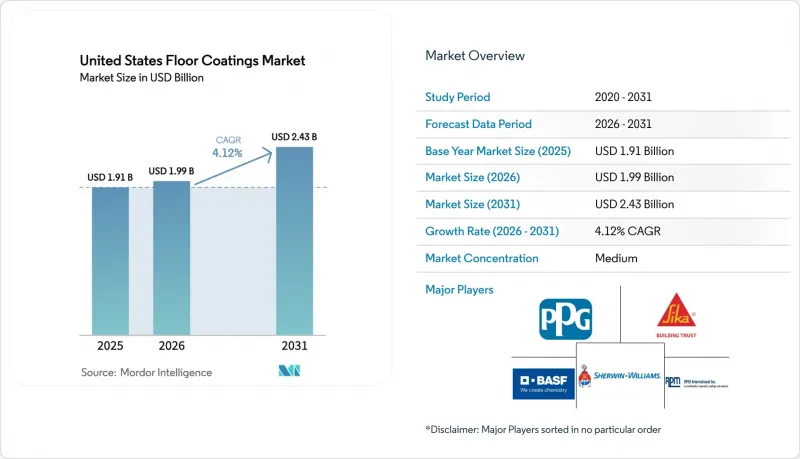
This report is Segmented by Product Type (Epoxy, Polyurethane, Polyaspartic, Acrylic, and Others), Floor Material (Concrete, Wood, and Others), and End-Use Industry (Industrial/Institutional, Commercial, and Residential). The Market Forecasts are Provided in Terms of Value (USD).
United States Floor Coatings Market Trends and Insights
Robust Growth in Commercial and Industrial Construction
The United States' commercial construction's projected 8.6% growth in 2025 creates a multiplier effect for floor coatings demand, particularly in sectors requiring specialized performance characteristics. The Texas construction industry maintains nearly USD 40 Billion in ongoing and upcoming projects through TxDOT, including a USD 3 Billion expansion at Dallas-Fort Worth International Airport. This infrastructure surge extends beyond traditional applications, as the U.S. Bureau of Labor Statistics identifies power generation and electrical contractor segments as key employment growth areas, directly correlating with increased demand for conductive and dissipative floor coatings in energy infrastructure projects. The construction industry's 4.7% employment growth projection through 2033 indicates sustained demand for flooring installations, though labor constraints may shift preferences toward faster-curing polyaspartic systems. Healthcare construction's 27% share of anticipated projects benefits antimicrobial coating segments, as post-pandemic facility design prioritizes infection control surfaces.
Rising Adoption of Epoxy Systems for Durability
Epoxy's 42.35% share in 2024 reflects its chemical resistance and lifecycle performance, qualities prized in advanced manufacturing where thermal cycling and heavy loads are routine. Domestic output is growing as anti-dumping actions redirect sourcing toward U.S. plants, trimming lead times but lifting input costs. Innovations such as bio-based resins align with sustainability goals without sacrificing film integrity. Clean-room settings in automotive battery and aerospace assembly continue to specify epoxy floors for their ability to meet both Electrostatic Discharge (ESD) and sanitary standards.
Volatile Epoxy and Raw-material Prices
Raw material price volatility creates margin pressure and project cost uncertainty that constrains market growth, particularly as anti-dumping investigations reshape epoxy resin supply chains. The U.S. International Trade Commission's determination that the domestic industry suffers material injury from subsidized imports from South Korea, Taiwan, and Thailand resulted in potential duties that could increase input costs for floor coating manufacturers. The concentration of epoxy production in Asia creates supply chain vulnerabilities that manifest as price volatility during geopolitical tensions or logistics disruptions. Smaller coating manufacturers face particular challenges in managing input cost fluctuations, as they lack larger competitors' purchasing power and supply chain diversification. The shift toward domestic epoxy production, while reducing import dependence, may result in structurally higher costs due to smaller production scales and higher labor costs compared to Asian facilities.
Other drivers and restraints analyzed in the detailed report include:
- Demand for Aesthetic Decorative Coatings in Remodeling
- Shift Toward Low-VOC, High-solids Formulations
- Stricter State VOC Limits Raise Compliance Costs
For complete list of drivers and restraints, kindly check the Table Of Contents.
Segment Analysis
Epoxy retained a 41.70% United States floor coatings market share in 2025 thanks to its entrenched performance record in factories, warehouses, and aviation hangars. Polyaspartic systems, however, are projected to expand at a 5.52% CAGR, propelled by overnight-curing capability that limits facility downtime, low to zero VOC profiles, and elasticity that tolerates substrate movement. The United States floor coatings market size for epoxy remains healthy, yet its expansion is moderating as users weigh lifecycle savings against longer application windows. Polyurethane coatings straddle cost and performance, especially where chemical resistance outstrips acrylics but budgets preclude premium solutions. Graphene-enhanced and bio-based chemistries in the "Others" segment promise niche traction in ESD-sensitive and Leadership in Energy and Environmental Design (LEED)-driven projects, respectively.
Sustained industrial upgrades, notably at EV battery plants and chemical processing hubs, keep epoxy relevant, while retail chains and stadium operators gravitate to polyaspartic overlays that can reopen floors within a single shift. Manufacturers able to supply both chemistries offer contractors the flexibility to choose system packages based on project timelines and environmental constraints. Supply-chain security, particularly for amine hardeners derived from imported feedstocks, remains a strategic concern shared across all resin systems.
Complete Report Scope:
- By Product Type
- Epoxy
- Polyurethane
- Polyaspartic
- Acrylic
- Others
- By Floor Material
- Concrete
- Wood
- Others
- By End-use Industry
- Industrial/Institutional
- Commercial
- Residential
List of Companies Covered in this Report:
- Akzo Nobel N.V.
- Armorpoxy Inc
- BASF
- Henkel AG & Co. KGaA
- ICP Group
- Jotun
- Kansai Nerolac Paints Limited
- LATICRETE International Inc.
- Mapei S.p.A
- Nippon Paint Holdings Co., Ltd.
- PPG Industries Inc.
- RPM International Inc.
- Sika AG
- Tambour
- Teknos Group
- The Euclid Chemical Company
- The Sherwin-Williams Company
Additional Benefits:
- The market estimate (ME) sheet in Excel format
- 3 months of analyst support
TABLE OF CONTENTS
1 Introduction
- 1.1 Study Assumptions & Market Definition
- 1.2 Scope of the Study
2 Research Methodology
3 Executive Summary
4 Market Landscape
- 4.1 Market Overview
- 4.2 Market Drivers
- 4.2.1 Robust Growth in Commercial and Industrial Construction
- 4.2.2 Rising Adoption of Epoxy Systems for Durability
- 4.2.3 Demand for Aesthetic Decorative Coatings in Remodeling
- 4.2.4 Shift Toward Low-VOC, High-solids Formulations
- 4.2.5 EV Gigafactory and Data-center Builds Need ESD Flooring
- 4.3 Market Restraints
- 4.3.1 Volatile Epoxy and Raw-material Prices
- 4.3.2 Stricter State VOC Limits Raise Compliance Costs
- 4.3.3 Shortage of Certified Resinous-flooring Applicators
- 4.4 Value Chain Analysis
- 4.5 Porter's Five Forces
- 4.5.1 Threat of New Entrants
- 4.5.2 Bargaining Power of Buyers
- 4.5.3 Bargaining Power of Suppliers
- 4.5.4 Threat of Substitute Products
- 4.5.5 Degree of Competition
5 Market Size & Growth Forecasts (Value)
- 5.1 By Product Type
- 5.1.1 Epoxy
- 5.1.2 Polyurethane
- 5.1.3 Polyaspartic
- 5.1.4 Acrylic
- 5.1.5 Others
- 5.2 By Floor Material
- 5.2.1 Concrete
- 5.2.2 Wood
- 5.2.3 Others
- 5.3 By End-use Industry
- 5.3.1 Industrial/Institutional
- 5.3.2 Commercial
- 5.3.3 Residential
6 Competitive Landscape
- 6.1 Market Concentration
- 6.2 Strategic Moves
- 6.3 Market Share(%)/ Ranking Analysis
- 6.4 Company Profiles (includes Global level Overview, Market level overview, Core Segments, Financials as available, Strategic Information, Market Rank/Share for key companies, Products & Services, and Recent Developments)
- 6.4.1 Akzo Nobel N.V.
- 6.4.2 Armorpoxy Inc
- 6.4.3 BASF
- 6.4.4 Henkel AG & Co. KGaA
- 6.4.5 ICP Group
- 6.4.6 Jotun
- 6.4.7 Kansai Nerolac Paints Limited
- 6.4.8 LATICRETE International Inc.
- 6.4.9 Mapei S.p.A
- 6.4.10 Nippon Paint Holdings Co., Ltd.
- 6.4.11 PPG Industries Inc.
- 6.4.12 RPM International Inc.
- 6.4.13 Sika AG
- 6.4.14 Tambour
- 6.4.15 Teknos Group
- 6.4.16 The Euclid Chemical Company
- 6.4.17 The Sherwin-Williams Company
7 Market Opportunities & Future Outlook
- 7.1 White-space & Unmet-need Assessment
- 7.2 Antimicrobial Epoxy Floor Coatings

