PUBLISHER: Mordor Intelligence | PRODUCT CODE: 2116963

PUBLISHER: Mordor Intelligence | PRODUCT CODE: 2116963
India Chlorine - Market Share Analysis, Industry Trends & Statistics, Growth Forecasts (2026 - 2031)
According to Mordor Intelligence, the india chlorine market size was valued at 4.92 Million tons in 2025 and estimated to grow from 5.26 Million tons in 2026 to reach 7.34 Million tons by 2031, at a CAGR of 6.89% during the forecast period (2026-2031).
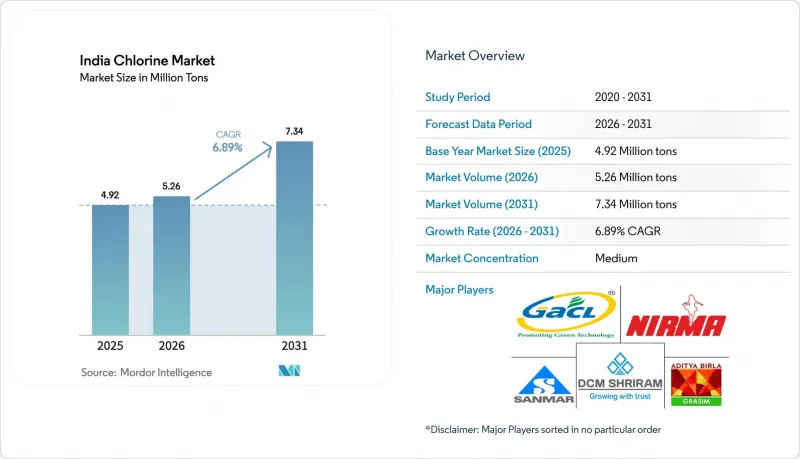
This report is Segmented by Form (Liquid Chlorine, Gaseous Chlorine (Cylinders), and Derived Hypochlorite Solutions), Production Process and Technology (Membrane Cell, Diaphragm Cell, and Mercury Cell (legacy)), and Application (EDC/PVC, Chloromethanes, and More), End-User Industry (Chemical, Water Treatment, and More)
India Chlorine Market Trends and Insights
Expansion of PVC and CPVC Capacity Pipeline
New PVC and CPVC plants are central to the next growth wave in the India chlorine market. Domestic PVC demand climbed 9% in 2024, encouraging firms such as Adani and Reliance to schedule multi-stage vinyl expansions that will lift captive chlorine offtake. CPVC resin capacity at Epigral nearly tripled to 75,000 TPA in 2024, widening domestic supply for high-temperature piping and lowering import dependence. The capacity pipeline shifts the supply-demand balance by absorbing merchant chlorine and stabilizing realizations for integrated producers. Margin exposure to global vinyl price cycles remains, yet energy-efficient plants and port-adjacent logistics give western clusters a structural edge. Policymakers view vinyl import substitution as strategic for infrastructure, reinforcing offtake security for chlorine producers.
Rapid Growth in Municipal Water-Treatment Infrastructure
The Jal Jeevan Mission lifted rural piped-water coverage to 79.74% of households by March 2025, creating a non-cyclical demand channel for chlorine disinfectants. Municipal operators favor hypochlorite because it simplifies storage and dosing in decentralized schemes. Rising urban wastewater volumes also require chlorine dosing at sewage plants to meet pathogen limits prescribed by the Bureau of Indian Standards. As water coverage expands into underserved eastern districts, chlorine usage disperses geographically and lowers the historic concentration in Gujarat-centered industrial corridors. Long-term budget allocations further insulate water-treatment demand from macro swings that affect commodity chemicals.
Stringent Environmental and Worker-Safety Regulations
The Central Pollution Control Board includes chlor-alkali in its red category, requiring comprehensive impact assessments for any expansion. Zero-liquid-discharge norms add costly evaporators and crystallizers, pushing up unit capital cost. Plants using legacy mercury cells face stranded assets and must invest heavily in brine-filtration, membranes, and gas handling equipment to comply. Worker-safety norms mandate specialized personal protective gear, leak-detection systems, and on-site emergency response teams. Smaller standalone producers often struggle with the capital load, tilting the India chlorine industry toward larger, better-funded operators.
Other drivers and restraints analyzed in the detailed report include:
- Strong Pharmaceuticals and Agro-Chemicals Output Linkage
- Captive Consumption Strategy Amid Negative Chlorine Pricing
- Excess Caustic-Soda Capacity Creating Chlorine Oversupply
For complete list of drivers and restraints, kindly check the Table Of Contents.
Segment Analysis
Liquid chlorine accounted for 64.55% of the India chlorine market share in 2025, anchored by well-developed rail and tanker infrastructure between Gujarat's production hubs and downstream consumers. The India chlorine market size for hypochlorite solutions is, however, set to expand briskly as municipal schemes prefer safer, diluted products with simpler logistics. Gaseous cylinders remain a niche choice for small-scale users who value precise dosing over bulk-handling economics.
Liquid chlorine continues to dominate large EDC plants that require uninterrupted, high-purity feedstock. Western ports simplify raw salt supply, and pipelines in Dahej and Bharuch enable direct transfers to vinyl units. Meanwhile, hypochlorite gains ground in health-care facilities and public utilities seeking low-risk chlorine handling. State water boards issue tenders that explicitly favor local hypochlorite supply, redirecting some volume away from pressurized gas formats. Overall, diversifying form preferences enrich the value proposition for integrated producers.
Membrane technology captured 69.70% of overall output in 2025 and is projected to grow at 6.94% through 2031, reflecting its critical role in the India chlorine market. Diaphragm cells hang on in a few plants where brine purity is easier to manage, while mercury cells are fast approaching retirement.
The India chlorine market size gains efficiency as membrane units roll out advanced rectifiers that raise current density without overheating. Operators invest in nanofiltration to strip sulfates and calcium, cutting brine purge volumes by up to 90%. Hydrogen co-produced from membrane plants feeds new hydrogen-peroxide lines and onsite boilers, securing incremental revenue streams. Equipment suppliers betting on diaphragm retrofits are pivoting toward turnkey membrane packages that promise quick payback under high power tariffs.
Complete Report Scope:
- By Form
- Liquid Chlorine
- Gaseous Chlorine (Cylinders)
- Derived Hypochlorite Solutions
- By Production Process and Technology
- Membrane Cell
- Diaphragm Cell
- Mercury Cell (legacy)
- By Application
- EDC/PVC
- Isocyanates and Oxygenates
- Chloromethanes
- Solvents and Epichlorohydrin
- Inorganic Chemicals
- Other Applications
- By End-user Industry
- Chemical
- Water Treatment
- Pharmaceutical
- Pulp and Paper
- Plastics
- Pesticides
- Other End-user Industries
List of Companies Covered in this Report:
- Chemfab Alkalis Limited
- Chemplast Sanmar Limited
- DCM Shriram
- DCW Ltd.
- De Nora India Limited
- Durgapur Chemicals Ltd.
- Epigral Limited
- Finolex Industries Limited (FIL)
- Grasim Industries Limited (Aditya Birla)
- Gujarat Alkalies and Chemicals Limited
- Gujarat Fluorochemicals Ltd.
- Kutch Chemical Industries Ltd.
- Lords Chloro Alkali Limited
- Meghmani Finechem Limited
- NIRMA
- Reliance Industries Limited
- Tata Chemicals Limited
- The Andhra Sugars Limited
Additional Benefits:
- The market estimate (ME) sheet in Excel format
- 3 months of analyst support
TABLE OF CONTENTS
1 Introduction
- 1.1 Study Assumptions and Market Definition
- 1.2 Scope of the Study
2 Research Methodology
3 Executive Summary
4 Market Landscape
- 4.1 Market Overview
- 4.2 Market Drivers
- 4.2.1 Expansion of PVC and CPVC Capacity Pipeline
- 4.2.2 Rapid Growth in Municipal Water-Treatment Infrastructure
- 4.2.3 Strong Pharmaceuticals and Agro-Chemicals Output Linkage
- 4.2.4 Captive Consumption Strategy Amid Negative Chlorine Pricing
- 4.2.5 Accelerated Switch to Membrane-Cell Technology Lowering Energy Cost
- 4.3 Market Restraints
- 4.3.1 Stringent Environmental and Worker-Safety Regulations
- 4.3.2 Excess Caustic-Soda Capacity Creating Chlorine Oversupply
- 4.3.3 Limited Downstream Integration (Disposal Logistics Cost)
- 4.4 Value Chain Analysis
- 4.5 Regulatory Landscape
- 4.6 Porter's Five Forces
- 4.6.1 Threat of New Entrants
- 4.6.2 Bargaining Power of Suppliers
- 4.6.3 Bargaining Power of Buyers
- 4.6.4 Threat of Substitutes
- 4.6.5 Degree of Competition
5 Market Size and Growth Forecasts (Volume)
- 5.1 By Form
- 5.1.1 Liquid Chlorine
- 5.1.2 Gaseous Chlorine (Cylinders)
- 5.1.3 Derived Hypochlorite Solutions
- 5.2 By Production Process and Technology
- 5.2.1 Membrane Cell
- 5.2.2 Diaphragm Cell
- 5.2.3 Mercury Cell (legacy)
- 5.3 By Application
- 5.3.1 EDC/PVC
- 5.3.2 Isocyanates and Oxygenates
- 5.3.3 Chloromethanes
- 5.3.4 Solvents and Epichlorohydrin
- 5.3.5 Inorganic Chemicals
- 5.3.6 Other Applications
- 5.4 By End-user Industry
- 5.4.1 Chemical
- 5.4.2 Water Treatment
- 5.4.3 Pharmaceutical
- 5.4.4 Pulp and Paper
- 5.4.5 Plastics
- 5.4.6 Pesticides
- 5.4.7 Other End-user Industries
6 Competitive Landscape
- 6.1 Market Concentration
- 6.2 Strategic Moves
- 6.3 Market Share (%)/Ranking Analysis
- 6.4 Company Profiles (includes Global level Overview, Market level overview, Core Segments, Financials as available, Strategic Information, Market Rank/Share, Products and Services, Recent Developments)
- 6.4.1 Chemfab Alkalis Limited
- 6.4.2 Chemplast Sanmar Limited
- 6.4.3 DCM Shriram
- 6.4.4 DCW Ltd.
- 6.4.5 De Nora India Limited
- 6.4.6 Durgapur Chemicals Ltd.
- 6.4.7 Epigral Limited
- 6.4.8 Finolex Industries Limited (FIL)
- 6.4.9 Grasim Industries Limited (Aditya Birla)
- 6.4.10 Gujarat Alkalies and Chemicals Limited
- 6.4.11 Gujarat Fluorochemicals Ltd.
- 6.4.12 Kutch Chemical Industries Ltd.
- 6.4.13 Lords Chloro Alkali Limited
- 6.4.14 Meghmani Finechem Limited
- 6.4.15 NIRMA
- 6.4.16 Reliance Industries Limited
- 6.4.17 Tata Chemicals Limited
- 6.4.18 The Andhra Sugars Limited
7 Market Opportunities and Future Outlook
- 7.1 White-space and Unmet-Need Assessment

