PUBLISHER: Mordor Intelligence | PRODUCT CODE: 2117254

PUBLISHER: Mordor Intelligence | PRODUCT CODE: 2117254
India Rail Freight Transport - Market Share Analysis, Industry Trends & Statistics, Growth Forecasts (2026 - 2031)
According to Mordor Intelligence, the India rail freight transport market size is expected to grow from USD 22.52 billion in 2025 to USD 24.31 billion in 2026 and is forecast to reach USD 35.63 billion by 2031 at 7.95% CAGR over 2026-2031.
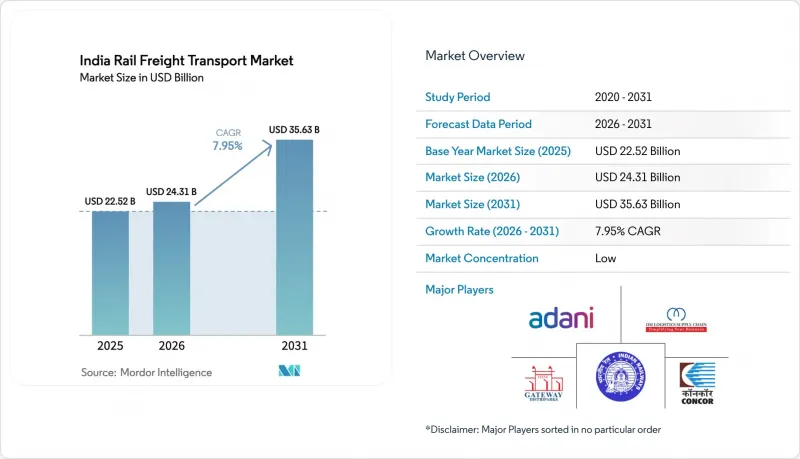
This report is Segmented by Service Type (Transportation and Services Allied To Transportation), by Cargo Type (Containerized, Non-containerized/Bulk and Liquid Bulk), and by Destination (Domestic and International). The Market Forecasts are Provided in Terms of Value (USD).
India Rail Freight Transport Market Trends and Insights
Dedicated Freight Corridors Coming Online
The nearly complete Eastern and Western Dedicated Freight Corridors now handle 391 freight trains per day, allow double-stack containers, and raise average speeds to 60 km/h, cutting Delhi-Mumbai transit time by half. With the Vaitarna-JNPT stretch due by December 2025, exporters gain a seamless rail path to India's busiest container port. Economic modeling by Indian Railways estimates USD 1.93 billion in annual savings from lower fuel use and reduced inventory dwell. Encouraged by these gains, detailed studies for three new corridors-East Coast, East-West, and North-South-have been submitted, with the World Bank and JICA expressing funding interest.
National Logistics Policy & Gati Shakti Push
The Gati Shakti geospatial portal fuses datasets from 44 ministries and every state, trimming rail project approval cycles to weeks instead of months. Rail track construction increased to 14 km per day in FY 2023, yielding 5,423 km of new lines. Forty-eight cargo terminals are live and 91 more are in advanced stages, accelerating the policy goal of driving logistics costs below 10% of GDP by 2030. Rail planners now synchronize siding locations, road links, and port access within a single workflow, eliminating historical hand-offs that stalled projects.
Network Congestion on Golden Quadrilateral
The golden quadrilateral corridors move 70% of national freight on just 25% of track, leading to 115-150% capacity utilization and average freight speeds below 25 km/h. Mixed passenger-freight operations force long signal blocks and yard holds, eroding schedule reliability. The government has sanctioned 155 line additions and 235 doubling projects, but commissioning lags mean congestion will persist in the near term. Until DFC bypasses are fully operational, shippers of time-sensitive cargo still shift to trucks for certainty.
Other drivers and restraints analyzed in the detailed report include:
- Rapid Coal-to-Container Mix Diversification
- Rail-Linked Industrial Corridors and MMLPs
- Road-Freight Cost Advantage < 500 km Hauls
For complete list of drivers and restraints, kindly check the Table Of Contents.
Segment Analysis
Transportation services accounted for 90.35% of the India rail freight transport market share in 2025 as Indian Railways shifted 1.4 billion t of cargo over its 68,103 km network. Revenue remains shipment-led, yet services allied to transportation-terminal handling, warehousing, and documentation-are poised for a 6.05% CAGR to 2031, reflecting shippers' preference for turnkey solutions. Private cargo-terminal developers operating under the Gati Shakti framework have already commissioned 97 facilities that each generate USD 12.05 million of annual revenue without revenue-sharing obligations to Indian Railways. The India rail freight transport market size for allied services is set to expand further as e-commerce and FMCG shippers demand integrated storage, labeling, and reverse-logistics options within rail terminals.
Allied services growth is accelerated by policy changes permitting 100% foreign ownership in terminal infrastructure. DHL, Maersk, and Reliance are piloting temperature-controlled storage at railheads to attract pharmaceuticals and perishables, cargo traditionally hauled by road. As these value-added offerings mature, the India rail freight transport market is expected to witness a progressive shift in revenue mix, although pure play transportation will still hold the lion's share through 2031.
Complete Report Scope:
- By Service
- Transportation
- Services Allied to Transportation
- By Cargo Type
- Containerized (incl. Intermodal)
- Non-containerized / Bulk
- Liquid Bulk
- By Destination
- Domestic
- International (EXIM)
List of Companies Covered in this Report:
- Indian Railways
- Container Corporation of India (CONCOR)
- Adani Logistics Ltd
- Gateway Rail Freight Ltd
- OM Logistics Ltd
- Freight Mart Logistics
- Pristine Logistics & Infraprojects
- DP World India
- PSA India
- Nippon Express (NX) India
- TCI Express Ltd
- Mahindra Logistics Ltd
- TVS Supply Chain Solutions
- Allcargo Logistics
- Hindustan Logistics Private Limited (HLPL)
- DHL Group
- V-Xpress
- Delhi Cargo Courier Services
- BDG International India Pvt Ltd
- Anant Express Logistics
Additional Benefits:
- The market estimate (ME) sheet in Excel format
- 3 months of analyst support
TABLE OF CONTENTS
1 Introduction
- 1.1 Study Assumptions & Market Definition
- 1.2 Scope of the Study
2 Research Methodology
3 Executive Summary
4 Market Landscape
- 4.1 Market Overview
- 4.2 Market Drivers
- 4.2.1 Dedicated freight-corridors coming online
- 4.2.2 National Logistics Policy & Gati Shakti push
- 4.2.3 Rapid coal-to-container mix diversification
- 4.2.4 Rail-linked industrial corridors and MMLPs
- 4.2.5 AFTO scheme boosting finished-vehicle moves
- 4.2.6 Dynamic km-based pricing pilots
- 4.3 Market Restraints
- 4.3.1 Network congestion on golden quadrilateral
- 4.3.2 Road-freight cost advantage < 500 km hauls
- 4.3.3 Wagons idle-time due to first/last-mile gaps
- 4.3.4 Dependence on coal (more than 45 %) exposes volumes
- 4.4 Value / Supply-Chain Analysis
- 4.5 Regulatory Landscape
- 4.6 Technological Outlook (IoT, Kavach, E-OT)
- 4.7 Porter's Five Forces
- 4.7.1 Threat of New Entrants
- 4.7.2 Bargaining Power of Buyers
- 4.7.3 Bargaining Power of Suppliers
- 4.7.4 Threat of Substitutes
- 4.7.5 Competitive Rivalry
- 4.8 Freight Cost Analysis
- 4.9 Capacity & Infrastructure Analysis
- 4.10 Spotlight - Belt & Road Initiative Implications
- 4.11 Key Trade Agreements Affecting Rail Freight
- 4.12 Impact of COVID-19 & Geo-Political Events
5 Market Size & Growth Forecasts (Value)
- 5.1 By Service
- 5.1.1 Transportation
- 5.1.2 Services Allied to Transportation
- 5.2 By Cargo Type
- 5.2.1 Containerized (incl. Intermodal)
- 5.2.2 Non-containerized / Bulk
- 5.2.3 Liquid Bulk
- 5.3 By Destination
- 5.3.1 Domestic
- 5.3.2 International (EXIM)
6 Competitive Landscape
- 6.1 Market Concentration
- 6.2 Strategic Moves
- 6.3 Market Share Analysis
- 6.4 Company Profiles (includes Global level Overview, Market level overview, Core Segments, Financials as available, Strategic Information, Market Rank/Share, Products & Services, Recent Developments)
- 6.4.1 Indian Railways
- 6.4.2 Container Corporation of India (CONCOR)
- 6.4.3 Adani Logistics Ltd
- 6.4.4 Gateway Rail Freight Ltd
- 6.4.5 OM Logistics Ltd
- 6.4.6 Freight Mart Logistics
- 6.4.7 Pristine Logistics & Infraprojects
- 6.4.8 DP World India
- 6.4.9 PSA India
- 6.4.10 Nippon Express (NX) India
- 6.4.11 TCI Express Ltd
- 6.4.12 Mahindra Logistics Ltd
- 6.4.13 TVS Supply Chain Solutions
- 6.4.14 Allcargo Logistics
- 6.4.15 Hindustan Logistics Private Limited (HLPL)
- 6.4.16 DHL Group
- 6.4.17 V-Xpress
- 6.4.18 Delhi Cargo Courier Services
- 6.4.19 BDG International India Pvt Ltd
- 6.4.20 Anant Express Logistics
7 Market Opportunities & Future Outlook
- 7.1 White-space & Unmet-need Assessment
8 Appendix

