PUBLISHER: Mordor Intelligence | PRODUCT CODE: 2118106

PUBLISHER: Mordor Intelligence | PRODUCT CODE: 2118106
Middle East and Africa Data Center Real Estate - Market Share Analysis, Industry Trends & Statistics, Growth Forecasts (2026 - 2031)
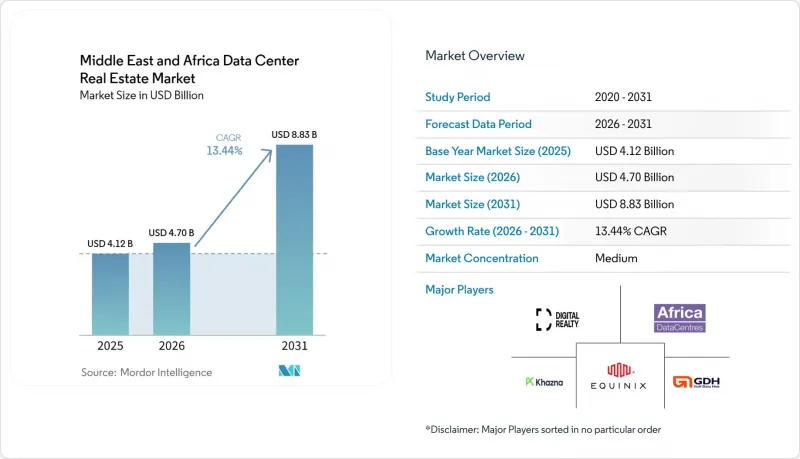
According to Mordor Intelligence, the Middle East and Africa data center real estate market size was valued at USD 4.12 billion in 2025 and is estimated to grow from USD 4.70 billion in 2026 to reach USD 8.83 billion by 2031, at a CAGR of 13.44% during the forecast period (2026-2031).
This report is Segmented by Property Type (Colocation, Hyperscale, and More), Ownership (Leased and Owner Occupied), Enterprise Size (Large Enterprises, and Small and Medium Enterprises), End-Users (Information Technology and Telecom, and More), and Country (United Arab Emirates, Saudi Arabia, and More). The Market Forecasts are Provided in Terms of Value (USD).
Middle East and Africa Data Center Real Estate Market Trends and Insights
Sovereign AI Investments Accelerate Data Center Development
Sovereign AI spending has become one of the clearest demand signals in the Middle East and Africa data center real estate market. Saudi Arabia's HUMAIN initiative is designed around USD 77 billion of investment and a target of 1.9 GW of data center capacity by 2030, which materially changes the scale of expected build activity in the Kingdom. This form of demand is more durable than a normal enterprise cycle because it is tied to national diversification plans and long-term digital priorities. It is also changing what kind of real estate is valuable, since AI training and inference require much higher power density and more advanced thermal design than standard workloads. That shift is pushing operators toward larger campuses, deeper utility planning, and facilities designed from the start for GPU-heavy demand.
Cloud-First Government Policies Increase Local Data Center Demand
Cloud-first directives are making public sector demand more visible in the Middle East and Africa data center real estate market. In the United Arab Emirates, the approved Agentic AI framework aims to deploy across 50% of government services within 2 years, directly supporting the need for domestic compute and storage capacity. That pattern matters because government workloads usually require stronger controls around residency, security, and procurement compliance than many commercial deployments. It also creates a preference for facilities that can meet sovereign operating requirements rather than only offer generic colocation space. The result is a more stable leasing pipeline for certified, locally compliant operators already positioned near government demand centers.
High Cooling Costs Increase Data Center Operating Expenses
Cooling remains a structural cost challenge for the Middle East and Africa data center real estate market, especially in Gulf climates. The move toward AI-ready infrastructure does not remove that issue, because higher-density environments still need robust heat rejection and redundancy. Operators that rely on older air-cooled designs face additional pressure when trying to retrofit to meet newer tenant requirements. This tends to favor platforms with larger capital budgets and more mature engineering capability. As a result, cost pressure can narrow the field of operators that can compete for premium AI and hyperscale mandates.
Other drivers and restraints analyzed in the detailed report include:
- Subsea Cable Expansion Strengthens Regional Connectivity Infrastructure
- Liquid Cooling Adoption Supports High-Density Data Center Deployments
- Grid Capacity Constraints and Permitting Delays Slow Project Development
For complete list of drivers and restraints, kindly check the Table Of Contents.
Segment Analysis
Colocation accounted for 43.90% of revenue in 2025, making it the largest segment in the Middle East and Africa data center real estate market. That lead reflects a clear preference among enterprises and many cloud tenants for third-party managed facilities that offer flexibility without requiring direct ownership of land and buildings. Carrier neutrality also remains important in a region where tenants often value ecosystem access and interconnection options as much as raw space. In practical terms, colocation is still the baseline product around which many commercial leasing decisions are made.
Edge data center properties are forecast to expand at a 16.80% CAGR through 2031, making them the fastest-growing property format in the Middle East and Africa data center real estate market. This growth is tied to 5G rollout, lower latency needs, and the spread of AI inference closer to end users. Demand is also becoming more distributed, which improves the case for facilities in secondary cities rather than only in the main hubs. Hyperscale formats are reshaping lease structures as power pass-through clauses and stricter infrastructure specifications become more common. Modular properties are gaining relevance in African markets where rollout speed and infrastructure flexibility matter. Khazna's October 2025 plan to add more than 1 GW of capacity across multiple countries shows how leading operators are balancing colocation, hyperscale, and edge assets as one portfolio rather than as isolated formats.
Leased facilities accounted for 74.60% of revenue in 2025. They posted the highest projected growth at a 14.20% CAGR, giving the segment both scale and momentum in the Middle East and Africa data center real estate market. This pattern shows that tenants and operators still prefer asset-light or shared-capital structures as facility costs, power density, and cooling requirements rise. Leasing also lowers the hurdle for market entry and expansion, especially when projects need large upfront commitments. In that sense, the leading ownership model is closely aligned with the region's current capital cycle.
Owner-occupied assets accounted for the remaining 25.40% share and remain more common among sovereign entities and operators serving captive demand. Those assets are important because they often anchor highly regulated government workloads that are less exposed to normal commercial demand swings. At the same time, institutional capital is making leased structures even more attractive as investors separate property ownership from operating risk. Sale-leaseback logic fits well in a market where development costs are rising, and long-term tenants are becoming easier to underwrite. KKR's January 2025 partnership with Gulf Data Hub shows how private capital is moving into the platform level of the Middle East and Africa data center real estate market rather than staying at the asset edge. That capital structure shift is likely to reinforce leasing as the default route for future expansion.
Complete Report Scope:
- By Property Type
- Colocation
- Hyperscale
- Edge Data Center Properties
- Modular Data Center Properties
- Others (Wholesale, Retail and Enterprise)
- By Ownership
- Leased
- Owner Occupied
- By Enterprise Size
- Large Enterprises
- Small and Medium Enterprises
- By End-Users
- Information Technology and Telecom
- Banking, Financial Services, and Insurance
- Government and Public Sector
- Healthcare
- Other End Users
- By Country
- United Arab Emirates
- Saudi Arabia
- South Africa
- Egypt
- Rest of Middle East and Africa
List of Companies Covered in this Report:
- Khazna Data Centers LLC
- Digital Realty Trust, Inc.
- Equinix, Inc.
- Gulf Data Hub LLC
- Africa Data Centres Ltd.
- Teraco Data Environments (Pty) Ltd.
- center3 Company
- DataVolt
- Data Hub Integrated Solutions (Moro Hub)
- MedOne Data Centers Ltd.
- Raxio Group
- NTT DATA Group Corporation (NTT Global Data Centers)
- Vantage Data Centers
- EDGNEX Data Centres by DAMAC
- MEEZA QSTP LLC
- Pure Data Centres Group
- ODATA
- e&
- Saudi Telecom Company
- Oman Data Park
Additional Benefits:
- The market estimate (ME) sheet in Excel format
- 3 months of analyst support
TABLE OF CONTENTS
1 Introduction
- 1.1 Study Assumptions and Market Definition
- 1.2 Scope of the Study
2 Research Methodology
3 Executive Summary
4 Market Landscape
- 4.1 Market Overview
- 4.2 Market Drivers
- 4.2.1 Sovereign AI Investments Accelerate Data Center Development
- 4.2.2 Cloud-First Government Policies Increase Local Data Center Demand
- 4.2.3 Subsea Cable Expansion Strengthens Regional Connectivity Infrastructure
- 4.2.4 Liquid Cooling Adoption Supports High-Density Data Center Deployments
- 4.2.5 Free Zone Incentives Attract Data Center Investments
- 4.2.6 Waste Heat Recovery and Alternative Power Solutions Improve Sustainability
- 4.3 Market Restraints
- 4.3.1 High Cooling Costs Increase Data Center Operating Expenses
- 4.3.2 Grid Capacity Constraints and Permitting Delays Slow Project Development
- 4.3.3 Shortage of Certified Data Center Professionals Limits Operational Capacity
- 4.3.4 Water-Use Restrictions Challenge Cooling Infrastructure Development
- 4.4 Value / Supply-Chain Analysis
- 4.4.1 Overview of the Supply Chain and Ecosystem
- 4.4.2 List of Key Raw Materials, Resources & Suppliers
- 4.4.3 List of Major Distributors and Channel Partners
- 4.4.4 List of Major End Users
- 4.5 Regulatory Landscape
- 4.6 Technological Outlook
- 4.7 Porter's Five Forces Analysis
- 4.7.1 Bargaining Power of Suppliers
- 4.7.2 Bargaining Power of Consumers
- 4.7.3 Threat of New Entrants
- 4.7.4 Threat of Substitutes
- 4.7.5 Intensity of Competitive Rivalry
5 Market Size & Growth Forecasts (Value, USD)
- 5.1 By Property Type
- 5.1.1 Colocation
- 5.1.2 Hyperscale
- 5.1.3 Edge Data Center Properties
- 5.1.4 Modular Data Center Properties
- 5.1.5 Others (Wholesale, Retail and Enterprise)
- 5.2 By Ownership
- 5.2.1 Leased
- 5.2.2 Owner Occupied
- 5.3 By Enterprise Size
- 5.3.1 Large Enterprises
- 5.3.2 Small and Medium Enterprises
- 5.4 By End-Users
- 5.4.1 Information Technology and Telecom
- 5.4.2 Banking, Financial Services, and Insurance
- 5.4.3 Government and Public Sector
- 5.4.4 Healthcare
- 5.4.5 Other End Users
- 5.5 By Country
- 5.5.1 United Arab Emirates
- 5.5.2 Saudi Arabia
- 5.5.3 South Africa
- 5.5.4 Egypt
- 5.5.5 Rest of Middle East and Africa
6 Competitive Landscape
- 6.1 Market Concentration
- 6.2 Strategic Moves
- 6.3 Market Share Analysis
- 6.4 Company Profiles (Includes Global Level Overview, Market Level Overview, Core Segments, Financials as available, Strategic Information, Products and Services, Recent Developments)
- 6.4.1 Khazna Data Centers LLC
- 6.4.2 Digital Realty Trust, Inc.
- 6.4.3 Equinix, Inc.
- 6.4.4 Gulf Data Hub LLC
- 6.4.5 Africa Data Centres Ltd.
- 6.4.6 Teraco Data Environments (Pty) Ltd.
- 6.4.7 center3 Company
- 6.4.8 DataVolt
- 6.4.9 Data Hub Integrated Solutions (Moro Hub)
- 6.4.10 MedOne Data Centers Ltd.
- 6.4.11 Raxio Group
- 6.4.12 NTT DATA Group Corporation (NTT Global Data Centers)
- 6.4.13 Vantage Data Centers
- 6.4.14 EDGNEX Data Centres by DAMAC
- 6.4.15 MEEZA QSTP LLC
- 6.4.16 Pure Data Centres Group
- 6.4.17 ODATA
- 6.4.18 e&
- 6.4.19 Saudi Telecom Company
- 6.4.20 Oman Data Park
7 Market Opportunities & Future Outlook
- 7.1 White-Space and Unmet-Need Assessment

