PUBLISHER: Mordor Intelligence | PRODUCT CODE: 2119014

PUBLISHER: Mordor Intelligence | PRODUCT CODE: 2119014
United States E-Commerce Last-Mile Delivery - Market Share Analysis, Industry Trends & Statistics, Growth Forecasts (2026 - 2031)
According to Mordor Intelligence, the United States e-commerce last-mile delivery market size was valued at USD 65.59 billion in 2025 and is estimated to grow from USD 71.6 billion in 2026 to reach USD 108.74 billion by 2031, at a CAGR of 8.72% during the forecast period 2026-2031.
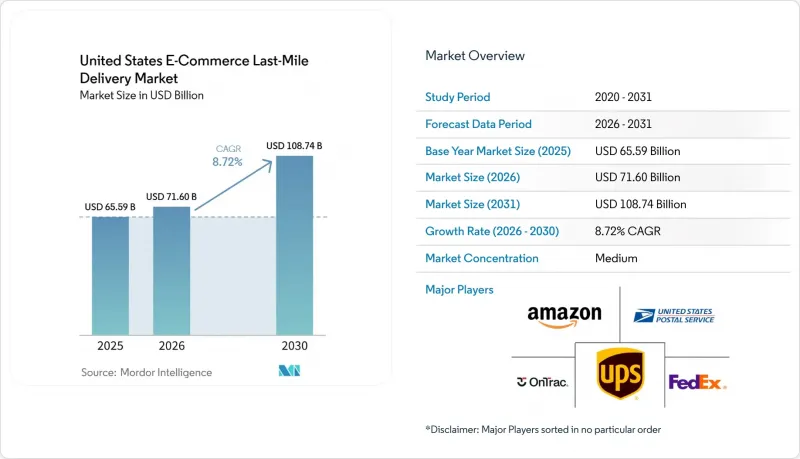
Delivery speed now shapes purchasing behavior more directly, and the service baseline keeps moving higher as Amazon expands same-day and next-day coverage into smaller cities and rural communities. This report is Segmented by Delivery Type (Standard, Same-Day, Next-Day), by Delivery Model (B2C, B2B, C2C), City Tier (Tier 1, Tier 2, Tier 3 & Below), by Product Type (Foods & Beverages, Personal & Household Care, Fashion & Lifestyle, Furniture, and More), and by Geography (Northeast, Southeast, Midwest, Southwest, West). The Market Forecasts are Provided in Terms of Value (USD).
United States E-Commerce Last-Mile Delivery Market Trends and Insights
Rising Demand for Same-Day and Next-Day Delivery in Urban E-Commerce Corridors
Speed has become a core service requirement in the United States e-commerce last-mile delivery market, not a premium add-on. Amazon expanded same-day and next-day delivery to more than 4,000 smaller United States cities and rural communities in 2025, supported by a USD 4 billion investment to triple its rural delivery network. In May 2026, Amazon launched Amazon Now and brought 30-minute delivery to dozens of US cities, including Atlanta, Dallas-Fort Worth, Philadelphia, and Seattle. That rollout shows how major operators are shifting inventory closer to demand and turning fulfillment speed into a more local operating problem. It also raises the service threshold for retailers that still depend on slower national routing models. The result is a United States e-commerce last-mile delivery market that rewards carriers and platforms with dense urban coverage, tight inventory positioning, and consistent execution within short windows.
Parcel Density Gains from Micro-Fulfillment and Route Optimization
Parcel density has become one of the most important cost levers in the United States e-commerce last-mile delivery market. Amazon states that it uses more than 20 machine learning models to refine delivery routes up to the point when a package is loaded, using traffic and real-time operating conditions to improve route selection. In July 2026, Descartes Systems Group acquired Drivin, adding route optimization and AI-based dispatch tools to its last-mile software portfolio. Research published in Scientific Reports in 2025 found that traffic-aware routing and adaptive dispatch can reduce missed deliveries and lower per-stop costs in urban delivery systems. Micro-fulfillment supports those gains by placing inventory closer to the order location and reducing the distance per stop. As these methods spread, the United States e-commerce last-mile delivery market becomes more favorable to operators that can combine software intelligence with localized inventory and route planning.
Last-Mile Cost Inflation from Residential Surcharges and Failed Delivery Attempts
Residential delivery costs are rising faster than many operators can offset through volume alone in the United States e-commerce last-mile delivery market. UPS and FedEx both implemented a 5.9% general rate increase for 2026, but residential surcharges increased faster, with FedEx moving from USD 5.95 to USD 6.45 and UPS moving from USD 6.10 to USD 6.50. That makes residential-heavy shipping books more exposed than the headline rate increase suggests. The pressure is strongest where delivery density is low, and customer expectations for free shipping remain high. It also encourages more route audits, stricter service-area planning, and wider use of alternative delivery points. In the United States e-commerce last-mile delivery market, this cost profile favors operators that can shorten routes, reduce reattempts, and control surcharge exposure at the lane level.
Other drivers and restraints analyzed in the detailed report include:
- Carrier Diversification Away from Single-Carrier Dependence
- Automation in Sortation, Dispatch, and Exception Management
- Driver Shortages and Peak-Season Capacity Constraints
For complete list of drivers and restraints, kindly check the Table Of Contents.
Segment Analysis
Next-day delivery held 41.22% of the United States e-commerce last-mile delivery market share in 2025, making it the largest delivery type by value. That position reflects how fast delivery has become a standard expectation across major online retail categories. Retailers outside Amazon's ecosystem are no longer building next-day capacity to stand out. They are building it to stay credible in the United States e-commerce last-mile delivery market. Compliance limits, route length, and low delivery density keep standard service relevant in many parts of the country.
Same-day delivery is projected to expand at a 12.17% CAGR through 2031, indicating that the fastest service tier is moving beyond a narrow urban premium use case. Amazon's May 2026 launch of Amazon Now pushed that benchmark even lower by offering 30-minute delivery in dozens of US cities. That move matters because it shifts the service ladder from standard versus expedited into a more granular speed hierarchy. Standard delivery still plays an important role for long-zone shipments and value-oriented orders where rapid fulfillment does not justify the cost. Over time, the United States e-commerce last-mile delivery market is likely to see same-day grow fastest in dense metros, while next-day remains the broad commercial anchor and standard delivery stays important in outer-zone and rural lanes.
B2C delivery captured 65.1% of the United States e-commerce last-mile delivery market size in 2025, confirming that residential retail demand remains the sector's largest volume engine. Years of investment by major retailers and parcel operators have made B2C the most established operating model. Its scale also means that changes in residential delivery cost, customer promise windows, and carrier productivity have a wide effect across the market. Instacart expanded its enterprise fulfillment relationship with ALDI in Q1 2026 through a redesigned digital storefront and exclusive fulfillment support, showing how platform-based fulfillment models continue to blur demand boundaries across the United States e-commerce last-mile delivery market.
C2C is forecast to grow at 14.84% CAGR through 2031, making it the fastest-moving delivery model in the current structure. That growth is linked to resale platforms and recommerce activity that create parcel demand outside traditional retail supply chains. C2C growth matters because it introduces more uneven shipment patterns, variable pickup points, and dispersed origin locations. Those traits make flexible regional operators and app-based delivery networks more relevant in selected lanes. B2B remains smaller in the e-commerce last-mile setting, but it still supports meaningful volume in industrial supplies, commercial replenishment, and scheduled business deliveries. As that blurring continues, the United States e-commerce last mile delivery industry will need more flexible pickup, reverse logistics, and order orchestration capabilities to serve both structured retail flows and less predictable peer-originated parcel activity.
Complete Report Scope:
- By Delivery Type
- Standard Delivery
- Same-Day Delivery
- Next-Day Delivery
- By Delivery Model
- Business-to-Consumer (B2C)
- Business-to-Business (B2B)
- Consumer-to-Consumer (C2C)
- By City Tier
- Tier 1
- Tier 2
- Tier 3 and Below
- By Product Type
- Foods and Beverages
- Personal and Household Care
- Fashion and Lifestyle (Accessories, Apparel, Footwear)
- Furniture
- Consumer Electronics and Household Appliances
- Other Products
- By Region
- Northeast
- Southeast
- Midwest
- Southwest
- West
List of Companies Covered in this Report:
- Amazon, Inc.
- United Parcel Service of America, Inc.
- FedEx
- United States Postal Service (USPS)
- OnTrac
- DHL Group
- Pitney Bowes, Inc.
- Veho Tech, Inc.
- Target Corporation
- DoorDash, Inc.
- Instacart, Inc.
- Uber Technologies, Inc.
- Walmart, Inc.
- Better Trucks
- Jitsu
- UniUni
- SpeedX
- Sway
- International Distribution Service plc
- Dropoff, Inc.
- RXO, Inc.
- GoFor
Additional Benefits:
- The market estimate (ME) sheet in Excel format
- 3 months of analyst support
TABLE OF CONTENTS
1 Introduction
- 1.1 Study Assumptions and Market Definition
- 1.2 Scope of the Study
2 Research Methodology
3 Executive Summary
4 Market Landscape
- 4.1 Market Overview and Role of Last-Mile Delivery in E-Commerce Logistics
- 4.2 E-Commerce Spending Trends
- 4.3 Market Drivers
- 4.3.1 Rising Demand for Same-Day and Next-Day Delivery in Urban E-Commerce Corridors
- 4.3.2 Parcel Density Gains from Micro-Fulfillment and Route Optimization
- 4.3.3 Carrier Diversification Away From Single-Carrier Dependence
- 4.3.4 Growth of Alternative Delivery Points, Lockers, and Pickup Networks
- 4.3.5 Automation in Sortation, Dispatch, and Exception Management
- 4.3.6 Sustainable Fleet Transition in High-Stop-Density Urban Routes
- 4.4 Market Restraints
- 4.4.1 Last-Mile Cost Inflation from Residential Surcharges and Failed Delivery Attempts
- 4.4.2 Driver Shortages and Peak-Season Capacity Constraints
- 4.4.3 Fragmented Address Quality and Hard-to-Serve Suburban Sprawl
- 4.4.4 Regulatory and Labor Compliance Complexity Across States and Cities
- 4.5 Regulatory Framework
- 4.6 Value Chain and Distribution Channel Architecture Analysis
- 4.7 Technology Innovations Outlook
- 4.8 Porter's Five Forces Analysis
- 4.8.1 Threat of New Entrants
- 4.8.2 Bargaining Power of Suppliers
- 4.8.3 Bargaining Power of Buyers
- 4.8.4 Threat of Substitutes
- 4.8.5 Rivalry Among Competitors
- 4.9 Evolution of E-Commerce Last-Mile Delivery Requirements
- 4.10 Pricing and Cost Structure Analysis
- 4.11 Consumer Behavior and Delivery Preferences Analysis
- 4.12 Sustainable Delivery Solutions and Green Logistics Initiatives
- 4.13 Impact of Geo-Political Events on Supply Chain Shifts
5 Market Size and Growth Forecasts (Value, 2026-2031)
- 5.1 By Delivery Type
- 5.1.1 Standard Delivery
- 5.1.2 Same-Day Delivery
- 5.1.3 Next-Day Delivery
- 5.2 By Delivery Model
- 5.2.1 Business-to-Consumer (B2C)
- 5.2.2 Business-to-Business (B2B)
- 5.2.3 Consumer-to-Consumer (C2C)
- 5.3 By City Tier
- 5.3.1 Tier 1
- 5.3.2 Tier 2
- 5.3.3 Tier 3 and Below
- 5.4 By Product Type
- 5.4.1 Foods and Beverages
- 5.4.2 Personal and Household Care
- 5.4.3 Fashion and Lifestyle (Accessories, Apparel, Footwear)
- 5.4.4 Furniture
- 5.4.5 Consumer Electronics and Household Appliances
- 5.4.6 Other Products
- 5.5 By Region
- 5.5.1 Northeast
- 5.5.2 Southeast
- 5.5.3 Midwest
- 5.5.4 Southwest
- 5.5.5 West
6 Competitive Landscape
- 6.1 Market Concentration
- 6.2 Key Strategic Moves
- 6.3 Market Share Analysis
- 6.4 Company Profiles (includes Global Level Overview, Market Level Overview, Core Segments, Financials as Available, Strategic Information, Market Rank/Share for Key Companies, Products & Services, and Recent Developments)
- 6.4.1 Amazon, Inc.
- 6.4.2 United Parcel Service of America, Inc.
- 6.4.3 FedEx
- 6.4.4 United States Postal Service (USPS)
- 6.4.5 OnTrac
- 6.4.6 DHL Group
- 6.4.7 Pitney Bowes, Inc.
- 6.4.8 Veho Tech, Inc.
- 6.4.9 Target Corporation
- 6.4.10 DoorDash, Inc.
- 6.4.11 Instacart, Inc.
- 6.4.12 Uber Technologies, Inc.
- 6.4.13 Walmart, Inc.
- 6.4.14 Better Trucks
- 6.4.15 Jitsu
- 6.4.16 UniUni
- 6.4.17 SpeedX
- 6.4.18 Sway
- 6.4.19 International Distribution Service plc
- 6.4.20 Dropoff, Inc.
- 6.4.21 RXO, Inc.
- 6.4.22 GoFor
7 Market Opportunities and Future Outlook
- 7.1 White-space and Unmet-Need Assessment

