PUBLISHER: Mordor Intelligence | PRODUCT CODE: 2119117

PUBLISHER: Mordor Intelligence | PRODUCT CODE: 2119117
Middle East and Africa Low Smoke Zero Halogen (LSZH) Cables - Market Share Analysis, Industry Trends & Statistics, Growth Forecasts (2026 - 2031)
According to Mordor Intelligence, the Middle East and Africa low smoke zero halogen (LSZH) cables market size is expected to increase from USD 0.84 billion in 2025 to USD 0.89 billion in 2026 and reach USD 1.24 billion by 2031, growing at a CAGR of 6.86% over 2026-2031.
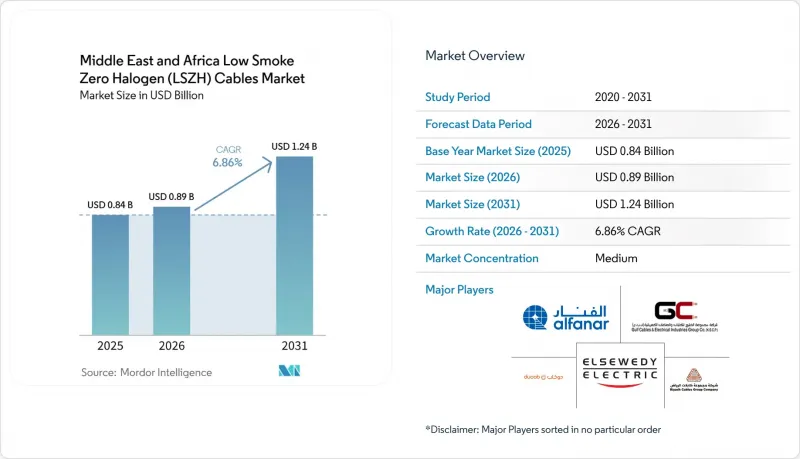
This report is Segmented by Cable Type (Power Cables, Control and Instrumentation Cables, and More), Voltage Rating (Less Than 1 KV, 1-35 KV, 36-65 KV, and Above 65 KV), Insulation Material (PVC (Polyvinyl Chloride), and More), End-User Industry (Commercial Buildings, Data Centers, and More), and Geography. The Market Forecasts are Provided in Terms of Value (USD).
Middle East and Africa Low Smoke Zero Halogen (LSZH) Cables Market Trends and Insights
Life-Safety Requirements in High-Occupancy and Enclosed Infrastructure
Mandatory LSZH specifications in enclosed spaces are embedded in building requirements across the GCC, and their use continues to widen through code revision cycles. The UAE Fire and Life Safety Code of Practice, including its 2025 amendments, requires LSZH cables in enclosed spaces within high-rise buildings and links compliance to Dubai Civil Defense certification. The code sets requirements for circuit integrity and references tests measuring halogen-acid gas emissions and smoke density. Saudi procurement requirements also refer to IEC 60332 fire-testing criteria for buildings above defined occupancy thresholds. Insurance underwriters increasingly make the use of LSZH a condition of fire-risk coverage for large commercial developments, thereby strengthening demand where enforcement is less consistent. This commercial requirement reinforces the regulatory case for compliant products in the Middle East and Africa low smoke zero halogen (LSZH) cables market.
GCC Data Center and Digital Infrastructure Expansion
Data center construction supports demand for LSZH fiber optic cables because enclosed server halls, risers, and associated electrical spaces require certified fire-performance products. High-density computing equipment creates more demanding thermal conditions than conventional IT installations, increasing the value of cable systems per MW of installed capacity. NEOM and DataVolt began work on a USD 5 billion AI data center complex in Saudi Arabia in 2026, with a first phase targeting 200 MW by Q4 2027 and full capacity targeting 1.5 GW by 2030. Prysmian announced a EUR 5.5 billion (USD 6.16 billion) long-term optical cable supply agreement with Molex in July 2026, alongside a EUR 1.25 billion (USD 1.40 billion) increase in fiber and optical cable capacity. The agreement shows how global suppliers are securing capacity for hyperscale deployments as regional projects move forward. The Middle East and Africa low smoke zero halogen (LSZH) cables market, therefore, gains from digital projects that require both connectivity and stringent fire performance.
LSZH Price Premium Versus PVC Cable Alternatives
The price premium for halogen-free cable materials remains the most persistent barrier to adoption in cost-sensitive projects. The premium is particularly important for control and instrumentation cables, where the compound represents a larger share of the total material cost than for large-conductor power cables. Developers without financing conditions that require international fire-safety standards can face material budget pressure across the entire cable bill of materials. This is most evident in commercial and light-industrial construction categories in Africa, where procurement decisions remain highly cost-led. The restraint is less pronounced where building codes are consistently enforced because projects must absorb the cost of compliant products. It remains significant for the Middle East and Africa low smoke zero halogen (LSZH) cables market in non-prestige categories, where compliance checks are less consistent.
Other drivers and restraints analyzed in the detailed report include:
- Railway, Metro, Airport, and Tunnel Development
- Oil and Gas Electrification and Offshore Modernization
- Limited Enforcement Consistency Across African Markets
For complete list of drivers and restraints, kindly check the Table Of Contents.
Segment Analysis
Power cables accounted for 36.29% of the Middle East and Africa low smoke zero halogen (LSZH) cables market share in 2025, reflecting their central role in commercial construction, grid infrastructure, and industrial facilities. IEC 60502-2:2014/AMD1:2024 introduced ST8 and ST12 halogen-free sheath options and expanded fire-performance requirements for medium-voltage power cables. Fiber optic cables are projected to grow at an 8.11% CAGR from 2026 to 2031, driven by data centers requiring LSZH-jacketed optical products for enclosed server halls. The Middle East and Africa LSZH cables market size for fiber systems is supported by stricter fire classifications around high-density computing facilities.
Data and communication cables, as well as building wires, serve commercial, hospitality, and residential projects where code compliance is a requirement. Specialty products include mica-tape fire-resistant variants, radiation cross-linked offshore products, and rail-compliant constructions. These categories are used in applications where IEC 60331 circuit-integrity requirements are accompanied by halogen-free and low-smoke attributes. Ducab launched the GCC's first high-voltage fiber-optic cable at Middle East Energy 2025, underscoring regional investment in higher-specification products.
The less-than-1-kV segment accounted for 61.11% of the regional value in 2025, supported by building wires and low-voltage distribution systems. Commercial construction, hospitality projects, health-care facilities, and data centers account for much of this demand. The 1-35 kV tier is expected to expand at a 7.41% CAGR through 2031 as utilities and municipalities develop underground cabling, renewable-energy connections, and denser grids. The Middle East and Africa low smoke zero halogen (LSZH) cables market size for this tier is driven by procurement standards that increasingly include halogen-free medium-voltage cable specifications.
The 36-65 kV and above 65 kV tiers serve transmission, offshore interconnection, and selected utility applications. Their volumes are lower, but their value per kilometer and specification intensity are higher. LSZH use in these tiers is concentrated in substations, tunneled corridors, and offshore platforms. Ducab completed the Middle East's first extended pre-qualification test for a 400 kV extra-high-voltage cable system in February 2026, aligned with IEEE, IEC, and AEIC standards.
Complete Report Scope:
- By Cable Type
- LSZH Power Cables
- LSZH Control and Instrumentation Cables
- LSZH Data and Communication Cables
- LSZH Fiber Optic Cables
- LSZH Building Wires
- Specialty LSZH Cables
- By Voltage Rating
- Less Than 1 kV
- 1-35 kV
- 36-65 kV
- Above 65 kV
- By Insulation Material
- PVC (Polyvinyl Chloride)
- XLPE (Cross-linked Polyethylene)
- PE (Polyethylene)
- Other Specialty Insulation Materials
- By End-User Industry
- Commercial Buildings
- Industrial Manufacturing
- Data Centers
- Energy and Utilities
- Transportation Infrastructure
- Telecommunications
- Renewable Energy
- Other End-User Industries
- By Geography
- Middle East
- Saudi Arabia
- United Arab Emirates
- Qatar
- Rest of Middle East
- Africa
- South Africa
- Egypt
- Nigeria
- Rest of Africa
- Middle East
List of Companies Covered in this Report:
- Ducab Group
- Riyadh Cables Group
- Elsewedy Electric S.A.E.
- Gulf Cable and Electrical Industries Co. K.S.C.P.
- Alfanar Group
- Middle East Specialized Cables Company
- Prysmian S.p.A.
- Nexans S.A.
- Southwire Company, LLC
- HELUKABEL GmbH
- Eland Cables Ltd.
- Belden Inc.
- CommScope Holding Company, Inc.
- TE Connectivity Ltd.
- Sumitomo Electric Industries, Ltd.
- Furukawa Electric Co., Ltd.
- Leoni AG
- Bahra Cables Company
- Top Cable, S.A.
- Fahad Cables Industry FZE
- Gulf Cables and Electrical Industries Company
Additional Benefits:
- The market estimate (ME) sheet in Excel format
- 3 months of analyst support
TABLE OF CONTENTS
1 INTRODUCTION
- 1.1 Study Assumptions and Market Definition
- 1.2 Scope of the Study
2 RESEARCH METHODOLOGY
3 EXECUTIVE SUMMARY
4 MARKET LANDSCAPE
- 4.1 Market Overview
- 4.2 Market Drivers
- 4.2.1 Life-Safety Requirements in High-Occupancy and Enclosed Infrastructure
- 4.2.2 GCC Data Center and Digital Infrastructure Expansion
- 4.2.3 Railway, Metro, Airport, and Tunnel Development
- 4.2.4 Oil and Gas Electrification and Offshore Modernization
- 4.2.5 Project-Specification Localization and Regional Manufacturing Qualification
- 4.2.6 Multilateral-Institution Procurement Favoring International Fire-Safety Standards
- 4.3 Market Restraints
- 4.3.1 LSZH Price Premium Versus PVC Cable Alternatives
- 4.3.2 Limited Enforcement Consistency Across African Markets
- 4.3.3 Specialized Polymer and Flame-Retardant Compound Supply Exposure
- 4.3.4 Limited Installer and Consultant Familiarity With LSZH Performance Classes
- 4.4 Industry Value Chain Analysis
- 4.5 Porter's Five Forces Analysis
- 4.5.1 Threat of New Entrants
- 4.5.2 Bargaining Power of Suppliers
- 4.5.3 Bargaining Power of Buyers
- 4.5.4 Threat of Substitutes
- 4.5.5 Rivalry Among Existing Competitors
5 MARKET SIZE AND GROWTH FORECASTS (VALUE)
- 5.1 By Cable Type
- 5.1.1 LSZH Power Cables
- 5.1.2 LSZH Control and Instrumentation Cables
- 5.1.3 LSZH Data and Communication Cables
- 5.1.4 LSZH Fiber Optic Cables
- 5.1.5 LSZH Building Wires
- 5.1.6 Specialty LSZH Cables
- 5.2 By Voltage Rating
- 5.2.1 Less Than 1 kV
- 5.2.2 1-35 kV
- 5.2.3 36-65 kV
- 5.2.4 Above 65 kV
- 5.3 By Insulation Material
- 5.3.1 PVC (Polyvinyl Chloride)
- 5.3.2 XLPE (Cross-linked Polyethylene)
- 5.3.3 PE (Polyethylene)
- 5.3.4 Other Specialty Insulation Materials
- 5.4 By End-User Industry
- 5.4.1 Commercial Buildings
- 5.4.2 Industrial Manufacturing
- 5.4.3 Data Centers
- 5.4.4 Energy and Utilities
- 5.4.5 Transportation Infrastructure
- 5.4.6 Telecommunications
- 5.4.7 Renewable Energy
- 5.4.8 Other End-User Industries
- 5.5 By Geography
- 5.5.1 Middle East
- 5.5.1.1 Saudi Arabia
- 5.5.1.2 United Arab Emirates
- 5.5.1.3 Qatar
- 5.5.1.4 Rest of Middle East
- 5.5.2 Africa
- 5.5.2.1 South Africa
- 5.5.2.2 Egypt
- 5.5.2.3 Nigeria
- 5.5.2.4 Rest of Africa
- 5.5.1 Middle East
6 COMPETITIVE LANDSCAPE
- 6.1 Market Concentration
- 6.2 Strategic Moves
- 6.3 Market Share Analysis
- 6.4 Company Profiles (includes Global Level Overview, Market Level Overview, Core Segments, Financials as available, Strategic Information, Market Rank/Share, Products and Services, Recent Developments)
- 6.4.1 Ducab Group
- 6.4.2 Riyadh Cables Group
- 6.4.3 Elsewedy Electric S.A.E.
- 6.4.4 Gulf Cable and Electrical Industries Co. K.S.C.P.
- 6.4.5 Alfanar Group
- 6.4.6 Middle East Specialized Cables Company
- 6.4.7 Prysmian S.p.A.
- 6.4.8 Nexans S.A.
- 6.4.9 Southwire Company, LLC
- 6.4.10 HELUKABEL GmbH
- 6.4.11 Eland Cables Ltd.
- 6.4.12 Belden Inc.
- 6.4.13 CommScope Holding Company, Inc.
- 6.4.14 TE Connectivity Ltd.
- 6.4.15 Sumitomo Electric Industries, Ltd.
- 6.4.16 Furukawa Electric Co., Ltd.
- 6.4.17 Leoni AG
- 6.4.18 Bahra Cables Company
- 6.4.19 Top Cable, S.A.
- 6.4.20 Fahad Cables Industry FZE
- 6.4.21 Gulf Cables and Electrical Industries Company
7 MARKET OPPORTUNITIES AND FUTURE OUTLOOK
- 7.1 White-Space and Unmet-Need Assessment

