PUBLISHER: Mordor Intelligence | PRODUCT CODE: 2119584

PUBLISHER: Mordor Intelligence | PRODUCT CODE: 2119584
Europe Sensors - Market Share Analysis, Industry Trends & Statistics, Growth Forecasts (2026 - 2031)
According to Mordor Intelligence, the Europe sensors market size stood at USD 26.89 billion in 2026 and is projected to reach USD 37.09 billion by 2031, advancing at a 6.64% CAGR during 2026-2031.
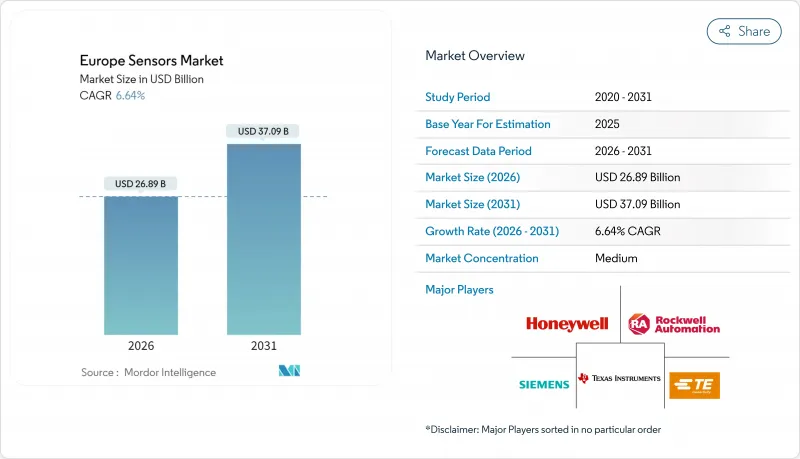
This report is Segmented by Parameters Measured (Temperature, Pressure, and More), Mode of Operation (Optical, Electrical Resistance, Biosensor, and More), End-User Industry (Automotive, Consumer Electronics, Energy, Industrial, Medical and Wellness, Construction, Agriculture and Mining, and More), Sensor Technology (MEMS, and Non-MEMS), and Country. The Market Forecasts are Provided in Terms of Value (USD).
Europe Sensors Market Trends and Insights
Surging Demand in the Automotive Sector
European automakers integrated 150-200 sensors per 2026 model, up from roughly 100 in 2020, a jump driven by Euro NCAP protocols that make advanced driver-assistance systems standard fitment. Radar, ultrasonic, and camera arrays dominate the bill of materials, yet cost-reduced solid-state LiDAR, such as Valeo's SCALA 3 at sub-USD 1,000, has begun enabling Level 3 highway autonomy. Additional content stems from battery-management sensors monitoring thermal runaway in 800-volt packs. Continental's 2025 acquisition of silicon carbide signals vertical integration in high-temperature current sensing. Together, these trends lift unit volumes and average selling prices, reinforcing the growth trajectory of the Europe sensors market.
Proliferation of Industry 4.0 Smart Factories
More than 2 million industrial IoT nodes were deployed in 2025, each bundling 3-5 sensors for vibration, temperature, and energy data. Predictive maintenance reduces unplanned downtime by up to 30%, justifying retrofit costs within 2 years. Siemens' Xcelerator platform posted 40% annual growth in connected assets as tier-one suppliers demanded real-time quality traceability. The pivot to edge inference boosts demand for smart sensors with 16-bit ADCs and on-board DSPs, typified by Bosch Sensortec's BHI360 launch in October 2025. These deployments underpin long-run demand visibility for the Europe sensors market.
High Initial Integration Costs
Retrofitting legacy equipment costs EUR 5,000-15,000 per asset, a hurdle for SMEs operating on sub-10% margins. Integration fees for ERP mapping range from EUR 50,000 to EUR 100,000, stretching payback timelines. Pressure and temperature loops often remain analog, forcing either rip-and-replace or edge-digitization middleware. Endress+Hauser's Heartbeat Technology is gaining traction as a cost-effective compromise that defers capital replacement. Until hardware prices drop further, cost sensitivities will curb uptake and slightly temper the Europe sensors market CAGR.
Other drivers and restraints analyzed in the detailed report include:
- Acceleration of Electric-Vehicle Adoption
- Rapid Uptake of Industrial IoT Edge-AI Sensors
- Semiconductor Supply-Chain Disruptions
For complete list of drivers and restraints, kindly check the Table Of Contents.
Segment Analysis
Environmental devices are forecast to grow at 8.61% during 2026-2031 as the Corporate Sustainability Reporting Directive phases in third-party-verified Scope 1-3 disclosures. The Europe sensors market for this sub-segment is expanding rapidly because particulate-matter, NOx, and VOC analyzers now feed continuous-emissions-monitoring systems across chemical and metallurgical sites. Satellite feedback from ESA's Sentinel-5, launched in August 2025, improves ground-station calibration and extends sensor life. Temperature sensors, at 26.87% share in 2025, remain indispensable in custody-transfer flows across energy and food processing. Flow instruments are rising as utilities deploy smart meters to spot leaks, while proximity sensors meet IEC 61496 redundancy rules in collaborative robots.
Combination modules that measure temperature, humidity, and pressure in a single package reflect a trend toward convergence that rewards suppliers skilled in multi-chip packaging. Chemical sensors are moving from niche to mainstream as pharmaceutical bioreactors demand real-time glucose and pH monitoring. Magnetic sensors embedded in brushless DC motors continue to proliferate as industrial electrification advances. Overall, diversified use cases ensure the parameters-measured category remains a steady volume driver within the Europe sensors market.
Optical devices retained a 19.16% share in 2025, driven by safety curtains, fiber-optic strain sensors, and spectrometry modules. However, solid-state LiDAR is tracking an 8.43% CAGR as sub-USD 500 pricing opens warehouse automation and agricultural machinery opportunities. Electrical-resistance sensors like thermistors continue to serve legacy HVAC and force applications but face a margin squeeze. Biosensors for glucose and lactate now achieve clinical accuracy in handhelds, setting the stage for multi-analyte wearables. Capacitive and piezoelectric sensors serve touch and ultrasonic applications, though growth is modest given the technology's maturity.
Radar, both 24 GHz short-range and 77 GHz long-range, remains standard in blind-spot and adaptive-cruise systems, with NXP and Infineon leading chipset supply. As autonomous platforms demand redundancy, perception stacks increasingly fuse camera, radar, and LiDAR data, thereby increasing the need for synchronized, time-stamped outputs. Suppliers offering turnkey sensor suites enjoy a competitive edge in the Europe sensors market.
Complete Report Scope:
- By Parameters Measured
- Temperature
- Pressure
- Level
- Flow
- Proximity
- Environmental
- Chemical
- Inertial
- Magnetic
- Vibration
- By Mode of Operation
- Optical
- Electrical Resistance
- Biosensor
- Piezoresistive
- Image
- Capacitive
- Piezoelectric
- LiDAR
- Radar
- By End-User Industry
- Automotive
- Consumer Electronics
- Energy
- Industrial
- Medical and Wellness
- Construction, Agriculture and Mining
- Aerospace
- Defense
- By Sensor Technology
- MEMS
- Non-MEMS
- By Country
- Germany
- United Kingdom
- France
- Italy
- Spain
- Netherlands
- Poland
- Rest of Europe
List of Companies Covered in this Report:
- Texas Instruments Incorporated
- TE Connectivity Ltd
- Honeywell International Inc.
- Rockwell Automation Inc.
- Siemens AG
- STMicroelectronics NV
- AMS AG
- NXP Semiconductors NV
- Infineon Technologies AG
- Bosch Sensortec GmbH
- Sick AG
- ABB Limited
- Omron Corporation
- Continental AG
- Baumer Group
- Pepperl+Fuchs GmbH
- First Sensor AG
- Analog Devices Inc.
- Sensata Technologies Holding PLC
- Balluff GmbH
Additional Benefits:
- The market estimate (ME) sheet in Excel format
- 3 months of analyst support
TABLE OF CONTENTS
1 INTRODUCTION
- 1.1 Study Assumptions and Market Definition
- 1.2 Scope of the Study
2 RESEARCH METHODOLOGY
3 EXECUTIVE SUMMARY
4 MARKET LANDSCAPE
- 4.1 Market Overview
- 4.2 Market Drivers
- 4.2.1 Surging Demand in Automotive Sector
- 4.2.2 Proliferation of Industry 4.0 Smart Factories
- 4.2.3 Acceleration of Electric-Vehicle Adoption
- 4.2.4 Rapid Uptake of Industrial IoT Edge-AI Sensors
- 4.2.5 Mandatory EU Climate-Monitoring Regulations
- 4.2.6 Growth of Smart Infrastructure (Rail, Energy)
- 4.3 Market Restraints
- 4.3.1 High Initial Integration Costs
- 4.3.2 Semiconductor Supply-Chain Disruptions
- 4.3.3 Skills Gap in Sensor Fusion Engineering
- 4.3.4 GDPR-Driven Data-Governance Complexity
- 4.4 Industry Value Chain Analysis
- 4.5 Regulatory Landscape
- 4.6 Technological Outlook
- 4.7 Porter's Five Forces Analysis
- 4.7.1 Bargaining Power of Suppliers
- 4.7.2 Bargaining Power of Consumers
- 4.7.3 Threat of New Entrants
- 4.7.4 Threat of Substitute Products
- 4.7.5 Intensity of Competitive Rivalry
- 4.8 Impact of Macroeconomic Factors on the Market
5 MARKET SIZE AND GROWTH FORECASTS (VALUE)
- 5.1 By Parameters Measured
- 5.1.1 Temperature
- 5.1.2 Pressure
- 5.1.3 Level
- 5.1.4 Flow
- 5.1.5 Proximity
- 5.1.6 Environmental
- 5.1.7 Chemical
- 5.1.8 Inertial
- 5.1.9 Magnetic
- 5.1.10 Vibration
- 5.2 By Mode of Operation
- 5.2.1 Optical
- 5.2.2 Electrical Resistance
- 5.2.3 Biosensor
- 5.2.4 Piezoresistive
- 5.2.5 Image
- 5.2.6 Capacitive
- 5.2.7 Piezoelectric
- 5.2.8 LiDAR
- 5.2.9 Radar
- 5.3 By End-User Industry
- 5.3.1 Automotive
- 5.3.2 Consumer Electronics
- 5.3.3 Energy
- 5.3.4 Industrial
- 5.3.5 Medical and Wellness
- 5.3.6 Construction, Agriculture and Mining
- 5.3.7 Aerospace
- 5.3.8 Defense
- 5.4 By Sensor Technology
- 5.4.1 MEMS
- 5.4.2 Non-MEMS
- 5.5 By Country
- 5.5.1 Germany
- 5.5.2 United Kingdom
- 5.5.3 France
- 5.5.4 Italy
- 5.5.5 Spain
- 5.5.6 Netherlands
- 5.5.7 Poland
- 5.5.8 Rest of Europe
6 COMPETITIVE LANDSCAPE
- 6.1 Market Concentration
- 6.2 Strategic Moves
- 6.3 Market Share Analysis
- 6.4 Company Profiles (includes Global Level Overview, Market Level Overview, Core Segments, Financials as available, Strategic Information, Market Rank/Share, Products and Services, and Recent Developments)
- 6.4.1 Texas Instruments Incorporated
- 6.4.2 TE Connectivity Ltd
- 6.4.3 Honeywell International Inc.
- 6.4.4 Rockwell Automation Inc.
- 6.4.5 Siemens AG
- 6.4.6 STMicroelectronics NV
- 6.4.7 AMS AG
- 6.4.8 NXP Semiconductors NV
- 6.4.9 Infineon Technologies AG
- 6.4.10 Bosch Sensortec GmbH
- 6.4.11 Sick AG
- 6.4.12 ABB Limited
- 6.4.13 Omron Corporation
- 6.4.14 Continental AG
- 6.4.15 Baumer Group
- 6.4.16 Pepperl+Fuchs GmbH
- 6.4.17 First Sensor AG
- 6.4.18 Analog Devices Inc.
- 6.4.19 Sensata Technologies Holding PLC
- 6.4.20 Balluff GmbH
7 MARKET OPPORTUNITIES AND FUTURE OUTLOOK
- 7.1 White-Space and Unmet-Need Assessment

