PUBLISHER: Mordor Intelligence | PRODUCT CODE: 2120580

PUBLISHER: Mordor Intelligence | PRODUCT CODE: 2120580
Japan Paper Packaging - Market Share Analysis, Industry Trends & Statistics, Growth Forecasts (2026 - 2031)
According to Mordor Intelligence, Japan paper packaging market size stands at USD 26.76 billion in 2026 and is projected to reach USD 35.16 billion by 2031, reflecting a 5.61% CAGR.
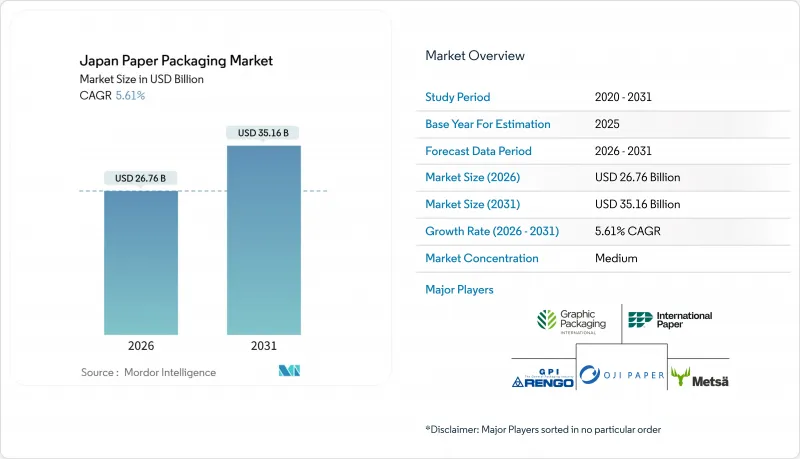
This report is Segmented by Material Type (Virgin Paperboard, Recycled Paperboard, Kraft Paper, and More), Product Type (Flexible Paper Packaging, and Rigid Paper Packaging), Packaging Format (Primary Packaging, Secondary Packaging, and Tertiary/Transit Packaging), and End-Use Industry (Beverage, Healthcare and Pharmaceuticals, and More). The Market Forecasts are Provided in Terms of Value (USD).
Japan Paper Packaging Market Trends and Insights
Regulations On Plastic-Based Packaging
Japan's Plastic Resource Circulation Act became effective in April 2022. It obliges municipalities to expand the collection of sorted plastic items and requires businesses that distribute single-use plastic products to adopt reduction or substitution measures. The Ministry of the Environment's design guidelines favor low-plastic or plastic-free designs, and certified products receive preferential treatment in government procurement. These rules raise compliance costs for plastic substrates while exempting most paper equivalents from the positive-list restrictions that govern food-contact plastics. As a result, supermarkets and convenience stores are switching to barrier-coated paper for cutlery, straws, and trays, thereby accelerating demand in the Japanese paper packaging market.
Expansion Of E-Commerce Fulfillment Packaging
Business-to-consumer e-commerce reached JPY 26.1 trillion (USD 180 billion) in fiscal 2024 and lifted Japan's e-commerce ratio to 9.8%. Japan Post Holdings plans Yu-Packet revenue of JPY 160 billion (USD 1.1 billion) by fiscal 2025 and is investing JPY 270 billion (USD 1.9 billion) in small-parcel sorters and robotic arms. These automated hubs require corrugated and paper mailers that feed smoothly through high-speed sorters without crushing. Demand is strongest in high-penetration categories, such as books, electronics, and household goods, which bolsters volumes in the Japanese paper packaging market and pressures converters to deliver precise dimensions, barcode-friendly surfaces, and stack strength.
Rising Raw Material Costs
Oji Holdings forecasts long-fiber kraft pulp to rise from USD 570 per tonne in fiscal 2025 to USD 610 by fiscal 2027, squeezing converters that serve price-sensitive corrugated customers. Although Japan's recovered-paper rate exceeds 80%, the pool of high-grade waste is diminishing due to falling newspaper volumes, and exports to ASEAN buyers add volatility. Converters therefore shift toward specialty papers where unique coatings justify pass-through pricing, but commodity segments of the Japan paper packaging market face margin compression.
Other drivers and restraints analyzed in the detailed report include:
- Increasing Demand From The Food And Beverage Sector
- Premiumization Of Convenience Foods
- Shrinking Graphic Paper Mills' Capacity Allocation
For complete list of drivers and restraints, kindly check the Table Of Contents.
Segment Analysis
Recycled paperboard held 45.34% of the Japan paper packaging market share in 2025, underpinned by municipal collection efficiencies and brand commitments to post-consumer content. Specialty grades are forecast to rise by 6.32% annually through 2031. The Japan paper packaging market size for specialty paper is growing as barrier-coated substrates, such as Toppan's GL-X-P, reduce carbon emissions by up to 35% compared to laminated films. Nippon Paper's SHIELDPLUS achieves near-film oxygen and water vapor resistance without the use of aluminum or PVDC, thereby protecting dry foods and confectionery. Virgin board retains a foothold in pharma and cosmetics, where contamination risk drives preference for traceable fiber. Molded pulp, while small, appeals to electronics firms looking to replace expanded polystyrene. Supply limitations and long mold-cycle times temper its contribution to Japan paper packaging market growth.
Japan paper packaging market size expansion is also linked to virgin board as the Ministry of Health, Labour and Welfare's positive list tightens allowable substances in food-contact materials. High-purity kraft papers are engineered with fluorine-free grease resistance for quick-service restaurant wraps, and Tokushu Tokai Paper targets a capacity of 7,000-8,000 tonnes per year for these grades. Recycled streams, although voluminous, face contamination challenges that restrict direct contact uses, channeling demand into secondary and transit packaging.
Rigid formats led revenue with 55.32% share in 2025, yet flexible paper is projected to grow 6.64% per year to 2031 as mono-material pouches and wraps displace plastic laminates. DNP's high-barrier sheet maintains oxygen transmission below 0.5 cc m-2 day-1 atm and achieves 85% repulpability, enabling coffee and confectionery brands to meet Europe's recyclability mandates. Folding cartons benefit from premiumization, with embossing and multi-panel structures lifting value per unit. Corrugated boxes face commoditization, but large-format and reinforced versions earn premiums for industrial exports. The Japan paper packaging market size for flexible formats gains as heat-sealable coatings improve machineability and sealing speed, positioning paper for dry-mix, spice, and snack pouches that were once film-centric.
Automation within converting halls accelerates the uptake of flexible formats because servo-driven pouch makers and laser scoring lines reduce changeover time from 90 minutes to under 20, enabling economical short runs for seasonal flavors and limited-edition SKUs. As more beverage powders, spices, and confectionery products rotate through quarterly promotions, converters justify capital expenditures on retrofit kits that handle thinner kraft and maintain seal integrity at 300 packs per minute, thereby widening the performance gap between paper-based pouches and legacy plastic laminates.
Complete Report Scope:
- By Material Type
- Virgin Paperboard
- Recycled Paperboard
- Kraft Paper
- Specialty Paper
- Molded Pulp
- By Product Type
- Flexible Paper Packaging
- Pouches and Bags
- Wraps and Films
- Other Flexible Paper Packaging
- Rigid Paper Packaging
- Folding Carton
- Corrugated Boxes
- Other Rigid Paper Packaging
- Flexible Paper Packaging
- By Packaging Format
- Primary Packaging
- Secondary Packaging
- Tertiary / Transit Packaging
- By End-Use Industry
- Food
- Beverage
- Healthcare and Pharmaceuticals
- Personal Care and Cosmetics
- Industrial
- Other End-Use Industries
List of Companies Covered in this Report:
- Oji Paper Co., Ltd. (Oji Holdings Corporation)
- Rengo Co., Ltd.
- Nippon Paper Industries Co., Ltd.
- Daio Paper Corporation
- Graphic Packaging International, LLC
- International Paper Company
- THE PACK CORPORATION
- Toppan Inc. (Packaging)
- Toyo Seikan Group Holdings, Ltd.
- Hokuetsu Corporation
- Smurfit WestRock
- Marubeni Paper Recycle Co., Ltd.
- Seiko Packaging Co., Ltd.
- Mitsubishi Paper Mills Limited
- Kyodo Printing Co., Ltd.
- Nihon Matai Co., Ltd.
- Chuetsu Pulp & Paper Co., Ltd.
- Tomoku Co., Ltd.
- Showa Packaging Co., Ltd.
- Metsa Group
Additional Benefits:
- The market estimate (ME) sheet in Excel format
- 3 months of analyst support
TABLE OF CONTENTS
1 INTRODUCTION
- 1.1 Study Assumptions and Market Definition
- 1.2 Scope of the Study
2 RESEARCH METHODOLOGY
3 EXECUTIVE SUMMARY
4 MARKET LANDSCAPE
- 4.1 Market Overview
- 4.2 Industry Value, Supply-Chain Analysis
- 4.3 Market Drivers
- 4.3.1 Increasing Demand from the Food and Beverage Sector
- 4.3.2 Regulations on Plastic-based Packaging
- 4.3.3 Expansion of E-commerce Fulfillment Packaging
- 4.3.4 Premiumization of Convenience Foods
- 4.3.5 Emergence of Smart Paper Packaging (NFC, QR)
- 4.3.6 Corporate Net-Zero Procurement Commitments
- 4.4 Market Restraints
- 4.4.1 Rising Raw Material Costs
- 4.4.2 Shrinking Graphic Paper Mills' Capacity Allocation
- 4.4.3 Aged Logistics Infrastructure Creating Bottlenecks
- 4.4.4 Skilled Labor Shortages in Paper Converting Plants
- 4.5 Impact of Macroeconomic Factors on the Market
- 4.6 Regulatory Landscape
- 4.7 Technological Outlook
- 4.8 Porter's Five Forces Analysis
- 4.8.1 Bargaining Power of Suppliers
- 4.8.2 Bargaining Power of Buyers
- 4.8.3 Threat of New Entrants
- 4.8.4 Threat of Substitute Products
- 4.8.5 Intensity of Competitive Rivalry
5 MARKET SIZE AND GROWTH FORECASTS (VALUE)
- 5.1 By Material Type
- 5.1.1 Virgin Paperboard
- 5.1.2 Recycled Paperboard
- 5.1.3 Kraft Paper
- 5.1.4 Specialty Paper
- 5.1.5 Molded Pulp
- 5.2 By Product Type
- 5.2.1 Flexible Paper Packaging
- 5.2.1.1 Pouches and Bags
- 5.2.1.2 Wraps and Films
- 5.2.1.3 Other Flexible Paper Packaging
- 5.2.2 Rigid Paper Packaging
- 5.2.2.1 Folding Carton
- 5.2.2.2 Corrugated Boxes
- 5.2.2.3 Other Rigid Paper Packaging
- 5.2.1 Flexible Paper Packaging
- 5.3 By Packaging Format
- 5.3.1 Primary Packaging
- 5.3.2 Secondary Packaging
- 5.3.3 Tertiary / Transit Packaging
- 5.4 By End-Use Industry
- 5.4.1 Food
- 5.4.2 Beverage
- 5.4.3 Healthcare and Pharmaceuticals
- 5.4.4 Personal Care and Cosmetics
- 5.4.5 Industrial
- 5.4.6 Other End-Use Industries
6 COMPETITIVE LANDSCAPE
- 6.1 Market Concentration
- 6.2 Strategic Moves
- 6.3 Market Share Analysis
- 6.4 Company Profiles (includes Global Level Overview, Market Level Overview, Core Segments, Financials as available, Strategic Information, Market Rank, Products and Services, and Recent Developments)
- 6.4.1 Oji Paper Co., Ltd.
(Oji Holdings Corporation)
- 6.4.2 Rengo Co., Ltd.
- 6.4.3 Nippon Paper Industries Co., Ltd.
- 6.4.4 Daio Paper Corporation
- 6.4.5 Graphic Packaging International, LLC
- 6.4.6 International Paper Company
- 6.4.7 THE PACK CORPORATION
- 6.4.8 Toppan Inc. (Packaging)
- 6.4.9 Toyo Seikan Group Holdings, Ltd.
- 6.4.10 Hokuetsu Corporation
- 6.4.11 Smurfit WestRock
- 6.4.12 Marubeni Paper Recycle Co., Ltd.
- 6.4.13 Seiko Packaging Co., Ltd.
- 6.4.14 Mitsubishi Paper Mills Limited
- 6.4.15 Kyodo Printing Co., Ltd.
- 6.4.16 Nihon Matai Co., Ltd.
- 6.4.17 Chuetsu Pulp & Paper Co., Ltd.
- 6.4.18 Tomoku Co., Ltd.
- 6.4.19 Showa Packaging Co., Ltd.
- 6.4.20 Metsa Group
7 MARKET OPPORTUNITIES AND FUTURE OUTLOOK
- 7.1 White-Space and Unmet-Need Assessment

