PUBLISHER: Mordor Intelligence | PRODUCT CODE: 2120685

PUBLISHER: Mordor Intelligence | PRODUCT CODE: 2120685
Safety Instrumented System - Market Share Analysis, Industry Trends & Statistics, Growth Forecasts (2026 - 2031)
According to Mordor Intelligence, the safety instrumented system market size was valued at USD 4.92 billion in 2025 and estimated to grow from USD 5.26 billion in 2026 to reach USD 7.32 billion by 2031, at a CAGR of 6.83% during the forecast period (2026-2031).
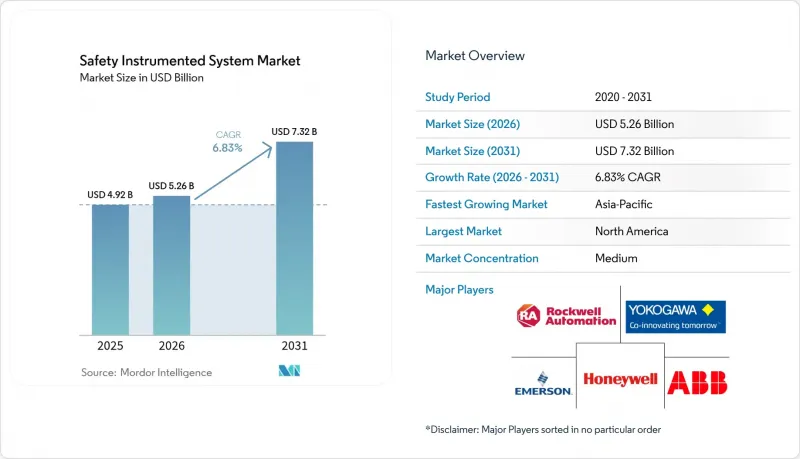
This report is Segmented by Component (Safety Sensors, Logic Solvers/Safety PLCs, and More), Application (Emergency Shutdown Systems, Fire and Gas Monitoring, and More), End-User Industry (Oil and Gas, Chemicals and Petrochemicals, and More), Service (Engineering and Consulting, Integration and Installation, and More), and Geography. The Market Forecasts are Provided in Terms of Value (USD).
Global Safety Instrumented System Market Trends and Insights
Stricter Global Functional-Safety Regulations Drive Systematic Compliance
Global enforcement of IEC 61511 and OSHA Process Safety Management elevates the Safety Instrumented System market as facilities migrate from periodic audits to continuous performance verification. Functional-safety assessments grew 40% since 2024, stretching engineering resources and elongating project lead times. Operators with legacy platforms face mandatory overhauls, creating a seller's market for certified integrators able to commit resources and deliver turnkey upgrades within eighteen to twenty-four months. High demand also supports premium pricing for TUV-certified components, reinforcing revenue growth momentum.
Brownfield Upgrades Accelerate as Aging Infrastructure Meets Modern Standards
The Safety Instrumented System market benefits when older refineries and chemical complexes retrofit integrated safety architectures instead of constructing new plants. Brownfield retrofits already represent 65% of projects; Gulf Coast facilities spearhead activity as insurance underwriters tie coverage to conformance with current standards. Integration engineers bridge legacy protocols with contemporary Safety PLCs, often shrinking retrofit payback to less than four years by combining incident-risk mitigation with downtime reduction.
High Capital and Lifecycle Costs Challenge Mid-Tier Adoption
Full-facility deployments range from USD 5 million to USD 15 million, a hurdle for mid-size operators. Annual upkeep absorbs 15-20% of initial cost, covering proof-testing, component swaps, and software patches. Capital scarcity in emerging markets hampers replacement planning despite mounting compliance pressure. "Safety-as-a-Service" subscription schemes now spread capital across multi-year operating budgets, yet financing options remain limited, especially where local lenders assign high risk premiums.
Other drivers and restraints analyzed in the detailed report include:
- Digitalized Diagnostics Transform Proof-Testing Economics
- SIL-Certified Cyber-Secure Architectures Address New Threats
- Legacy-System Integration Complexity Extends Timelines and Budgets
For complete list of drivers and restraints, kindly check the Table Of Contents.
Segment Analysis
Software and Services recorded the fastest 7.11% CAGR because cloud analytics, machine learning, and virtual-commissioning tools unlock fresh value streams. The Safety Instrumented System market size for Software and Services is projected to climb from USD 1.27 billion in 2025 to USD 1.91 billion by 2031. AI-enhanced platforms distinguish genuine process excursions from noise, cutting nuisance trips by 50% and conserving production. Sensors retain a 38.10% revenue lead, yet the market pivots toward data-centric offerings that complement hardware with actionable insight.
Logic Solvers and Safety PLCs grow at a steady clip, buoyed by rising demand for high-pressure and high-speed applications. Final Elements leverage smart actuators providing continuous feedback, strengthening proof-test coverage. Vendors bundle sensors with subscription analytics, shifting revenue toward recurring models and reinforcing stickiness among installed-base customers.
Emergency Shutdown retains 41.30% share in 2025, yet HIPPS experiences the highest 7.23% CAGR. Hydrogen pipelines and blue-ammonia export terminals require HIPPS capable of 2 second closure under 1,000 bar pressure. The Safety Instrumented System market size attached to HIPPS is forecast to almost double by 2030 as governments allocate record hydrogen incentives. Fire and Gas monitoring accelerates on stricter emissions controls, introducing multi-spectrum detectors that reduce false alarms. Burner Management Systems and Turbomachinery Control integrate with plant-wide safety layers, enabling coordinated shutdown to avert cascading failures.
Complete Report Scope:
- By Component
- Safety Sensors
- Logic Solvers / Safety PLCs
- Final Elements (Valves, Actuators, Solenoids)
- Software and Services
- By Application
- Emergency Shutdown Systems (ESD)
- Fire and Gas Monitoring and Control (FandG)
- High-Integrity Pressure Protection Systems (HIPPS)
- Burner Management Systems (BMS)
- Turbomachinery Control (TMC)
- By End-User Industry
- Oil and Gas
- Chemicals and Petrochemicals
- Power Generation (incl. Nuclear and Renewables)
- Pharmaceuticals and Life Sciences
- Food and Beverage
- Metals and Mining
- Water and Wastewater
- Other End-User Industries
- By Service
- Engineering and Consulting
- Integration and Installation
- Testing, Certification and Audit
- Maintenance and Training
- By Geography
- North America
- South America
- Europe
- Asia-Pacific
- Middle East and Africa
Geography Analysis
North America generated 39.24% of 2025 revenue on the back of OSHA Process Safety Management rigor and Gulf Coast brownfield programs. The United States alone houses more than 3,000 newly certified functional-safety engineers every year, sustaining a robust project pipeline. Operators focus on analytics upgrades, integrating cloud dashboards that visualize safety metrics for executive leadership. Canada's upstream LNG terminals invest in SIL 3 HIPPS to safeguard high-pressure pipelines.
Europe follows with sizeable share under SEVESO III and the push for digital sovereignty that embeds cybersecurity into functional safety. Refiners in Germany and the Netherlands add predictive proof-testing to optimize turnarounds. Offshore North Sea platforms retrofit common-asset safety suites monitored from onshore control centers, shrinking field labor requirements.
Asia-Pacific is the fastest-growing territory at 8.13% CAGR. China and India commission large chemical parks with integrated safety from day one, bypassing legacy barriers. Government hydrogen roadmaps fast-track HIPPS spending, while Southeast Asian petrochemical hubs adopt modular Safety-as-a-Service to cap upfront capital. Australia's mining sector deploys AI-based diagnostics to balance extreme uptime demands with worker-safety mandates.
The Middle East and Africa channel petro-revenues into high-spec refineries, often engaging international licensors that include certified safety as part of engineering packages. South America shows rising activity within mining and biofuels as operators align with stricter environmental standards and insurer expectations.
- ABB Ltd.
- Baker Hughes Co.
- Emerson Electric Co.
- General Electric Co.
- HIMA Paul Hildebrandt GmbH and Co KG
- Honeywell International Inc.
- Johnson Controls International plc (Tyco Fire and Security)
- Mangan Inc.
- Mitsubishi Electric Corp.
- Moore Industries-International, Inc.
- Omron Corp.
- Pepperl+Fuchs SE
- Pilz GmbH and Co. KG
- Proserv Controls LLC
- Rockwell Automation Inc.
- Rotork plc
- Schneider Electric SE
- Schlumberger NV
- Siemens AG
- SIS-TECH Solutions LP
- Valmet Oyj
- Yokogawa Electric Corp.
Additional Benefits:
- The market estimate (ME) sheet in Excel format
- 3 months of analyst support
TABLE OF CONTENTS
1 INTRODUCTION
- 1.1 Study Assumptions and Market Definition
- 1.2 Scope of the Study
2 RESEARCH METHODOLOGY
3 EXECUTIVE SUMMARY
4 MARKET LANDSCAPE
- 4.1 Market Overview
- 4.2 Market Drivers
- 4.2.1 Stricter global functional-safety regulations (IEC 61511, OSHA PSM)
- 4.2.2 Accelerating brown-field upgrades in oil and gas and chemicals
- 4.2.3 Digitalized diagnostics and IIoT cut downtime and proof-test cost
- 4.2.4 SIL-certified cyber-secure architectures drive replacement demand
- 4.2.5 Modular "Safety as-a-Service" platforms for mid-tier plants
- 4.2.6 Decarbonization (blue-H2, CCUS) projects require new HIPPS
- 4.3 Market Restraints
- 4.3.1 High capex and lifecycle maintenance cost
- 4.3.2 Legacy-system integration complexity
- 4.3.3 Shortage of TUV/CFSE-certified safety engineers
- 4.3.4 SIL-grade component supply-chain constraints
- 4.4 Industry Value Chain Analysis
- 4.5 Regulatory Landscape
- 4.6 Technological Outlook
- 4.7 Porter's Five Forces Analysis
- 4.7.1 Threat of New Entrants
- 4.7.2 Bargaining Power of Buyers
- 4.7.3 Bargaining Power of Suppliers
- 4.7.4 Threat of Substitutes
- 4.7.5 Intensity of Competitive Rivalry
5 MARKET SIZE AND GROWTH FORECASTS (VALUE)
- 5.1 By Component
- 5.1.1 Safety Sensors
- 5.1.2 Logic Solvers / Safety PLCs
- 5.1.3 Final Elements (Valves, Actuators, Solenoids)
- 5.1.4 Software and Services
- 5.2 By Application
- 5.2.1 Emergency Shutdown Systems (ESD)
- 5.2.2 Fire and Gas Monitoring and Control (FandG)
- 5.2.3 High-Integrity Pressure Protection Systems (HIPPS)
- 5.2.4 Burner Management Systems (BMS)
- 5.2.5 Turbomachinery Control (TMC)
- 5.3 By End-User Industry
- 5.3.1 Oil and Gas
- 5.3.2 Chemicals and Petrochemicals
- 5.3.3 Power Generation (incl. Nuclear and Renewables)
- 5.3.4 Pharmaceuticals and Life Sciences
- 5.3.5 Food and Beverage
- 5.3.6 Metals and Mining
- 5.3.7 Water and Wastewater
- 5.3.8 Other End-User Industries
- 5.4 By Service
- 5.4.1 Engineering and Consulting
- 5.4.2 Integration and Installation
- 5.4.3 Testing, Certification and Audit
- 5.4.4 Maintenance and Training
- 5.5 By Geography
- 5.5.1 North America
- 5.5.2 South America
- 5.5.3 Europe
- 5.5.4 Asia-Pacific
- 5.5.5 Middle East and Africa
6 COMPETITIVE LANDSCAPE
- 6.1 Market Concentration
- 6.2 Strategic Moves
- 6.3 Market Share Analysis
- 6.4 Company Profiles (includes Global-level Overview, Market-level Overview, Core Segments, Financials as available, Strategic Information, Market Rank/Share, Products and Services, Recent Developments)
- 6.4.1 ABB Ltd.
- 6.4.2 Baker Hughes Co.
- 6.4.3 Emerson Electric Co.
- 6.4.4 General Electric Co.
- 6.4.5 HIMA Paul Hildebrandt GmbH and Co KG
- 6.4.6 Honeywell International Inc.
- 6.4.7 Johnson Controls International plc (Tyco Fire and Security)
- 6.4.8 Mangan Inc.
- 6.4.9 Mitsubishi Electric Corp.
- 6.4.10 Moore Industries-International, Inc.
- 6.4.11 Omron Corp.
- 6.4.12 Pepperl+Fuchs SE
- 6.4.13 Pilz GmbH and Co. KG
- 6.4.14 Proserv Controls LLC
- 6.4.15 Rockwell Automation Inc.
- 6.4.16 Rotork plc
- 6.4.17 Schneider Electric SE
- 6.4.18 Schlumberger NV
- 6.4.19 Siemens AG
- 6.4.20 SIS-TECH Solutions LP
- 6.4.21 Valmet Oyj
- 6.4.22 Yokogawa Electric Corp.
7 MARKET OPPORTUNITIES AND FUTURE OUTLOOK
- 7.1 White-space and Unmet-need Assessment

