PUBLISHER: Mordor Intelligence | PRODUCT CODE: 2121600

PUBLISHER: Mordor Intelligence | PRODUCT CODE: 2121600
Middle East CT - Market Share Analysis, Industry Trends & Statistics, Growth Forecasts (2026 - 2031)
According to Mordor Intelligence, Middle East CT market size in 2026 is estimated at USD 308.3 million, growing from 2025 value of USD 297.59 million with 2031 projections showing USD 367.92 million, growing at 3.60% CAGR over 2026-2031.
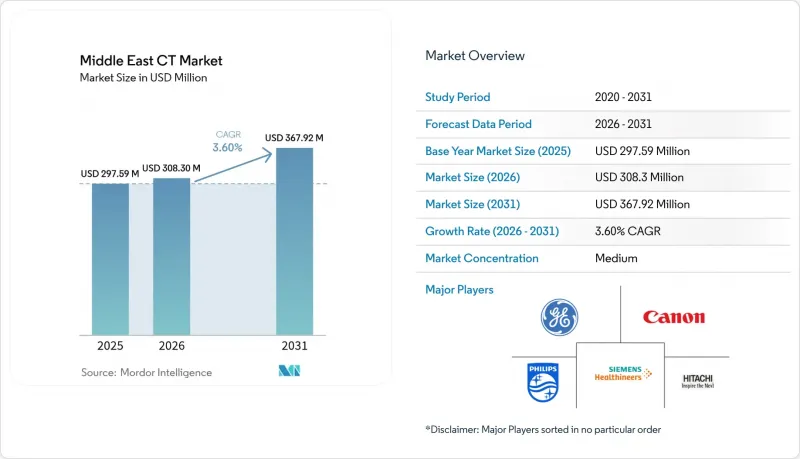
This report is Segmented by Technology (Low-Slice, Mid-Slice, High-Slice), Product Type (Stationary CT Scanners, Portable/Mobile CT Scanners), Application (Oncology, Cardiology, and More), End-User (Hospitals, Diagnostic Imaging Centers, and More), Device Architecture (Spiral/Helical CT, Ring-Gantry CT and More). The Market Forecasts are Provided in Terms of Value (USD).
Middle East CT Market Trends and Insights
Rising Chronic-Disease Burden Demanding Advanced Imaging
Cancer incidence in the WHO Eastern Mediterranean Region is projected to double by 2040, and cardiovascular disease already accounts for 40% of deaths in the UAE. These epidemiological trends underpin sustained CT demand as health systems scale early-detection programs. The population aged 65+ across MENA is expected to rise from 28 million in 2018 to 92 million in 2050. Late-stage presentations and rural access gaps amplify the requirement for higher-resolution scanners capable of precise staging and treatment planning. Refugee inflows into Jordan further strain centralized diagnostic hubs, reinforcing the need for expanded regional imaging capacity.
GCC Infrastructure Investments Under Vision 2030 Programmes
Saudi Arabia has allocated USD 66 billion for healthcare modernization by 2030, with private-sector participation targeted to increase from 40% to 65%. Twenty-one planned "health clusters," each serving about 1 million residents, are generating systematic procurement cycles for CT equipment. The UAE mirrors this pattern through dedicated medical-tourism initiatives, underpinned by ongoing capital expenditure in acute-care hospitals and outpatient imaging centers. Such government-backed projects favor vendors offering turnkey installation, local service staff and AI-ready detectors.
High Capital & Lifecycle Costs of CT Systems
High-end CT scanners range from USD 500,000 to USD 2 million, a hurdle for hospitals reliant on constrained public budgets. Lifecycle expenses-annual service contracts, tube replacements, and facility retrofits-compound total ownership costs. The utilization rates exceed safe thresholds because sites lack funds for additional capacity. Equipment-as-a-service offerings now allow pay-per-scan arrangements that shift spending from CapEx to OpEx, while refurbished units cut purchase prices by up to 70% and improve supply-chain sustainability by 32% energy savings.
Other drivers and restraints analyzed in the detailed report include:
- Rapid Technology Upgrades (Low-Dose, Spectral, AI-Ready CT)
- Adoption of AI-Enabled Diagnostic Workflows
- Shortage of Trained Radiologists / Technologists
For complete list of drivers and restraints, kindly check the Table Of Contents.
Segment Analysis
Mid-end 64-slice configurations captured 42.68% of the Middle East computed tomography market share in 2025. Hospitals and diagnostic centers choose these platforms because they cover routine oncology, trauma, and cardiac work-ups without the price premium of 128- or 256-slice scanners. The Middle East computed tomography market size for dual- or multi-energy CT is projected to grow at a 6.19% CAGR between 2026 and 2031, reflecting the clinical value of single-scan spectral protocols. Photon-counting prototypes preview the next upgrade cycle and are expected to reach commercial volumes post-2027 as reimbursement pathways mature.
Demand patterns diverge across income tiers. Lower-slice (< 64) units dominate primary clinics in developing nations, often secured via donor funding and refurbished import channels. Conversely, Gulf tertiary centers favor systems with 128-slice capabilities or higher for coronary CT angiography and whole-body trauma imaging; vendors bundle AI-enabled reconstruction and dose monitoring to satisfy regulatory dose index limits. Over the forecast period, software upgrades-rather than hardware replacement-will generate an increasing share of segment revenue as providers unlock latent detector performance.
Stationary installations represented 91.20% of total revenues in 2025. Integrated RIS/PACS workflows, high throughput, and full-body imaging capability secure their position as the backbone of acute-care diagnostics. Service contracts and tube-exchange cycles underpin predictable aftermarket revenue for OEMs. The Middle East computed tomography market size for portable scanners is advancing ata 6.78% CAGR on the back of defense deployments, ambulance-based stroke units, and rural outreach initiatives.
Mobile configurations priced between USD 95,000 and USD 730,000 allow multi-site utilization, maximizing uptime in resource-limited settings. In the Gulf, field hospitals and medical teams for sporting events adopt lightweight, wheeled platforms that plug into existing power infrastructure. OEM differentiation now hinges on battery runtime, image stabilization and tele-radiology integration.
Complete Report Scope:
- By Technology (Slice Count)
- Low-slice (<64)
- Mid-slice (64)
- High-slice (128-256)
- By Product Type
- Stationary CT Scanners
- Portable / Mobile CT Scanners
- By Application
- Oncology
- Cardiology
- Neurology
- Vascular
- Musculoskeletal
- Dental & Maxillofacial
- Trauma & Emergency
- Other Applications
- By End-User
- Hospitals
- Diagnostic Imaging Centers
- Dental Clinics
- Academic & Research Institutes
- By Device Architecture
- Spiral / Helical CT
- Ring-Gantry CT
- C-arm CT
- O-arm CT
- By Geography
- Saudi Arabia
- United Arab Emirates
- Egypt
- Iran
- Rest of Middle East
List of Companies Covered in this Report:
- Accuray
- Canon
- Carestream Health
- FUJIFILM
- GE Healthcare
- Hitachi (Fujifilm)
- Mobile Scanners Gulf
- Neusoft
- Koninklijke Philips
- Planmeca
- PointNix
- Samsung (NeuroLogica)
- Shenzhen Anke High-Tech
- Shimadzu
- Siemens Healthineers
- United Imaging Healthcare
- Vatech Co.
- Xoran Technologies
Additional Benefits:
- The market estimate (ME) sheet in Excel format
- 3 months of analyst support
TABLE OF CONTENTS
1 Introduction
- 1.1 Study Assumptions & Market Definition
- 1.2 Scope of the Study
2 Research Methodology
3 Executive Summary
4 Market Landscape
- 4.1 Market Overview
- 4.2 Market Drivers
- 4.2.1 Rising chronic-disease burden demanding advanced imaging
- 4.2.2 GCC infrastructure investments under Vision 2030 programmes
- 4.2.3 Rapid technology upgrades (low-dose, spectral, AI-ready CT)
- 4.2.4 Adoption of AI-enabled diagnostic workflows
- 4.2.5 Medical-tourism boom boosting high-end imaging demand (UAE, Turkey)
- 4.2.6 Defence & emergency-medicine programmes driving mobile CT procurement
- 4.3 Market Restraints
- 4.3.1 High capital & lifecycle costs of CT systems
- 4.3.2 Shortage of trained radiologists / technologists
- 4.3.3 Import-supply risks amid geo-political disruptions
- 4.3.4 Growing public radiation-safety concerns amplified on social media
- 4.4 Value / Supply-Chain Analysis
- 4.5 Regulatory Landscape
- 4.6 Technological Outlook
- 4.7 Porter's Five Forces
- 4.7.1 Threat of New Entrants
- 4.7.2 Bargaining Power of Suppliers
- 4.7.3 Bargaining Power of Buyers
- 4.7.4 Threat of Substitutes
- 4.7.5 Competitive Rivalry
5 Market Size & Growth Forecasts
- 5.1 By Technology (Slice Count)
- 5.1.1 Low-slice (<64)
- 5.1.2 Mid-slice (64)
- 5.1.3 High-slice (128-256)
- 5.2 By Product Type
- 5.2.1 Stationary CT Scanners
- 5.2.2 Portable / Mobile CT Scanners
- 5.3 By Application
- 5.3.1 Oncology
- 5.3.2 Cardiology
- 5.3.3 Neurology
- 5.3.4 Vascular
- 5.3.5 Musculoskeletal
- 5.3.6 Dental & Maxillofacial
- 5.3.7 Trauma & Emergency
- 5.3.8 Other Applications
- 5.4 By End-User
- 5.4.1 Hospitals
- 5.4.2 Diagnostic Imaging Centers
- 5.4.3 Dental Clinics
- 5.4.4 Academic & Research Institutes
- 5.5 By Device Architecture
- 5.5.1 Spiral / Helical CT
- 5.5.2 Ring-Gantry CT
- 5.5.3 C-arm CT
- 5.5.4 O-arm CT
- 5.6 By Geography
- 5.6.1 Saudi Arabia
- 5.6.2 United Arab Emirates
- 5.6.3 Egypt
- 5.6.4 Iran
- 5.6.5 Rest of Middle East
6 Competitive Landscape
- 6.1 Market Concentration
- 6.2 Strategic Moves
- 6.3 Market Share Analysis
- 6.4 Company Profiles (includes Global-level Overview, Market-level Overview, Core Segments, Financials as available, Strategic Information, Market Rank/Share, Products & Services, Recent Developments)
- 6.4.1 Accuray Inc.
- 6.4.2 Canon Medical Systems
- 6.4.3 Carestream Health
- 6.4.4 Fujifilm Holdings
- 6.4.5 GE HealthCare
- 6.4.6 Hitachi (Fujifilm)
- 6.4.7 Mobile Scanners Gulf
- 6.4.8 Neusoft Medical
- 6.4.9 Philips Healthcare
- 6.4.10 Planmeca Oy
- 6.4.11 PointNix
- 6.4.12 Samsung (NeuroLogica)
- 6.4.13 Shenzhen Anke High-Tech
- 6.4.14 Shimadzu Corp.
- 6.4.15 Siemens Healthineers
- 6.4.16 United Imaging Healthcare
- 6.4.17 Vatech Co.
- 6.4.18 Xoran Technologies
7 Market Opportunities & Future Outlook
- 7.1 White-space & Unmet-need Assessment

