PUBLISHER: Mordor Intelligence | PRODUCT CODE: 2121611

PUBLISHER: Mordor Intelligence | PRODUCT CODE: 2121611
Wood Coatings - Market Share Analysis, Industry Trends & Statistics, Growth Forecasts (2026 - 2031)
According to Mordor Intelligence, the wood coatings market size is estimated at 3.54 million tons in 2026, and is expected to reach 4.23 million tons by 2031, at a CAGR of 3.61% during the forecast period (2026-2031).
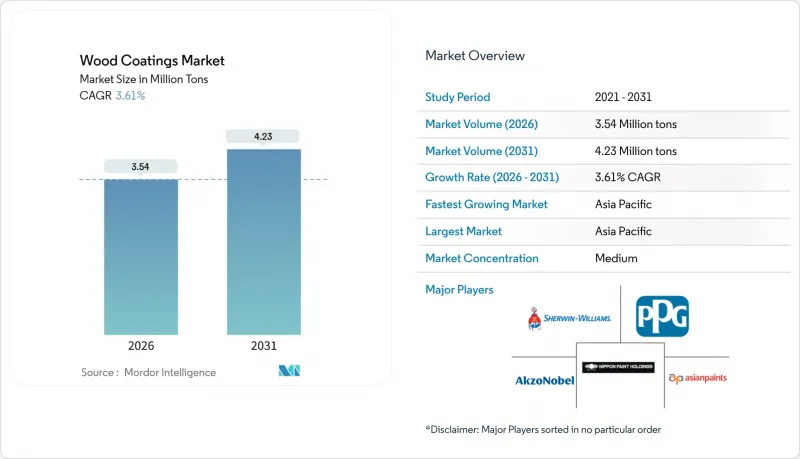
This report is Segmented by Resin Type (Polyurethane, Acrylic, Nitrocellulose, Polyester, and Others), Technology (Water-Borne, Solvent-Borne, UV-Cured, and Powder Coatings), Application (Furniture and Fixtures, Doors and Windows, Cabinets, and More), and Geography (Asia-Pacific, North America, Europe, South America, and Middle East and Africa). Market Forecasts are Provided in Terms of Volume (Tons).
Global Wood Coatings Market Trends and Insights
Modular and RTA Furniture Boom in Asia-Pacific
Ready-to-assemble formats now account for 60-70% of India's organized furniture sales, pushing finishing lines toward fast-curing waterborne topcoats that tolerate flat-pack boxing within 24 hours. Vietnam's wood and furniture exports jumped 21% in 2024 to USD 16.3 billion, and the local association targets USD 18 billion in 2025 as EU buyers seek EUDR-compliant suppliers. Thailand produced 6.63 million wooden furniture pieces in 2024, up 14.46%, while Indonesia shipped USD 2.02 billion of furniture, keeping wooden articles above 50% of export value. China's coastal clusters generated CNY 535.52 billion (USD 73.9 billion) in furniture revenue during the first ten months of 2024, with exports climbing 7.2% to USD 54.932 billion. These production hubs favor two-component polyurethane clears that hit >=2H pencil hardness at ambient cure, positioning the driver to add 0.8 percentage points to the regional CAGR.
EU-Led Shift to Low-VOC Waterborne Formulations
Directive 2004/42/EC caps VOC content at 400 g/L for interior and 300 g/L for exterior wood finishes, forcing a reevaluation of solvent-heavy alkyds and nitrocellulose lacquers. Regulation (EU) 2023/1464 also limits formaldehyde release to 0.062 mg/m3, tightening material specs for panel producers. The EU Ecolabel now requires interior coatings below 30 g/L VOC, a threshold only waterborne dispersions reliably meet. Akzo Nobel disclosed that 60% of its 2024 sales stemmed from sustainable products, and PPG opened a waterborne plant in Rayong, Thailand, to serve EU-bound furniture exporters. California Air Resources Board mirrors the restriction with a 550 g/L limit for clear finishes, reinforcing the 0.6 point uplift in long-term CAGR.
Resin and Solvent Price Volatility
Toluene diisocyanate averaged CNY 14,700/ton (USD 2,041/ton) and polymeric MDI hit CNY 15,200/ton (USD 2,110/ton) in Q3 2025, with force-majeure events limiting European volumes to 70% of contracts. The U.S. Producer Price Index for petrochemicals leaped 13.1% between December 2024 and March 2025 as ethylene exceeded 30 ¢/lb. Asian naphtha averaged USD 547/ton in April 2025, still 18% above the 2020-22 mean. Such swings drive formulators to shorten contract length and delay inventory builds, clipping 0.5 points from near-term CAGR.
Other drivers and restraints analyzed in the detailed report include:
- Premium Interior Decor Trend in North America
- Mass-Timber High-Rise Adoption Accelerating Clear UV Finish Demand
- Stricter Formaldehyde / VOC Caps
For complete list of drivers and restraints, kindly check the Table Of Contents.
Segment Analysis
Polyurethane commanded 60.14% of the Wood Coatings market in 2025 and will progress at a 3.82% CAGR through 2031, owing to >=2H pencil hardness and optical clarity essential for mass-timber interiors. Acrylics are witnessing rising demand and are on the back of better UV stability and easy waterborne blending. Nitrocellulose and polyester coatings face a margin squeeze from higher phthalic anhydride prices. Emerging blocked-isocyanate one-packs based on vanillin show 12-month pot life and deblock at 120 °C, mapping neatly onto infrared ovens now common in Vietnamese factories. Acrylic-urethane hybrids captured 9% of the waterborne subsegment in 2025 and could reach 14% by 2031 as they help formulators meet the EU Ecolabel VOC <30 g/L target.
Regulatory stick is speeding the shift. The EU BAT reference for wood treatment mandates closed-loop solvent recovery for nitrocellulose, an upgrade that costs EUR 200,000-500,000 per booth. Polyurethane players reply with systems stable at room temperature yet curing fully during a 15-minute bake, matching throughput at Indonesian and Indian RTA plants. Demand for biobased polyols, able to replace up to 50% of petrochemical content, is rising among buyers pursuing LEED v4 credits, placing smaller Brazilian and Indian formulators on the radar of global OEMs.
Complete Report Scope:
- By Resin Type
- Polyurethane
- Acrylic
- Nitrocellulose
- Polyester
- Others
- By Technology
- Water-borne
- Solvent-borne
- UV-Cured
- Powder Coatings
- By Application
- Furniture and Fixtures
- Doors and Windows
- Cabinets
- Other Applications (including Floors, Decks, and Molding Products)
- By Geography
- Asia-Pacific
- China
- India
- Japan
- South Korea
- Malaysia
- Thailand
- Indonesia
- Vietnam
- Rest of Asia-Pacific
- North America
- United States
- Canada
- Mexico
- Europe
- Germany
- United Kingdom
- France
- Italy
- Spain
- Nordics
- Russia
- Rest of Europe
- South America
- Brazil
- Argentina
- Colombia
- Rest of South America
- Middle East and Africa
- Saudi Arabia
- United Arab Emirates
- Qatar
- South Africa
- Nigeria
- Egypt
- Rest of Middle East and Africa
- Asia-Pacific
Geography Analysis
Asia-Pacific accounted for 56.68% of the Wood Coatings market size in 2025 and is projected to rise at a 3.91% CAGR through 2031. China's CNY 535.52 billion (USD 73.9 billion) furniture revenue and USD 54.932 billion export haul show coastal plants absorbing resin inflation via automation. Vietnam, India, and Indonesia benefit from 40-50% lower labor costs than Guangdong, and India's Production Linked Incentive scheme rebates 4-6% of incremental domestic furniture sales, enticing coatings makers to co-locate near Ahmedabad and Pune.
Wood coatings demand in North America is witnessing considerable gains as U.S. remodeling stays elevated and Canada maintains 240,000 annual housing starts. Mexican furniture exports to the United States reached USD 4.8 billion in 2024, up 9% year-over-year, underscoring nearshoring momentum.
Europe accounted for a considerable market size and is anticipated to register considerable gains in the near future. Germany, France, Italy, and the United Kingdom account for 62% of regional demand, and the Renovation Wave program anchors spending through 2030. Brazil's housing recovery drives South America's wood coatings market growth, while the Middle East and Africa's demand is rising as Saudi Arabia's Vision 2030 real-estate surge fuels demand for fire-retardant wood coatings.
- Akzo Nobel N.V.
- Asian Paints
- Axalta Coating Systems
- Benjamin Moore & Co.
- Ceramic Industrial Coatings
- Hempel A/S
- Jotun
- Kansai Nerolac Paints Limited
- KAPCI Coating
- MAS Paints
- National Paints Factories Co. Ltd.
- Nippon Paint Holdings Co., Ltd.
- PPG Industries Inc.
- Ritver
- RPM International Inc.
- Teknos Group
- The Sherwin-Williams Company
Additional Benefits:
- The market estimate (ME) sheet in Excel format
- 3 months of analyst support
TABLE OF CONTENTS
1 Introduction
- 1.1 Study Assumptions and Market Definition
- 1.2 Scope of the Study
2 Research Methodology
3 Executive Summary
4 Market Landscape
- 4.1 Market Overview
- 4.2 Market Drivers
- 4.2.1 Modular and RTA Furniture Boom in Asia-Pacific
- 4.2.2 EU-Led Shift to Low-VOC Waterborne Formulations
- 4.2.3 Premium Interior Decor Trend in North America
- 4.2.4 Mass-Timber High-rise Adoption Accelerating Clear UV Finish Demand
- 4.2.5 AI-Enabled Inline Color Matching Reduces Waste, Expands Coatings Throughput
- 4.3 Market Restraints
- 4.3.1 Resin and Solvent Price Volatility
- 4.3.2 Stricter Formaldehyde / VOC Caps
- 4.3.3 PFAS Phase-out Threatening Performance Additives Supply
- 4.4 Value Chain Analysis
- 4.5 Porter's Five Forces
- 4.5.1 Bargaining Power of Suppliers
- 4.5.2 Bargaining Power of Buyers
- 4.5.3 Threat of New Entrants
- 4.5.4 Threat of Substitutes
- 4.5.5 Degree of Competition
5 Market Size and Growth Forecasts (Volume)
- 5.1 By Resin Type
- 5.1.1 Polyurethane
- 5.1.2 Acrylic
- 5.1.3 Nitrocellulose
- 5.1.4 Polyester
- 5.1.5 Others
- 5.2 By Technology
- 5.2.1 Water-borne
- 5.2.2 Solvent-borne
- 5.2.3 UV-Cured
- 5.2.4 Powder Coatings
- 5.3 By Application
- 5.3.1 Furniture and Fixtures
- 5.3.2 Doors and Windows
- 5.3.3 Cabinets
- 5.3.4 Other Applications (including Floors, Decks, and Molding Products)
- 5.4 By Geography
- 5.4.1 Asia-Pacific
- 5.4.1.1 China
- 5.4.1.2 India
- 5.4.1.3 Japan
- 5.4.1.4 South Korea
- 5.4.1.5 Malaysia
- 5.4.1.6 Thailand
- 5.4.1.7 Indonesia
- 5.4.1.8 Vietnam
- 5.4.1.9 Rest of Asia-Pacific
- 5.4.2 North America
- 5.4.2.1 United States
- 5.4.2.2 Canada
- 5.4.2.3 Mexico
- 5.4.3 Europe
- 5.4.3.1 Germany
- 5.4.3.2 United Kingdom
- 5.4.3.3 France
- 5.4.3.4 Italy
- 5.4.3.5 Spain
- 5.4.3.6 Nordics
- 5.4.3.7 Russia
- 5.4.3.8 Rest of Europe
- 5.4.4 South America
- 5.4.4.1 Brazil
- 5.4.4.2 Argentina
- 5.4.4.3 Colombia
- 5.4.4.4 Rest of South America
- 5.4.5 Middle East and Africa
- 5.4.5.1 Saudi Arabia
- 5.4.5.2 United Arab Emirates
- 5.4.5.3 Qatar
- 5.4.5.4 South Africa
- 5.4.5.5 Nigeria
- 5.4.5.6 Egypt
- 5.4.5.7 Rest of Middle East and Africa
- 5.4.1 Asia-Pacific
6 Competitive Landscape
- 6.1 Market Concentration
- 6.2 Strategic Moves
- 6.3 Market Share/Ranking Analysis
- 6.4 Company Profiles (includes Global level Overview, Market level overview, Core Segments, Financials as available, Strategic Information, Products and Services, Recent Developments)
- 6.4.1 Akzo Nobel N.V.
- 6.4.2 Asian Paints
- 6.4.3 Axalta Coating Systems
- 6.4.4 Benjamin Moore & Co.
- 6.4.5 Ceramic Industrial Coatings
- 6.4.6 Hempel A/S
- 6.4.7 Jotun
- 6.4.8 Kansai Nerolac Paints Limited
- 6.4.9 KAPCI Coating
- 6.4.10 MAS Paints
- 6.4.11 National Paints Factories Co. Ltd.
- 6.4.12 Nippon Paint Holdings Co., Ltd.
- 6.4.13 PPG Industries Inc.
- 6.4.14 Ritver
- 6.4.15 RPM International Inc.
- 6.4.16 Teknos Group
- 6.4.17 The Sherwin-Williams Company
7 Market Opportunities and Future Outlook
- 7.1 White-space and Unmet-Need Assessment

